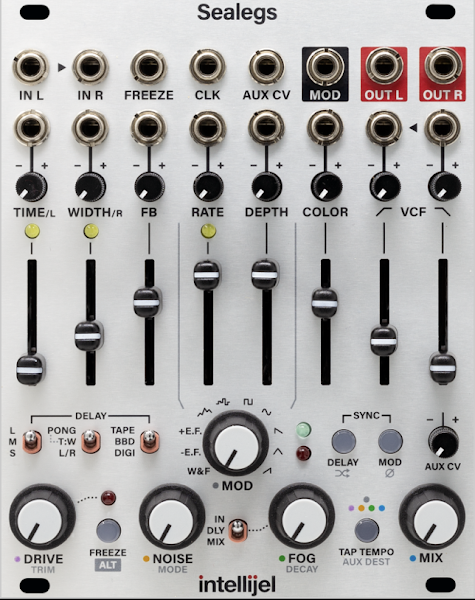
Intellijel has introduced Sealegs, a collection of effects, centered around a true stereo multi-model delay.
Features include Tape, Bucket Brigade, and Crossfading Digital models; a saturating input drive; low- and high-pass filters; crackle + hiss generator; a multi-position 1970s-inspired reverb; internal modulators; nine CV inputs with attenuverters; three sets of ranges; clock sync/tap tempo; and three unique stereo configurations.
Features:
Three Unique delay models — Tape, Bucket Brigade, and Crossfading Digital
Per-model Color, Modulation behavior, and Saturation/Limiting
True Stereo delay with separate L/R buffers
Three Stereo configurations (PONG, Time/Width, L/R)
Three Range variations for short Chorus/Flanger style delays to Long ambient repeats.
Up to 6(L) and 8(R) seconds of delay time (Width can add up to 33% to Time)
Built in modulator with Wow & Flutter, Envelope Follower, and 7 morphing wave shapes
Lush 1970s-inspired reverb with 3 insert positions.
Saturating input drive with level trim
Stable external clock (or tap tempo) sync for Delay Times or Modulation
Highpass and Lowpass filters for filtered repeats
Freeze functionality for holding the buffer and looping
Nine CV inputs with attenuverters
96 kHz 24-bit Stereo I/O and 32-bit floating point internal processing
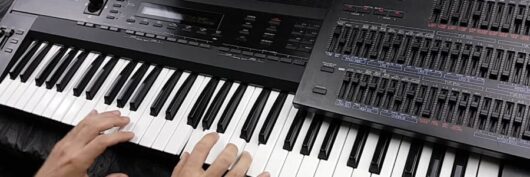
In the latest synth4ever video offers a review of the Roland D-50, a vintage digital synth from 1987.
The D-50 is a 16-voice polyphonic synthesizer, based on Roland’s LA (Linear Arithmetic) synthesis engine, which combines samples, virtual analog synthesis and integrated effects. The synth engine offered innovative capabilities and new sonic possibilities when it was introduced, which helped make it a hit for the company.
Video summary:
“In this synthesizer review of the Roland D-50, I provide an overview of the synth, it’s digital sample-based linear arithmetic synthesis engine, play Roland D-50 sounds, and provide my final thoughts on the Roland D50 including pros and cons.”
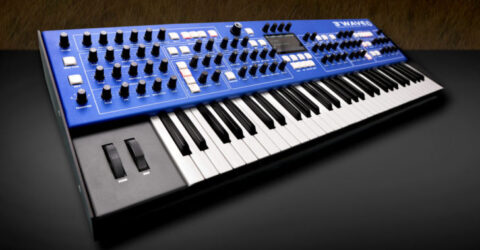
Groove Synthesis has release firmware v1.5 for the 3rd Wave synthesizer, a free update that adds MPE support and more.
New in 3rd Wave OS version 1.5:
Support for MIDI MPE controllers – enable MPE from the GLOBAL menu and explore the new modulation sources at the end of the list. Pitch bend range can be set in the MISC menu
Option for free running analog oscillators in the MISC menu which is settable per patch – In the analog waveform mode, which you are using when you select the Axx waveforms like Saw and Square, now has the option to make the waveforms not reset when you start a new note. In this mode, the oscillators will continue to drift from each other as they do on some fully analog synthesizers.
New poly unison mode – set the polyphony count in the second page of the UNISON menu. It will split the voices up automatically to use max voices per note
New shortcut buttons to easily set output routing per part
New option in GLOBAL menu to send midi program change messages
Now saving UNISON chord mode settings with program
Now pitch wheel, mod wheel, pressure are independent per part when controlling in midi multitimbral mode + pitch wheel destination is settable per part
Slight adjustments to circuit drift envelope sustain variance – gets rid of jumps when going from decay to sustain in the envelope
New options for longer LFO sync times
Improvements to LED brightness settings
Added smoothing to pan position changes to avoid audible stepping