Google Acquires AI Music Platform, ProducerAI
Google’s ProducerAI can create customized instruments and effects in your browser.
ProducerAI is a chatbot that generates songs, album art, music videos and even music-making apps.
Just days after unveiling its latest AI model for music generation, Lyria 3, Google has acquired AI music platform ProducerAI and folded the startup into Google Labs, its experimental playground for AI-powered products.
Founded by the makers of Riffusion – one of the first text-to-music AI apps – ProducerAI is a browser-based generative AI tool that is capable of producing songs based on text prompts. Following the acquisition, ProducerAI is now equipped with Lyria 3, a “high-fidelity, professional-grade” music generation model that Google claims has a deep understanding of musicality.
ProducerAI’s output is similar to that of rivals such as Suno and Udio – as in, it can confidently cough up a convincing imitation of a chosen genre that lacks soul, flair and humanity – but the interface is a little different. Users interact with the platform via a chatbot-style interface that utilizes Google Gemini, and can develop and refine their creations through a conversational, iterative process.
ProducerAI can also generate both album art and music videos using Google’s image and video generation models, Nano Banana and Veo.
Speaking to The Verge, ProducerAI’s Seth Forsgren said that his team is “just scratching the surface of what these models are going to be able to do once we harness everything that Google brings to the table.”
“You can talk to this producer like you would a Gemini model, ask questions, and learn about a new genre,” he added. “As soon as you want to, you can start actually creating, and you can craft things with these instruments and make a song and iterate on it.”
Tracks generated with ProducerAI will be embedded with SynthID, Google’s imperceptible watermark for identifying AI-generated content. While Google has not shared any specifics on how Lyria 3 was trained, the company says that it has “sought to develop this technology responsibly” and remained “mindful of copyright and partner agreements” during the model’s training process.
From our perspective, the most interesting thing about ProducerAI is the Spaces feature, which can be used to create musical mini-apps in the browser based on natural language prompts, allowing you to design customized instruments and effects without writing a single line of code.
Examples provided by Google include a cute mini keyboard you can play with your computer keyboard and a sophisticated modular audio patching environment, Node Atlas, complete with synthesis, sample playback, modulation and a comprehensive set of audio effects.
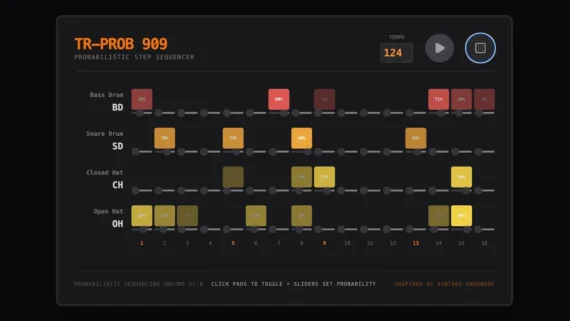
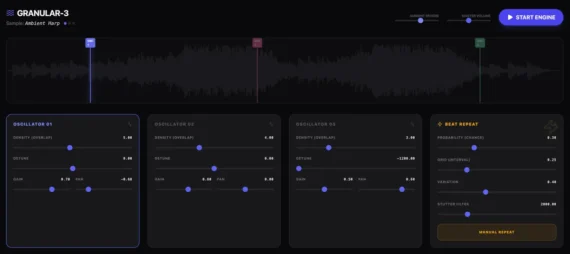
Though it’s unsurprisingly a little glitchy and unpredictable, the concept behind Spaces is a fascinating one, and it’s a lot of fun to play with – we managed to create a three-oscillator granular synth and a basic 909-style drum machine with probabilistic sequencing in the space of about ten minutes.
ProducerAI operates a credit-based system with several membership tiers, ranging from $8/month to $64/month – there’s also a free tier that gives you a limited number of credits.


