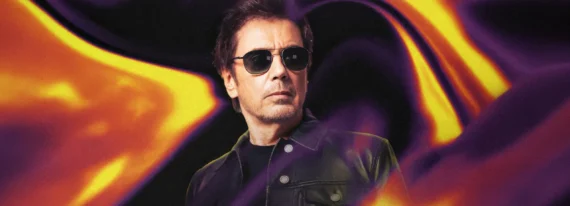
Amsterdam Dance Event (ADE) and Jean Michel Jarre have announced that Jarre will be featured as special guest of honor at this year’s event, being held Oct 21-25, 2026.
Jarre will perform Oxygène & Beyond: A Sonic Journey Celebrating 30 Years of ADE and be featured in a keynote interview.
“Electronic music, as well as ADE, has a history, a legacy and a future. The live show at ADE is going to celebrate its 30th anniversary, but also the 50th anniversary of Oxygène,” notes Jarre. “I have the ambition to keep the suspense and go from one track to another, into a different atmosphere, different stage design, mapping, giant projections and architectures of lights and videos, to share that moment that can stay in your heart and your brain for the rest of your lives.”
Tickets are available now. Visit the Amsterdam Dance Event site for more info.
Klevgrand promises to “redefine what a drum sampler can be” with OneShot 2.
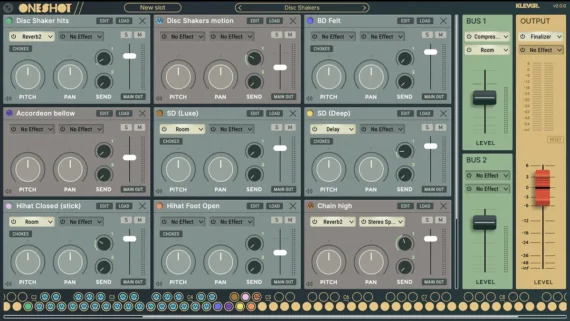
Klevgrand has announced an update to its OneShot drum sampler, introducing a sophisticated Motion engine, expanded sound library, new effects and multiple workflow enhancements to an instrument that the company promises “redefines what a drum sampler can be” – empowering anyone to create timed cymbal swells, shaker patterns, foley textures, and virtually any rhythmic movement imaginable.
While OneShot is based on a drum engine designed for single hits, OneShot 2’s Motion engine has been designed to create phrases that “breathe and evolve” by morphing through multiple samples, such as cymbal swells, brushed textures, shaker figures or foley elements. The engine can be controlled via an advanced envelope editor or MIDI CC, or even using your iPhone’s accelerometer via the new Motion controller app.
OneShot 2 expands the instrument’s sound library dramatically, and the collection of factory sounds now includes more than 20,000 samples, 780 slots and 310 presets.
Among the new content is a broad range of drum kits and percussion sounds equipped with multiple velocity layers and round-robins, including a new Studio Kit designed for “modern productions that call for expressive acoustic drums” and a Jazz Brush Kit “rich in subtle tone and articulation”.
Alongside the additional sounds, OneShot 2 has been kitted out with three new effects: Reverb2 is an easy-to-use reverb based on the algorithms from Klevgrand’s recently released Walls plugin, and Transient Adder draws on the company’s Fosfat plugin to add bite, punch and character to percussive sounds. Joining these is Unstereo, a utility for narrowing sounds with too much width in the stereo image.
OneShot 2 also brings a number of additional features requested by users, including Stack triggers, which allow the user to trigger several sounds with a single MIDI note, and workflow improvements such as smart batch preset import/export, effects copy/pasting, and Note Off functionality for one shot triggers.
OneShot2 is priced at $119.99 until the end of April, and upgrade pricing is available. The plugin is available for macOS and Windows in VST/AU/AAX formats.
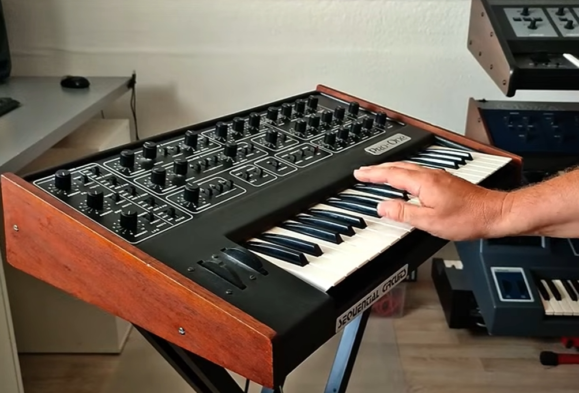
The latest RetroSound video features the Sequential Circuits Pro-One synthesizer – and some of the most iconic sounds of ’80s synthpop.
It’s a great demo of the range of the Pro-One, and highlights how important the synth was to the sound of the ’80s.
Video Summary:
“The Sequential Circuits Pro-One is one of the most legendary mono synthesizers of the 1980s—and responsible for some of the most iconic sounds of the synth-pop, new wave, and industrial era.
In this video, you’ll hear famous Sequential Pro-One sounds and riffs used in real hits from the 80s.
From powerful basslines to screaming leads to sequenced arpeggios, the Pro-One stands for raw analog character and a sound that has shaped entire decades.”