Archive for November, 2026

Living Sky Combines Convolution Reverb, 3D Positioning + Modulation For Immersive Audio


Canadian developer MNTRA has introduced Living Sky, a GPU-powered spatial mixing and reverb engine designed to combine 3D sound positioning with the acoustic characteristics of real-world spaces.

Available as a plugin for macOS and Windows, Living Sky combines convolution processing, spatial modulation and a library of captured acoustic environments in a single immersive audio production system.

Unlike conventional reverbs that primarily process audio through stereo or multichannel impulse responses, Living Sky uses hundreds of convolutions running on the GPU in real time. Its acoustic library contains more than 120 high-resolution spatial responses captured from real locations using higher-order Ambisonics and proprietary microphone arrays.

The system supports up to 64 independent audio sources, each with adjustable distance, elevation, azimuth and spatial width. Users can distribute sources across five reverb buses, combining up to three different Spaces per bus. The resulting acoustic environment can be further shaped using modulation, automation and MNTRA’s Aura processing, which provides a source-responsive reverb send.

Living Sky also includes a separate 3D Control App for positioning and manipulating sound sources visually. Its internal Ambisonic processing allows the same spatial mix to be translated into stereo, binaural, surround and immersive formats without rebuilding the mix.
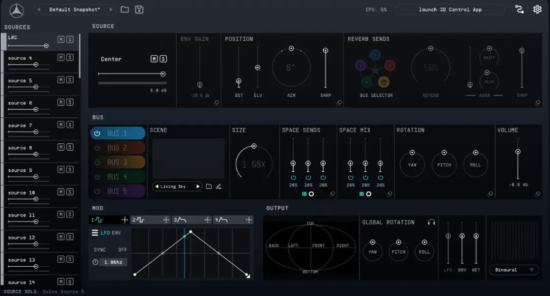
Features:

  • GPU-powered convolution engine combining hundreds of acoustic responses in real time.
  • Up to 64 independent spatial audio inputs per plugin instance.
  • Five reverb buses, each supporting up to three Spaces.
  • More than 120 captured spatial responses from real-world locations.
  • Additional virtually modelled acoustic Spaces from Lese Audio.
  • 3D source positioning with adjustable distance, elevation, azimuth and sharpness.
  • 32 modulation slots for movement and audio-responsive processing.
  • Aura source-responsive reverb processing with independent Drift and Flux controls.
  • Stereo, binaural, quad, surround, Dolby Atmos-compatible speaker layouts and fifth-order Ambisonics output options.
  • OSC head-tracking support for compatible binaural listening setups.
  • Separate 3D Control App linked to the main plugin.
  • VST3, AU and AAX plugin formats.

MNTRA Living Sky is available for $799 USD, with a free 30-day trial offering up to four sources and stereo and binaural output.
Behringer Opens New AQ64L 64-Pad MIDI Controller To Custom Firmware

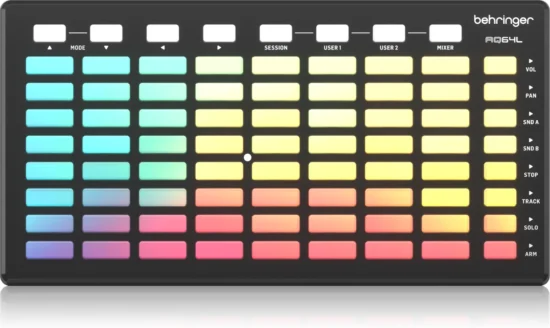
The AQ64L is an 8×8 RGB clip-launch controller with dedicated Ableton Live and FL Studio integration. Music Tribe has also published a developer kit for creating and installing custom firmware.

The Behringer AQ64L is an 8×8 RGB grid controller designed for launching audio clips and triggering MIDI events in a DAW.

The company is positioning it as an open hardware platform, publishing a developer kit for the controller, providing example firmware, hardware documentation and tools that allow users to build and install custom firmware.

The AQ64L has 64 illuminated pads arranged in an 8×8 grid, accompanied by 16 RGB function keys for navigation, mode selection and track and mixer control. Its layout is designed around clip-based performance workflows, with dedicated integration scripts available for Ableton Live and FL Studio.

The controller includes modes for session and clip launching, drum control, keyboard operation and mixer functions. In mixer mode, users can access volume, pan and send controls, along with track-related functions. Two user modes provide additional configuration options, while the device can also operate as a conventional USB MIDI controller.

Features:

  • 64-pad RGB clip-launch grid in an 8×8 layout
  • 16 RGB function keys for navigation, mode selection and track control
  • Dedicated Ableton Live integration scripts
  • Dedicated FL Studio integration scripts
  • Session, drum-controller, keyboard and mixer modes
  • Two user-configurable operating modes
  • Class-compliant USB MIDI operation
  • USB-C connection and bus-powered operation
  • Compatibility with computers and Apple iPad via a USB Camera Adapter

Behringer has not announced pricing or a confirmed release date for the AQ64L. The product page and software downloads are available on the official Behringer website, and the AQ64L developer kit can be accessed through GitHub.

DJW Audio Introduces DW-303, a Free Open-Source TB-303-Style Synthesizer


DW-303 is a free, open-source TB-303-style bass synthesizer featuring circuit-modeled sound generation, a 16-step sequencer, 64 patterns and support for multiple plugin formats and operating systems.

UK-based DJW Audio has released DW-303, a free, open-source bass synthesizer and step sequencer modeled on the classic Roland TB-303.

The software recreates the original instrument’s oscillator, filter, envelope and amplifier circuitry through component-level modeling, with versions available for macOS, Windows and Linux.

Rather than using a conventional virtual-analog synthesis architecture, DW-303 models the TB-303 signal path stage by stage using the original circuit schematic. The developer says the models were subsequently fitted against measurements of hardware, including the behavior of the filter resonance, accent and slide circuits.

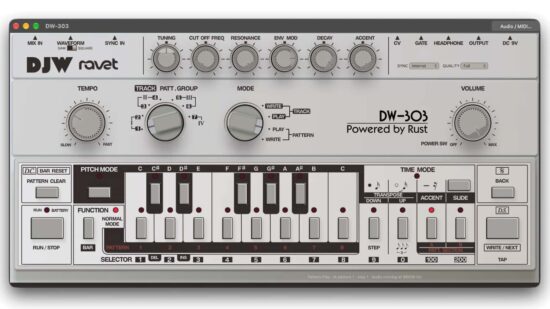
The synthesizer includes sawtooth and square waveforms, a resonant ladder filter and controls for cutoff frequency, resonance, envelope modulation, decay and accent. A Full quality mode performs the complete circuit simulation, while an Economy mode offers a lighter processing option.

DW-303 also recreates the TB-303’s characteristic 16-step programming workflow. Notes are entered in pitch mode, followed by rhythmic programming in time mode, with individual steps supporting notes, ties, rests, accents, slides and transposition.

Features:

  • Stage-by-stage circuit modeling of the oscillator, ladder filter, envelopes and VCA.
  • Sawtooth and square oscillator waveforms.
  • Resonant ladder filter with adjustable cutoff and resonance.
  • Filter envelope with adjustable envelope modulation and decay.
  • Accent circuitry with interaction between resonance and filter modulation.
  • 16-step sequencer with separate pitch and time programming modes.
  • 64 patterns organized into four groups, each with A and B sections.
  • Seven tracks for chaining patterns into longer arrangements.
  • Per-step accent, slide and transpose controls.
  • Internal, MIDI clock and DAW host synchronization.
  • MIDI keyboard input with last-note priority, portamento-style slides and velocity-controlled accent.
  • Full and Economy circuit simulation quality modes.
  • Factory patterns included.

DW-303 supports VST3, AU, AAX, CLAP and LV2 plugin formats, depending on operating system, as well as standalone operation. When synchronized to a DAW host, its sequencer follows the host tempo and transport, with patterns saved as part of the project session.

DJW Audio DW-303 is available free of charge for macOS 11 or later, Windows 10/11 and Linux x86_64. No license key or activation is required. The source code is available under the GPL-3.0-or-later license. Visit the official DW-303 product page for downloads and installation information, or visit the GitHub repository for the source code.