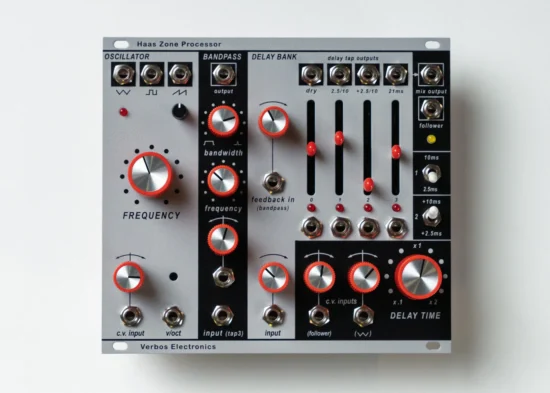
In the video, Mark Verbos introduces the Verbos Electronics Haas Zone Processor.
The Haas Zone Processor enables chorus, flange, phase cancellation, doubling, ADT, waveshaping and other effects.
At the core is a multi-tapped digital Delay Bank, largely influenced by vintage studio processors including the Marshall Time Modulator. Tap1 can be switched and swept from less than 1mS up to 20mS. Tap2 is chained from the output of Tap1, adding an additional 1mS-20mS. Tap3 ranges from 9-42mS. In addition to having their own full volume outputs, all 3 delay taps can be blended with the Dry input signal in a voltage controlled mixer.
Also included is a Bandpass filter, built from a 2 pole hi-pass followed by a 2 pole low-pass. Bandwidth can be swept from very narrow all the way to full bandwidth. Frequency can be swept across the full audio range and voltage controlled through a bipolar attenuator.
To the left is a Voltage Controlled Oscillator, similar to the modulation side of a Complex Oscillator. Included is a Triangle, Square and Sawtooth wave that range from 0-10v. The Frequency can sweep from more than 1 minute per cycle all the way up to audio range and tracks volt/octave.
There is an envelope Follower on the input and both it and the triangle output from the Oscillator are normalled to the c.v. inputs on the Delay Time. The output of Tap3 is normalled to the input of the Bandpass filter and the output of the Bandpass filter is normalled to the Feedback In. Through tweaking the Delay Time, Oscillator Frequency and Bandpass Frequency multiple resonance points can be accentuated.
The Haas Zone Processor is intended to be used as an effect, inside a patch as waveshaper or as a voice on its own.
The Verbos Electronics Haas Zone Processor is available now with a street price of about $800 USD.
Synthesist Ian Dixon shared this video intro to his free Roland D-50 Editor Librarian.
The Librarian is a browser-based Web MIDI tool for backing up, browsing, importing and editing D-50 sounds, without sending your patch data to the cloud.
Video Summary:
“In this video, I show the full workflow from the YouTube transcript: connecting the D-50 over MIDI, enabling SysEx, reading the current edit buffer, opening a patch library, sending sounds to the synth, receiving a full bulk dump from the D-50, saving a library backup, importing SysEx banks, and editing classic D-50 patches such as Fantasia. The editor also makes it easier to work with the D-50’s upper and lower tones, partials, PCM and synthesis structures, ring modulation, filter and amp envelopes, reverb, tuning and patch management.
The aim is to give the Roland D-50 a modern librarian/editor workflow: build a large library of card sounds and custom patches, search for sounds quickly, send patches to the edit buffer when recording, and avoid constantly swapping cards or managing small internal banks by hand.”
The Roland D-50 Editor Librarian is available now as a free, browser-based application.
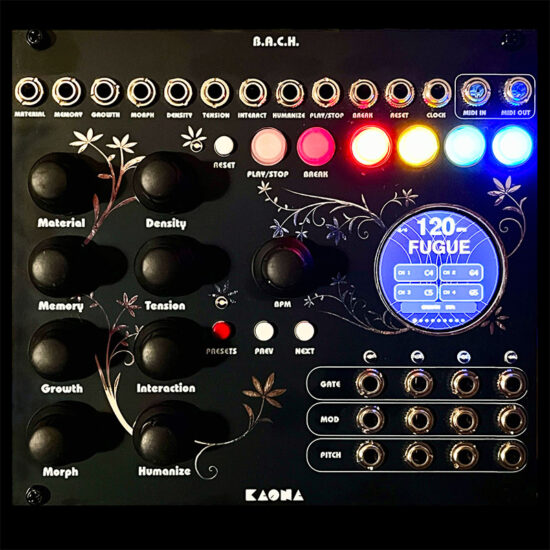
Kaona B.A.C.H. is a four-voice composition generator module that creates melodic, harmonic and rhythmic structures, in real time, for Eurorack and MIDI systems.
B.A.C.H. offers 12 composition systems, ranging from fugue and canon to Markov-based randomness, cellular automata, fractals and generative rhythmic structures.
The module can control modular equipment through Gate, Pitch and Mod outputs and MIDI synthesizers through independent MIDI channels.
Features:
Four-voice real-time composition generator
12 compositional languages
FUGUE constructs a multi-voice exposition from a subject, answers, a countersubject and episodes.
CANON develops a leading line through imitation, transposition, delay, contrary motion, retrograde or augmentation.
PROBA uses Markov chains and several transition vocabularies to produce directed randomness.
TINTINNABULI combines a melodic voice with voices whose notes are drawn from a triad or the current chord.
MINIMAL applies gradual processes of phase shifting, addition, substitution and hocketing.
CELLULAR turns the evolution of a cellular automaton into musical material. It provides access to 254 rules.
TREE interprets L-systems and their branching structures as melodic paths.
FRACTAL uses recursive sequences and chaotic systems, including Thue–Morse, Fibonacci, Sierpiski and the logistic map.
MOTIF develops chains of melodic and rhythmic cells drawn from 32 collections.
HYBRID distributes several composition engines across the four voices.
GROOVE organises four rhythmic roles using 64 structures.
GROOVE MIX applies these rhythmic structures to pitches produced by an associated melodic language.
Eight CV inputs with attenuation
Dedicated Clock, Play/Stop, Reset and Break inputs
Each track provides:
a GATE output;
a PITCH output following the 1 V/octave standard;
a MOD output for dynamics.
The Pitch outputs cover eight octaves, from 0 to 8 V. The Mod outputs cover a range of 0 to 5 V.
B.A.C.H. automatically retains its most recent state. The SD card provides 128 preset locations. Each preset stores the selected language, the eight control settings, musical parameters, CV attenuation settings, MIDI settings, Break configuration and the complete harmonic progression.
Kaona B.A.C.H. is available now for €594, with a 15% Early Bird pre-order discount. The first delivery is scheduled for the middle of October.