Archive for September, 2026

Spitfire Audio & BT Team Up For Phoenix “A Hybrid Synth For Cinematic Sound Design”

Spitfire Audio has teamed up with composer, producer and music technologist BT for the release of Phoenix, a hybrid software synthesizer that brings together samples from BT’s private archive with wavetable and FM synthesis, a versatile effects engine and extensive modulation capabilities.

Equipped with 16 voices of true stereo polyphony, Phoenix is built on six synthesis engines: a spectral wavetable engine, a six-operator, 34-algorithm FM engine, and a multi-sampled instrument engine with a broad sample library covering strings, brass, woodwind, choirs, guitars, pianos, and percussion from Spitfire Audio’s library, alongside more experimental sounds from BT’s own collection. These are joined by a dedicated transient engine, a sub-oscillator and noise oscillator.

Phoenix’s wavetable engine is built around a “stereo-from-the-ground-up” architecture with two independent synthesis chains per-voice across both left and right channels. This means that key parameters can be can be independently modulated across each channel, creating complex spatial effects. There’s also a deep cross-modulation bus with 20 modes spanning FM, AM, ring modulation, phase distortion, wavefolding and more.

The synth’s modulation engine comprises 37 sources in total, routed via a matrix with no fixed slot limit. You get multiple four-stage curve sequencers, five-stage envelope generators and LFOs with freely drawable waveforms, alongside four random generators that draw on sample-and-hold, noise, stochastic models and libraries of rhythmic patterns lifted from BT’s Stutter Edit plugin.

Paralleling the modulation engine in its depth, Phoenix’s library of effects features 37 processors, spanning multiple styles of reverb and delay, along with a multimode filter, chorus, flanger, phaser, tape emulation, saturation, distortion, multiband compression, and – as is to be expected in a BT plugin – glitchy rhythmic stutter effects.
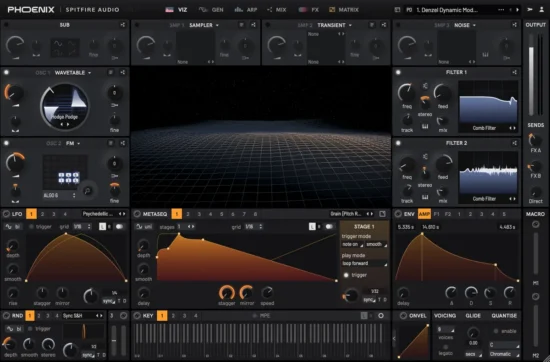
That’s not all: you also get a 128-step sequencer and arpeggiator with probability control, and Phoenix is MPE-compatible, giving you per-note control over all five dimensions of expression when used with an MPE controller. All in all, this looks like a beast of an instrument, and one of the most ambitious projects we’ve seen from Spitfire Audio in a long time.

“This is true cross-synthesis,” BT said in a press release. “I’ve spent my entire life exploring synthesis modalities, built on the back of giants, to be sure, and combined and augmented this way, none of this existed before, not even in a related form. This is a dream inspiration engine fully realized.”

Watch a conversation between BT and Spitfire Audio’s Paul Thomson below:

Currently priced at an introductory discount of $239 USD, Phoenix is available for macOS and Windows in VST3/AU/AAX formats. The synth currently requires an active internet connection to operate, but Spitfire Audio says it will be introducing offline operation in a future update.

Find out more on Spitfire Audio website.
Backgrounds Creates Evolving Soundscapes From Your Keyword Prompts


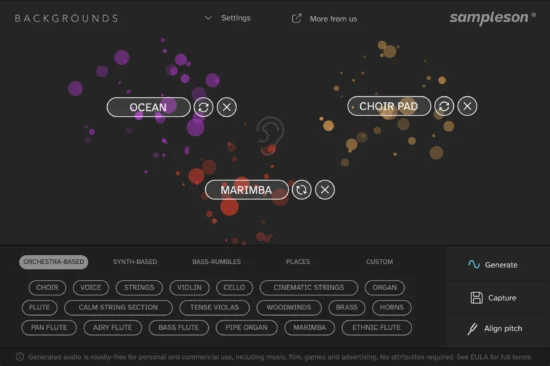
Sampleson Backgrounds is a new soundscape creation tool that lets users combine words and ideas on a canvas to generate evolving cinematic atmospheres.

Backgrounds uses semantic audio retrieval to match words and concepts with a curated library of more than 22,000 audio cells and 11,000 local embeddings. Users can drag keywords onto a canvas and combine concepts such as strings, rain, bass or thunder to create evolving soundscapes.

The software runs locally rather than relying on cloud processing or subscription-based tokens, and is available as a standalone application and plug-in for music production and sound-design workflows.

Features:

  • Word- and concept-based soundscape creation
  • Drag keywords onto a visual canvas
  • Semantic Audio Retrieval engine
  • Library of more than 22,000 audio cells
  • Combines multiple concepts into evolving atmospheres
  • Designed for cinematic ambience and sound design
  • Local processing with no cloud uploads
  • No subscription or token-based generation system

Sampleson Backgrounds is available now for macOS and Windows as a standalone application and VST3/AU plug-in, with an intro price of $39 USD (regularly $59).

Free Multiband Bitcrusher, RiverFlux Audio BIT LAYER


This free multiband bitcrusher is a surgical tool for lo-fi sound design.

If you like your sounds distorted, degraded and loaded with lo-fi character, then the humble bitcrusher is your friend.

By reducing the bit depth and sample rate of a signal, this audio effect produces crunchy textures, gritty timbres and artifacts reminiscent of vintage digital gear: it’s a powerful tool for creative sound design, capable of achieving everything from subtle fuzz to total sonic destruction.

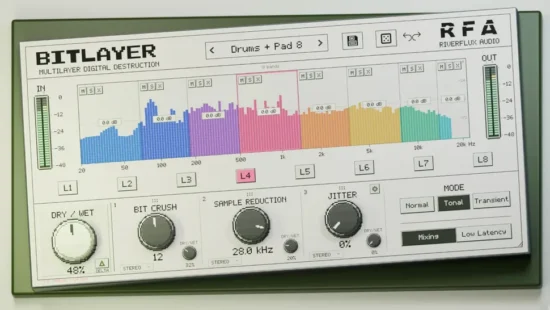
Many DAWs have a stock bitcrusher onboard, like Ableton Live’s Redux or Logic Pro’s Bitcrusher, but these tend to be on the simpler side. BIT LAYER, a new plugin from RiverFlux Audio, takes things to a different level, allowing you to precisely target your digital degradation with a multiband architecture, mid/side routing and tonal/transient processing. This adds up to more versatility than many paid-for bitcrusher plugins, and it’s totally free.

Bit Layer can dial in up to eight independent layers of processing, each with dedicated controls for bit depth, sample rate and jitter (all three can be reordered in the signal path) along with mute, solo, gain and dry/wet mix.

The plugin’s multiband functionality makes it possible to apply lo-fi texture in varying degrees and styles across the frequency spectrum, and this can be seriously useful for surgical sound design. You could crunch up the hi-hats in a drum loop while leaving the kick drum untouched, for example, or add some ear-catching grit to the high-end of a vocal without distorting the mids and lows.

The plugin’s targeting abilities extend beyond the frequency spectrum and into the stereo field, too: all three modules across each band have mid/side routing, so you’re able to apply the effect independently across mid (the sum of the left and right channels) or side (the difference between the two) channels.

There’s also tonal/transient splitting across each band, meaning that you can treat the transient (attack) portion of a signal independently to its sustained tonal content, once again opening up new possibilities for fine-tuned signal corruption.

All in all, this is a respectable amount of flexibility for a free plugin. If you’re looking for an upgrade to your DAW’s stock crusher but you’re not already in possession of one of the more full-featured paid-for options on the market, Bit Layer looks like a capable alternative.

RiverFlux Audio BIT LAYER is available now for Windows and Linux in VST3/CLAP formats, with AU support on macOS.

Head over to Gumroad to download the plugin.