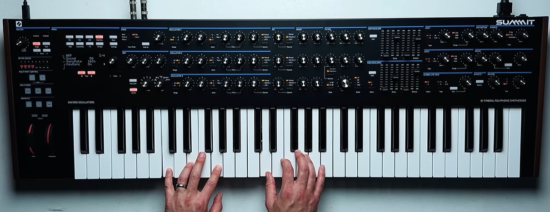
Synthesist and composer David Hilowitz – in his latest video – offers an in-depth overview and demo of the Novation Summit synthesizer.
The Novation Summit is a flagship 16-voice, dual-part bi-timbral digital-analog hybrid synthesizer featuring a 61-note keyboard.
Like the Peak, the Summit features Novation’s New Oxford Oscillators, which many see as combining the best of analog sound and digital control and flexibility. They offer a much wider range of sonic possibilities than traditional oscillators, including support for wavetables.
Features:
Peak powered up — the Peak architecture taken to the next level, with 16 voices, expanded controls, new filter options, and more
Digital where it counts — digital FPGA-generated New Oxford Oscillators for analogue-style, wavetable and FM synthesis
Analogue where it matters — dual analogue filters, analogue VCAs and three stages of analogue distortion per voice
Two sounds at once — multitimbral engine for splitting, stacking and switching between two simultaneous patches
Wavetable Editor — featuring drawing tools and a Live Edit mode, so you can draw your own oscillator shapes and preview them in real time
*Note: Hilowitz notes that this is a sponsored video, so it’s not a review, but rather offers an excellent introduction to the Summit and its sonic capabilities.
The Novation Summit is available with a street price of about $2,900 USD. Find out more on Novation site.
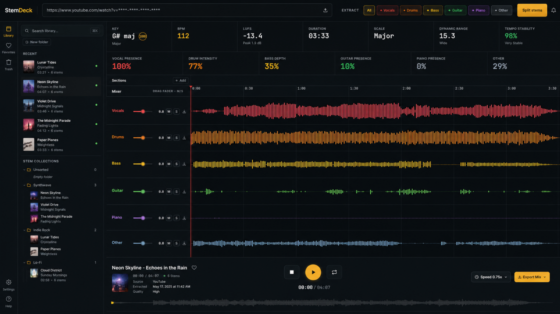
Stem separation has gone from a proprietary niche technology to a ubiquitous capability in the last few years, as exemplified by StemDeck – a free, open source stem separation app for Linux, Mac & Windows.
Stemdeck is a modern stem extraction platform, designed to isolate vocals, drums, bass, piano and guitar for practice, transcription, remixing, and creative audio workflows.
Drop in an MP3, WAV, FLAC, OGG/Opus, MP4, or M4A file, or paste a YouTube URL, and StemDeck splits the audio into up to six stems (vocals, drums, bass, guitar, piano, other). You can play them back in a DAW-style multitrack mixer: mute, solo, balance levels, zoom the waveform, loop a region, and export individual stems or a custom mix. Everything runs locally on your own machine.
StemDeck is a free, open alternative to cloud stem-splitters like Moises and LALAL.AI: no account, no quota, no uploads, no subscription. StemDeck does not store, cache, or redistribute any downloaded content. Everything happens locally and nothing leaves your machine.
“If you want stems for personal study and prefer to keep things local and free, StemDeck has you covered,” notes the developer. “If you need the polish, a mobile app, or deeper musician tooling, the commercial products are a better fit.”
Bitwig Studio 6.1 launches with ‘radically updated’ Sampler device.
After launching in public beta back in June, Bitwig Studio 6.1 update has been officially released, bringing with it a ‘radically updated’ Sampler device that the German developer promises will ‘invite you to sample in ways that weren’t possible before’.
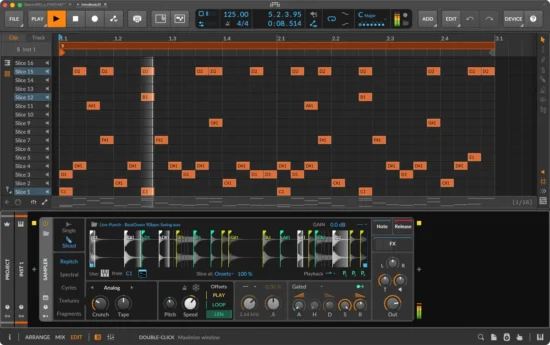
Sampler has received a major overhaul that dramatically transforms what the device can do, and among these new capabilities, sample slicing is one of the most useful new features for music-makers working with audio. Load up a sample, hit the Sliced icon and Sampler will chop it up into slices that can be triggered from a MIDI controller or the Piano Roll.
There are five Slicing Modes that determine how a sample is divided: Divisions slices the sample into a number of equal pieces between 8 and 64, Beats cuts at rhythmic intervals based on Sampler’s BPM detection, Onsets chops it at the transients with adjustable sensitivity, and Pitch slices at points where the sample’s pitch changes. There’s also a Manual mode for setting your own slice points.
There are several options for how slices are triggered, too: along with the usual chromatic layout, you can assign slices to white or black keys only, trigger them via note velocity, or trigger them with a dedicated Select parameter that responds to automation and any of Bitwig’s modulators. Each slice can also be given its own loop settings and modulated independently, courtesy of three per-slice modulation sources that can be mapped to any parameter in Sampler.
Sampler has also been equipped with new automatic pitch analysis that makes it quick and easy to map a sample’s pitch accurately across the keyboard. Sampler can now helpfully sets a sample’s root key automatically, either by detecting the average pitch across the sample’s duration or setting the root key from a chosen position in the waveform.
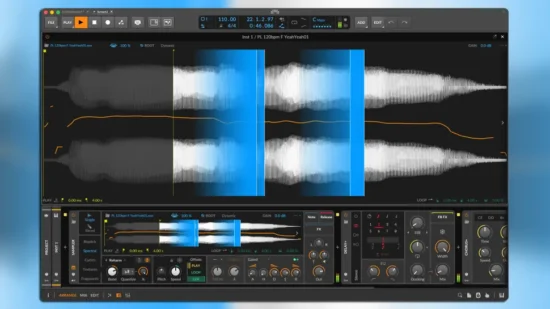
Click the Orb icon in Sampler and your sample’s pitch will be analysed, represented by an orange line running across the waveform. Press a key, and the sample will be dynamically retuned during playback to maintain the chosen pitch throughout its duration, even if the original sample changes in pitch.
The updated Sampler also features two new Play Modes: Spectral is designed for “stretching, bending and breaking” sounds, and uses a newly purpose-built algorithm to deliver clean and artifact-free time-stretching, with a Preserve Onsets function that maintains the punch of a sample’s transients even when slowing it right down. Spectral’s Reharm mode lets you shift the harmonics of a sample while leaving the fundamental where it is, and harmonics can be quantized in line the project’s global scale.
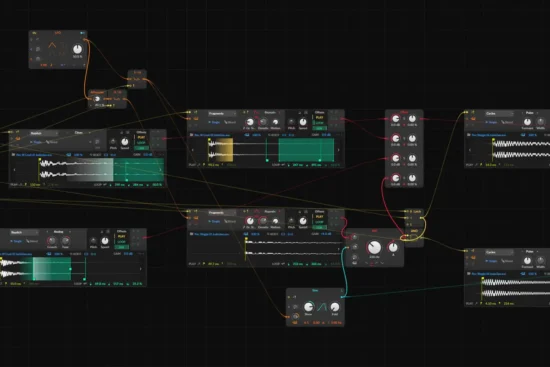
Complementing Textures, Sampler’s existing granular mode, Fragments Mode is a more advanced granular engine that can generate up to 256 independent grains per voice, giving each grain independent playback rate and direction, position and size. Grain size can be set in milliseconds or beat units, and there’s a morphing grain envelope, a Motion control that randomizes each grain’s playhead position and stereo placement, and the ability to repeat each grain up to 16 times for denser textures.
Sampler’s other Play Modes have also received an update: Repitch has been bolstered with two hardware-emulating characters that are applied per-voice – Bitwig says Analog delivers ‘juicy saturation and tape flavour’ while Digital emulates vintage samplers via bit and sample-rate reduction – while Cycles, a mode that turns samples into wavetable-style oscillators, gains pulse width-style modulation, phase modulation and control over odd and even harmonics.
Bitwig Studio’s new pitch detection also powers the Tuner, a new analysis tool available both as a device and as a Grid module. Grid users get some love too: the Sampler module can output its onset, pitch and envelope as signals, and Fragments grains can be triggered directly by signal input.
Whereas Bitwig Studio’s previous update was all about core DAW functionality, 6.1 finds the developer sharpening its focus and reimagining one key device that’ll be central to most users’ workflows, opening up an abundance of creative possibilities for music-makers that work with samples.
Bitwig Studio 6.1 tutorial:
Expanded and updated in Bitwig Studio 6.1, Bitwig’s Sampler now features two granular play modes: Textures and Fragments. Use them to create ambient soundscapes and frozen textures, or transform audio with precise control over every grain. This tutorial embedded above shows you how they work – and demonstrates how they combine with Bitwig features such as modulation and voice stacking to open up new sonic vistas.
Bitwig Studio 6.1 is available now, and is a free update for all customers with an active Upgrade Plan. The updated Sampler and the new Tuner are included in every edition, though the Spectral and Fragments Play Modes are exclusive to the full version of Bitwig Studio.