Synthesist and composer John C.S. Keston has released a new album, Consonant Dissonance, that explores improvising with piano and a modular synthesizer.
The album captures a series of piano improvisations that explore how the human expression of a piano performance can be emphasized or contrasted by feeding it through a modular synthesizer.
He explains:
“For each piece the piano signals are handled in different ways. These include granular synthesis, looping, pitch shifting, reverse, analog filtering, delay, and reverberation, all modulated via a function generator, low frequency oscillators, and a sampling touch controller operated by the performer.”
Universal Audio makes two classic reverbs used by The Beatles, Radiohead and Brian Eno available natively.
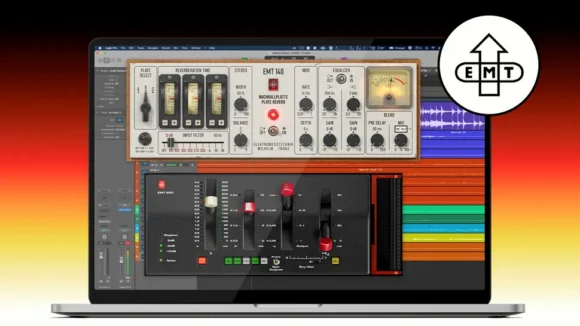
Universal Audio has announced that two of its EMT reverb emulations are now available as native plugins, meaning that UAD EMT 140 Classic Plate Reverberator and UAD EMT 250 Classic Electronic Reverb can be used in any DAW on macOS & Windows without any Apollo or UAD hardware.
Introduced in 1957 by German manufacturer Elektromesstechnik, the EMT 140 was the first plate reverb, an invention that gave studios an alternative to a spring reverb or dedicated echo chamber for the first time.
Released almost two decades later, the EMT 250 was the first commercially available digital reverb, and also offered several modulation and time-based effects. An ultra-rare piece of music tech history, it was originally priced at $20,000 and only around 250 units were built.
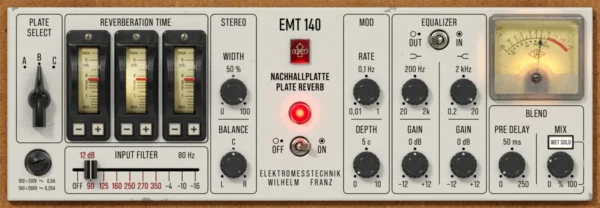
UA’s EMT 140 plugin emulates three different EMT units modelled at The Plant Studios in California that can be switched on the front panel, and complements the original controls with additional settings for balance, width and modulation. Each of its three plates can be set to an independent reverb time from 0.5 to 5.5 seconds, and you also get a choice of original EMT or Martech input filter models, a two-band shelving EQ and reverb time modulation.
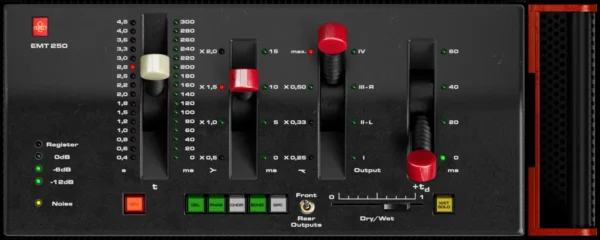
The EMT 250 plugin is built on an algorithm sourced from a “golden unit” at Ocean Way Recording, and the plugin features six program modes covering Reverb, Delay, Phase, Chorus, Echo and Space. Three of the panel’s four levers are remapped for each mode, controlling decay time and separate LF and HF decay multipliers in Reverb, or coarse and fine delay times and repeat damping in Echo. A front/rear switch gives you access to the four discrete outputs of the original hardware and a Noise control models its noise floor.
“Some sounds never go out of style,” said Bill Putnam Jr., CEO of Universal Audio. “The EMT 140 and EMT 250 have inspired generations of great recordings, and we’re excited to bring them to even more creators.”
Vintage Reverb Tutorial With The EMT 140 & 250:
Topics Covered:
00:00 – Intro
01:36 – Sound Examples
02:20 – Dry Example
03:02 – Wet Example
03:43 – EMT 250 Drums Example Reverb Mode
04:49 – EMT 140 Cabasa Example
05:46 – EMT 250 Guitar Example Chorus Mode
07:12 – EMT 250 Guitar Example Stereo to Mono Chorus
08:11 – EMT 250 Lead Vocal Example Reverb Mode
09:24 – EMT 250 Lead Vocal Example Echo Mode Throws
27:59 – EMT 140 Acoustic Guitar Example Bright & Dark
29:00 – EMT 140 Controls Tour
30:15 – EMT 140 Plate Selection
31:48 – EMT 140 Reverb Time
32:23 – EMT 140 Input Filter
33:18 – EMT 140 Stereo Section
34:28 – EMT 140 Mod Section
35:27 – EMT 140 Equalizer Section
36:51 – EMT 140 VU Meter Section
37:06 – EMT 140 Blend Section
39:04 – EMT 250 Controls Tour
39:19 – EMT 250 Logo Badge
39:33 – EMT 250 Register Section
40:31 – EMT 250 Noise Selector
40:46 – EMT 250 Lever Controls Reverb Mode
42:46 – EMT 250 Dry/Wet Wet Solo Section
43:46 – EMT 250 Lever Controls Delay Mode
45:08 – EMT 250 Lever Controls Echo Mode
46:38 – EMT 250 Lever Controls Chorus Mode
47:27 – EMT 250 Lever Controls Space Mode
48:13 – EMT 250 Lever Controls Phase Mode
49:48 – EMT 250 Front & Rear Outputs Switch
51:01 – EMT 140 & 250 Outro
The UAD EMT 140 Classic Plate Reverberator and UAD EMT 250 Classic Electronic Reverb are priced at $149 and currently available at an introductory discount of $79, and both are included in the UAD Spark subscription. Owners of the non-native versions are eligible for upgrade pricing.