Archive for April, 2025

Trump Tariffs Threaten To Double Electronic Music Gear Prices
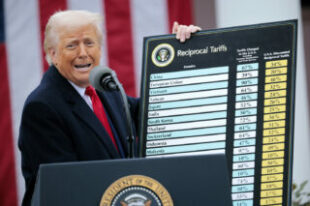


President Trump introduced new import tariffs in early April

The last week has been a bumpy ride for anyone following the Trump administration’s plans for increasing taxes imposed on imported goods.

President Trump announced a wide range of import tariffs in early April, driven by his goal to get greater cooperation on fighting Fentanyl abuse in the US, and to address administration concerns over trade imbalances with countries around the world.

Tariffs are taxes that US companies and individuals pay when they purchase goods from targeted countries.

As of today, it appears that the administration is reversing course on its plans for high ‘reciprocal tariffs’, and instead setting tariffs on imports from most countries to 10%. Meanwhile, they’ve raised tariffs from on Chinese imports to 145%.

Unfortunately, the high tariff rate threatens to double the cost of synthesizers and electronic music gear imported from China, and to dramatically increase the prices of US-made gear, too.
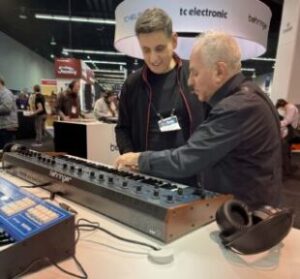
Uli Behringer displayed several new polysynth designs at the 2025 NAMM Show. US tariffs of 145% threaten to double the cost of synths imported from China.

Synth prices jumped notably earlier in the year, when Chinese import tariffs were around 30%. Since then, tariffs on Chinese imports been raised to 84%, 104%, and now a total of 145%.

While this promises to more than double the cost of electronic music gear imported from China, it also is forcing US manufacturers to raise their prices.

US synth makers get most of their parts and PCBs from China, and they’re seeing their parts cost jump 145%.

A related issue is that US manufacturers can’t predict what their costs will be in a month. One manufacture noted that they’d made a PCB order a month ago, and now that it’s about to ship, their cost will be more than double what they’d planned, because of the higher tariff rates.

This unpredictably is leading some US gear companies to pause manufacturing, because the new tariffs will make their pricing too high for their customers. Some manufactures plan on taking a ‘wait and see’ approach, hoping that the administration’s tariff plans will settle down, so that the companies can do long-term manufacturing and marketing planning.

The administration has also announced plans to increase taxes and duties on ‘de minimus’ purchases of $800 or less:

Sec. 3.  De Minimis Tariff Increase.  To ensure that the imposition of tariffs pursuant to section 2 of this order is not circumvented and that the purpose of Executive Order 14257 and this action is not undermined, I also deem it necessary and appropriate to:

(a)  increase the ad valorem rate of duty set forth in section 2(c)(i) of Executive Order 14256 from 30 percent to 90 percent;

(b)  increase the per postal item containing goods duty in section 2(c)(ii) of Executive Order 14256 that is in effect on or after 12:01 a.m. eastern daylight time on May 2, 2025, and before 12:01 a.m. eastern daylight time on June 1, 2025, from 25 dollars to 75 dollars; and

(c)  increase the per postal item containing goods duty in section 2(c)(ii) of Executive Order 14256 that is in effect on or after 12:01 a.m. eastern daylight time on June 1, 2025, from 50 dollars to 150 dollars.

Are the administration’s evolving tariff rates changing your buying plans? Share your thoughts in the comments.
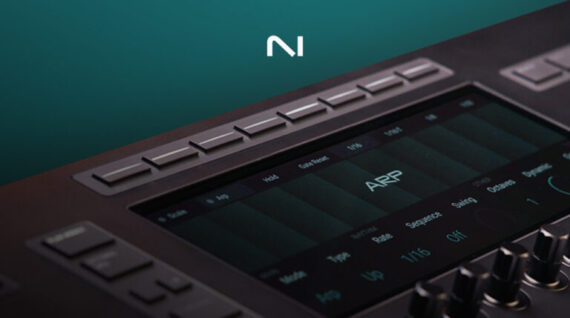
 

Native Instruments Kontrol S MK3 Update Adds On-Device Arpeggiator, dual MIDI & More


Native Instruments flagship Kontrol S MK3 MIDI keyboards just added several features that DAWless music producers have been asking for.

The Kontrol S MK3 MIDI keyboards continue to improve, with the latest firmware update (v1.9.4) looking particularly useful for those who like to use their controller in standalone mode.

DAWless music-making, of course, has become increasingly popular in recent years, as growing numbers of creators have come to the conclusion that it can feel liberating to jam without involving a computer and use a selection of hardware devices instead.

Thanks to the expansion of the Kontrol S MK3’s on-device Play Assist feature, which was introduced last year, standalone users now have arpeggiator and note repeat features built into the hardware, giving them more creative options.

In addition, they can also use the USB and 5-pin MIDI outputs simultaneously, and specify which data should go to each of them.

These features greatly add to the Kontrol S MK3’s versatility, and there are software-specific additions in the firmware update, as well. You can now sync the MIDI tempo with connected plugins, and there’s support for the Maschine 3.1 update.

I am glad that the Native Instruments Kontrol S MK3 controllers are entirely out of their Kontrol software cage and are full standalone controllers.

The new firmware v1.9.4 is available now as a free download for existing users through Native Access.

The Kontrol S MK3 continues to be available in 49-, 61- and 88-note and you can find out more on the Native Instruments website and Amazon site.


e-instruments Intros Slower, A Tape-based Tone Generator Put Your Music On The Fast Track To Success


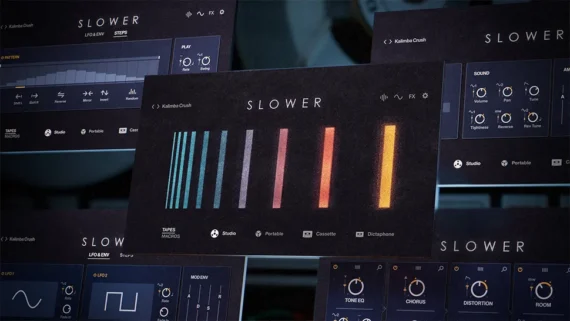
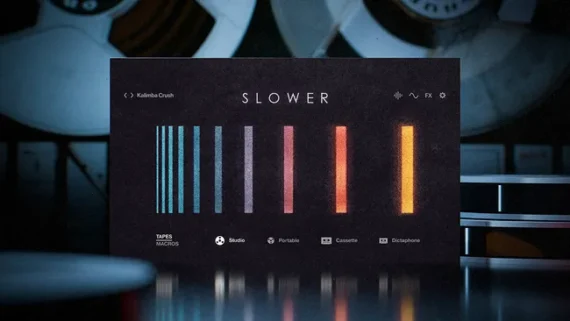
Slower, e-instruments’ new tape-based tone generator – a lovingly-crafted Kontakt library that’s based on a carefully curated collection of half-speed samples. Suddenly – but also slowly – you have access to a huge bank of keys, guitars, strings, brass, synth and other sounds of the sort that you have simply never heard before.

Here’s the Official Walkthrough:

These were captured using four different types of vintage tape machine:

  • Studio: Studer A812 and Revox PR99 – large open reel to reel
  • Portable: Uher 4400 Report IC and Uher 4400 Report Monitor – small reel to reel
  • Cassette: Tascam Portastudio 424mkiii – standard cassette
  • Dictaphone: Sony M650v dictaphone – micro cassette

Each of which has its own distinct character. The common denominator is that they can all impart the kind of warmth and depth that you simply wouldn’t get from a digital recording.

Why drop these recordings to half-speed tape, though? To create blissful, rich and pitched-down textures that emphasize those analogue qualities, such as wobble, noise and flutter.

Because e-instruments has gone to such great lengths to hone the source material, your first hours with Slower are going to be spent simply playing these gorgeous sounds. Expect acoustic and electric pianos, guitars of every flavour, evolving strings, breathy woodwinds and brass and classic synths, all with that half-speed twist.

From here, you’ll likely set about experimenting with the various processing options that are on offer. Slower features include 27 effects, sample reversing, modulation tools (LFOs, a step modulator and aftertouch support, for example) and the ability to dial in just the right amount of tape degradation. And if you want to get hands-on fast, there are three macro controls, each of which adjusts multiple parameters with a single fader. They’re perfect for automating and morphing sounds in real-time and for live performance.

And let’s not forget that you can instantly switch between those four different tape machines. Whether you want to go hi- or lo-fi, dirty or clean, there’s a suitable option.

Above all, you’re invited to explore. Whether you’re a producer, musician or composer, this endless supply of atmospheres and soundscapes won’t just help you to finish your current projects – it’ll also inspire whole new ones.

Audio Demos:

Slower is currently available at the introductory price of $/€99, rather than the regular $/€149, but this offer is only available between 9 and 13 April.

Find out more on e-instruments website.