Superbooth 2024 – Billed by iZotope as “Hollywood’s favourite toolkit for intelligent audio repair,” the company’s RX software has been updated to version 11. Stacked floor-to-ceiling with machine learning technology, this offers both new tools and improvements to existing ones.
RX 11 comes in three versions – Elements, Standard and Advanced – and the majority of the new features are available in the top two packages.
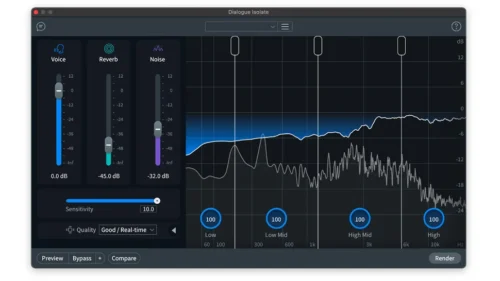
The enhanced Dialogue Isolate module (available in Standard for the first time) now comes with a De-Reverb option, and Loudness Optimize can maximise perceived loudness for streaming platforms. Relatedly, the new Streaming Preview module enables you to hear how your music will sound on different streaming platforms.
Music Rebalance gets a new neural network that enables you to access the individual parts within a full mix. There’s now a Mid/Side mode for the RX app, and Spectral Editor ARA means that you can now fix your audio without leaving your DAW (currently exclusive to Logic Pro for Mac in Rosetta mode but coming to more hosts soon).
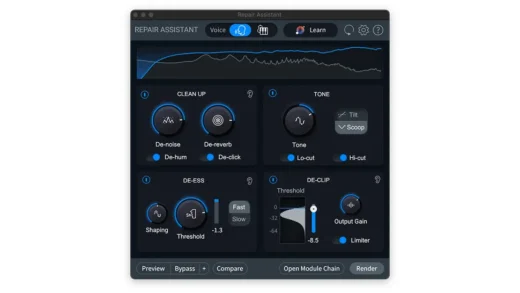
Elsewhere, the machine learning-enhanced Repair Assistant is included in all versions of RX 11. It promises improved quality and speed and comes with more controls.
Conversely, the Dialogue Contour tool is exclusive to RX 11 Advanced, and comes with new Formant and Variation controls for adjusting the character and expressivity of a voice.
Prices for the new versions are as follows: RX 11 Elements, $99 ($49 introductory); RX 11 Standard, $399 ($299 introductory); RX 11 Advanced, $1,199 ($999 introductory). Introductory pricing is available until 13 June, and existing iZotope customers may be eligible for loyalty discounts if they log in to their accounts.
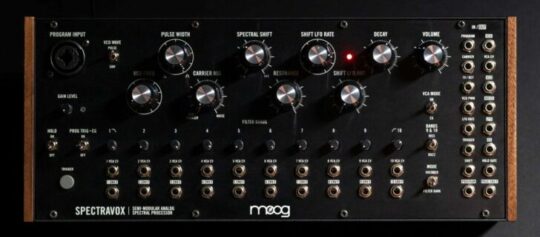
Ahead of Superbooth 2024, Moog Music has introduced the Spectravox Semi-Modular Analog Spectral Processor, an all-in-one synth voice and vocoder and the company’s fourth device in the Mother-32 Eurorack format.
The Moog Spectravox is an analog spectral processor based around a 10-band filter bank. Spectravox can create lively drones and colorful tonal sweeps on its own, or add resonant depth and “psychedelic spectral movement” to any external sound. Connect a microphone, and Spectravox becomes a 10-band analog vocoder, with innovative integrated modulation of all of its filters.
The Spectravox was originally introduced as the Engineering Workshop project at Moogfest 2019. A key difference in the updated design is that the sliders of the original have been swapped for a row of pots, making room for additional patch points.
What they say about the Spectravox:
“Synthesists have delighted in playing with the spectrum of sound since the Moog 907 Fixed Filter Bank appeared in the 1960s, creating lush vowel tones and multicolored timbral animation with hands-on level control of each frequency band of a sound. Unlike earlier fixed filter banks, however, the unique filters of Spectravox are no longer fixed in place and will jointly shift around the frequency space, allowing for the creation of otherworldly voltage-controlled spectral animation and vibrant phaser-like sweeps.
With 10 filters whose variable resonance can morph from soft precision to shimmering choral effects, Spectravox reshapes the sounds you love into surprising new forms and brings a new world of sonic possibilities to your studio.
With its combo XLR/jack program input, Spectravox becomes a fully featured 10-band vocoder, with a secondary filter bank for analyzing the spectral makeup of incoming sounds. In VOCODER mode, its 10 analysis filters map the timbral characteristics of any external sound onto any other sound you can imagine. Shape the warm analog oscillator of Spectravox with the dynamics of your voice, or use a drum machine to animate guitar chords in a mesmerizing broadband percussive space.
Spectravox uses the pioneering vocoding work of Bob Moog and Wendy Carlos in the late 1960s as its inspiration—work which was based on Homer Dudley’s original designs from the 1930s and which was used to prominent effect in Stanley Kubrick’s 1972 film A Clockwork Orange. Innovating further from these early designs, Spectravox uses 10 state-variable filters for its filter bank, all 10 of which are capable of being shifted with its internal triangle wave LFO or external control voltage. With the ability to emphasize vowel sounds via the Hiss and Buzz functionality of the Moog 16 Channel Vocoder, Spectravox is both a major step forward for analog filter banks and a loving exploration of early music technology history.
Scramble the Frequency Spectrum
Scramble the frequency spectrum and create wonderfully unpredictable textures with patch points for each filter in the filter bank and included patch cables. Add analog warmth and subtle phasing to digital synthesizers and sound sources. Integrate Spectravox with other Moog semi-modular instruments or Eurorack modules with an extensive patch bay providing control over almost all of its parameters. Spectravox is a boundary-pushing instrument that invites you to explore creative new ways of shaping and sculpting sound.
Moog’s official demo, a musical performance featuring Jamie Lidell’s Awake and Alive, an original composition showcasing the Moog Spectravox. The performance also features Aaron Steele on percussion and Luke Schneider on pedal steel.
Features:
Semi-Modular Design: No patching is required to start, allowing immediate musical exploration.
Dynamic 10-Band Filter Bank: Shift and shape frequencies to create everything from rich basses to ethereal pads.
Extensive Connectivity: Integrate seamlessly with other Moog semi-modular instruments, Eurorack modules, and external sound sources.
Innovative Modulation: Internal triangle wave LFO and external CV options for real-time control over filter movement and sonic texture.
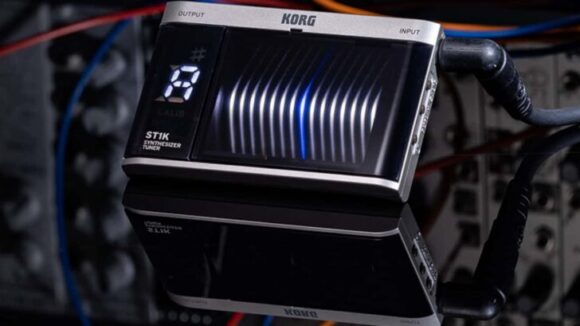
Ahead of Superbooth 2024, being held in Berlin May 16-18, Korg has introduced the ST1K, a tuner designed specifically for use with analog and modular synths.
What they have to say about it:
“Designed with the unique needs of analog and modular synth players in mind, the ST1K is compact, precise, and offers high visibility, ensuring your synth is accurately tuned the way you want every time.
Analog synthesizers can be tricky to tune, with their pitch often fluctuating as the circuit adjusts to temperature changes. You may also want to microtune different oscillators within the one synth. These requirements make reliable tuning essential, whether you’re recording in the studio or performing live.
The ST1K delivers this with its capability for ultra-precise tuning to ±0.1 cent, and features a large CMD LCD display that provides a clear, visually appealing readout of your tuning status, aligning with the aesthetics of modular and analog synths. It also includes a built-in high-sensitivity microphone, expanding its use to a broader range of instruments.?
Features:
“Optimized circuitry” for stable tuning of analog and modular synths.
3D visual meter.
Tuning down to ±0.1 cents.
Three meter display modes, in addition to note name display.
Compact, flat design that is easy to carry anywhere.
Details on pricing and availability for the Korg ST1K tuner are still to come at the Korg website.