Codec v2.0 Update ‘Modern Degradation Revamped’

Lese let us know that they has just updated Codec to version 2.0, bringing a handful of new features that give you more control over the way the plugin manipulates audio.

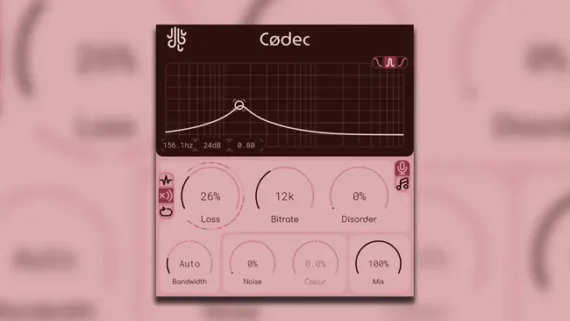
Codec repurposes a real-time audio coding standard designed for internet voice communications as an audio effect, producing a crunchy, digitally degraded sound that simulates a poor internet connection.

What’s new in Code 2.0 video:

Codec divides audio into individual packets, some of which can be randomly dropped out using its Loss control. This prompts the plugin’s internal decoder to try to conceal the packet loss, and there’s a choice of three modes that determine how this is handled by the plugin, each giving you a different sonic flavour.

The Disorder control (new in Codec 2.0) adjusts the ordering of packets being fed into the internal decoder to create a chaotic, glitchy effect, while a new Noise mode adds noise to the signal before it’s fed into the encoder, creating a “messier” sound.

Additional crunch can be applied via Codec’s Crunch controls, which crank up the gain on a selected frequency range prior to the encoding stage and dial it down it once the audio is compressed, creating more distortion artifacts with no added volume.

Codec is available now for PC and Mac in VST/AU formats. You can download it for free from the Lese website.

New Open Source Plugin Gives Keytar Players New Superpowers


Developer Peter Postman let us know about RibbonToNotes, a new open-source MIDI plugin that’s designed to give keytar players new superpowers.

What he has to say about it:

“When playing the Keytar, your left hand can’t do much more than some bending and filter sweeping.

With RibbonToNotes, you can also play notes and chords on the ribbon (which many Keytars have). This is convenient for playing key-switches, bass notes and chords on pads, or sending chords to arrangers.

It is not just for Keytars. You can use it for any ribbon. So it is also useful for extending the possibilities of small keyboard controllers.”

RibbonToNotes is open source, created with JUCE for both Windows and Mac. Since it is created with JUCE, it should also be possible to make an IOS version, but currently only Windows and Mac installers are available at the GitHub site.


PolyMAX Soft Synth Now Available As Free Download But For Limited-Time Only


Universal Audio is renowned for its well-regarded software emulations of vintage studio gear.

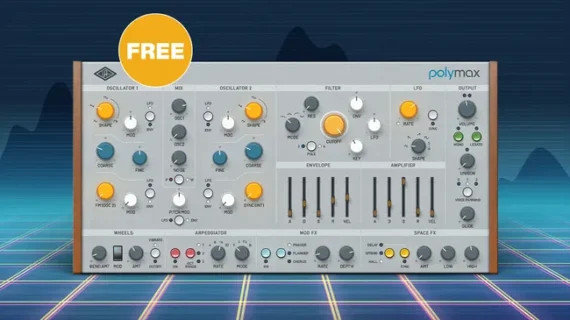
Today, Universal Audio is giving the $199 PolyMAX synth plugin away for free – but not for long.

Launched back in 2022, Universal Audio’s PolyMAX synth isn’t based on a single instrument, but instead draws broader inspiration from the “golden age of polysynthesis”, an era that brought us iconic synths like the Jupiter-8, OB-X and Prophet-5. Until now, PolyMAX has been priced at $199, but Universal Audio must be in a particularly generous mood, as they’re giving it away for free until June 30.

Universal Audio says that PolyMAX delivers the “organic, subtle beauty and musicality of classic analogue polyphonic synthesizers”, cherrypicking features, circuits and sounds from the developers’ favourite vintage instruments and “mixing, matching and modelling” these to create a “modern synth with retro roots”.

PolyMAX has a classic subtractive architecture: its dual analogue-modelled oscillators are equipped with continuously variable waveforms spanning triangle, sawtooth, square and pulse waves, and it has linear FM and osc sync, along with a noise oscillator.

PolyMAX’s resonant filter has low-pass, high-pass, band-pass and notch modes, giving you a choice between 4-pole and 2-pole slopes, while its mod envelope and tempo-syncable LFO can be used to modulate pitch, filter cutoff, FM amount and sync amount.

The synth features a healthy selection of effects: two effects slots provide a choice of phaser, flanger and chorus, along with delay and two types of reverb, including the “Hall B” algorithm from UA’s Lexicon 224 emulation. There’s also a multimode arpeggiator onboard.

It’s a solid, straightforward poly with a pleasantly intuitive interface that makes designing basic patches quick and relatively easy. If there’s space in your digital studio for another vintage-inspired subtractive synth, this one’s worth a download.

Find out more on the Universal Audio website.