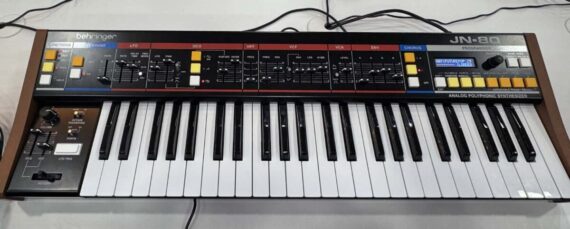
At the 2026 Winter NAMM Show, Behringer is previewing their knockoff of the Roland Juno-60, the JN-80.
The Behringer JN-80 – previously named the ‘Neptune-80 – is based on the Juno-60, but offers 8-voice polyphony, vs the original’s 6-voice polyphony. It also reduces the size of the control panel and uses a 4-octave keyboard, instead of the 5-octave keyboard of the original. It looks like Behringer has based the Neptune-80 dimensions on their Deepmind 12’s form factor.
While the JN-80 is a limited synth compared to the Deepmind 12, its look and sound will appeal to people that like the vintage Roland Juno-60, but not its vintage price.
Polyend Endless is a customisable stompbox with a text-to-effect generator
2026 Winter NAMM Show: Polyend latest announcement, Endless, a new hardware effects pedal platform that promises to let you create your own custom effects pedals with the help of artificial intelligence. Endless is another eye-catching innovation.
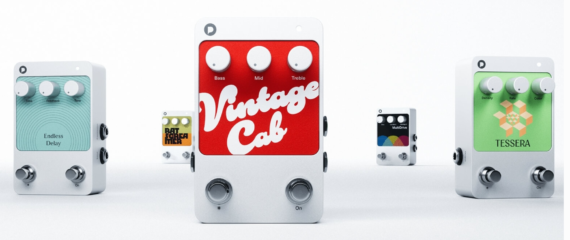
The Polyend Endless is a hardware effects pedal that you can customize in multiple ways: you can load effects from a library of options; you can code your own custom effect, or you can use Polyend’s Playground to ‘vibe code’ your own custom effects, with no coding required. This is a community-created pool of sounds that Polyend says is growing daily, but already contains options including multi-mode distortions, a micro-looping arpeggiator, granular reverb/delay, glitchy looper and tape simulators.
For those not au fait with coding, there is a system called Playground, which is currently in beta. Playground is a text-based generator that will turn user descriptions into playable effects. In Polyend’s words, users can “describe an idea, download the file, and drop it into the pedal. Play it, suggest tweaks, ask for improvements, and get results without coding.”
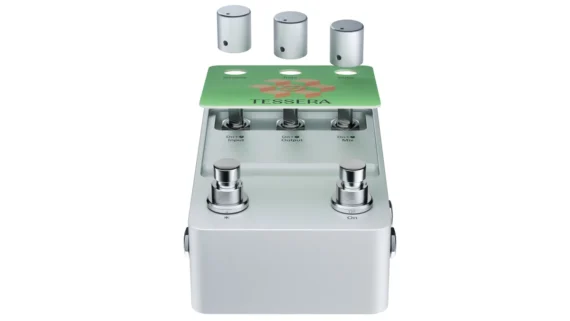
The system is based around an open-ended hardware pedal platform that features a custom-machined aluminum enclosure, swappable faceplates, a stereo 48 kHz / 24-bit audio path and the ability to update its firmware via USB-C. Under-the-hood, Endless is powered by a 720 MHz ARM Cortex-M7 processor.
Two footswitches handle control (right = on/bypass; the left is freely assignable on tap or hold), with a multicolor LED that changes state based on the left switch’s short/long latch. The three front-panel knobs pull double duty—hold On to access analog preamp level, master output, and wet/dry mix—and the configurable I/O lets you switch the pedal between stereo, mono, or mono-to-stereo.
“At Polyend, we try to design devices from a new angle,” said Piotr Raczyński, Polyend CEO. “Before we started Polyend, I was fiddling around with DIY guitar boxes. I always wanted a customisable effect box. Endless is that idea taken to the extreme. If you can describe the effect, you can make your own. If you can code it, you can shape it without limits.”
Endless doesn’t place limits on what you can build. You can create and share effects that can’t be found in another pedal, and access a growing effect library.
Available effects include:
Multidrive — multiband drive with selectable bands and multiple drive modes.
Tessera — transforms a signal into micro-looping arpeggios.
Tape Scanner — warm, gritty, lo-fi tape delay.
VHS Lo-Fi — VHS emulation from “fresh” to “dusty.”
Memory Cloud — a field of grains that can be reversed, randomized, and morphed from delay to reverb.
65’ Sparkle — amp simulation tuned for edge-of-breakup sweetness.
Glitch Loop — records a loop, then slices it into glitchy pieces on playback.
Arp — an arpeggiating pitch shifter with multiple playback modes.
*Note: A token system applies when generating new effects in the Playground, to cover the costs of the AI-based coding system. You own any effects that you create. Sharing is optional. There are no subscriptions or cloud fees.
Endless is available to preorder now, priced at $299/€299. The units are scheduled to start shipping February 22, 2026. Endless ships with a blank faceplate and $20 in Playground tokens. Head to the Polyend site for more.
Has Polyend come up with a use for AI that musicians won’t hate? Let us know what you think in the comments!
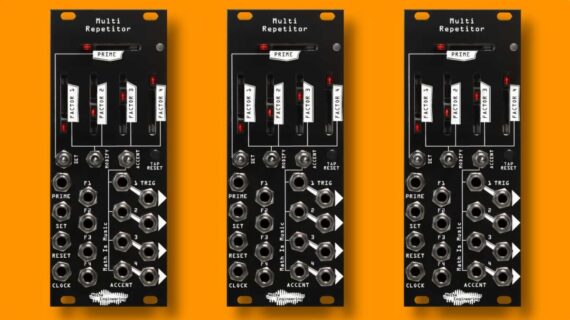
Noise Engineering has released Multi Repetitor, an algorithmic trigger sequencer for Euroack systems.
They describe it as “a sequel to their classic Numeric and Zularic Repetitor trigger generators.”
Multi Repetitor has been completely rethought from the originals, and takes the core features of the version one designs into a whole new realm. Rhythm generation starts with the three rhythm banks: choose from Zularic, Numeric, or the newly developed Euclidean-derived linear rhythms, then use the Prime fader to scroll through base rhythms on the fly.
Like its predecessors, it features four trigger outputs, now with dedicated performance faders that modify the rhythm output.
The newly rethought – and reversible – interface based adds extra parameters for more control of all four outputs.
While it keeps the clock and reset inputs, Multi Repetitor also features an internal tap-tempo clock for standalone sequencing. Finally, this version adds four accent gate outputs to the interface. The impetus for these changes, according to the team, was to make the module fit better into compact percussion systems while still being a fun generative sequencer for larger systems.
While it’s possible to get deep into rhythmic modification with the extensive patterns, modification algorithms, and accent options, Multi Repetitor is designed to be a plug-and-play rhythm sequencer. Noise Engineering said that one of their goals was to make it easy to tweak parameters by ear and jam with no preparation required.
Features:
Standalone play: tap in a tempo, patch up the outputs, and you’ve got a groove
Sequence triggers and accents for up to four voices in your systems
Choose from Zularic, Numeric, or Euclidean-derived base rhythm banks
Select different base rhythms from the banks using the Prime fader
Use three different algorithms to modify each output’s rhythm with the performance faders
Modulate your rhythms with full CV control over faders and banks, and keep things in sync with external clock and reset inputs
Plug-and-play operation: simple interface designed for performance is easy to use out of the box
The Multi Repetitor is available now, priced at $320 USD.