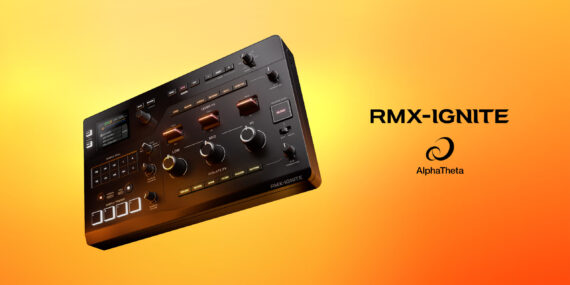
RMX-Ignite ‘Professional DJ Effector & Sampler’ Designed To Bring DJ Sets To Life


Meet the next-gen RMX-IGNITE effector, made to show DJs’ individuality and spark creativity. Remix tracks freely and deliver a live experience that fuses sound and movement.

Ahead of the 2026 NAMM Show, AlphaTheta has introduced a new DJ-focused effects processor and performance sampler, the RMX-Ignite.

The RMX range was originally established under the Pioneer DJ name in the 2012, with the launch of the RMX-1000. That unit – which was later joined by a smaller sibling, the RMX-500 – proved popular with both DJs and producers for its ability to quickly apply rhythmic and modulated effects to incoming audio.

In more recent years, both models have gained popularity among hardware live performers and ‘DAWless’ musicians, as a means to access software-style effects processing without the need to run through a computer.

Now the RMX range has been relaunched under the AlphaTheta brand. The RMX-Ignite significantly redesigns the format, and represents something of a step up in terms of both capabilities and price point.

In the words of AlphaTheta: “More than a decade after the launch of the RMX-1000 – the model released in 2012 that’s still highly respected by top DJs worldwide – this completely renewed effector combines dynamic sound-shaping control with advanced effects to enable new levels of live performance.”

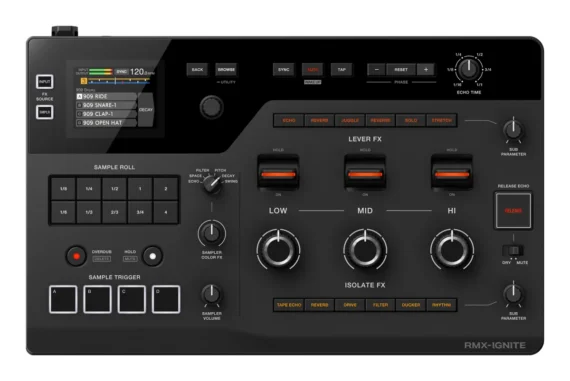
The Ignite is broadly divided into three sections. To the right hand side of its interface are two effects sections, each of which are split into low, mid and high frequency bands.

The upper section is labelled ‘Lever FX’, so called because its effects are engaged by flipping three chunky paddles. This section can make use of six effect types, labelled Echo, Reverb, Juggle, Reverse, Solo and Stretch, each of which can be refined using a sub parameter knob.

These effects are applied differently depending on the direction the user pushes each level. When pulled downwards, the effects are only applied while the level is held in position and disengage as soon as the user lets go. By pushing a lever upwards, the user can latch an effect so that it’s held until manually disengaged.

The lower section of the effects is labelled Isolate FX. These are engaged using a trio of bi-directional knobs that function much like the Color knobs found on DJM mixers, which let users sweep through effects to adjust the amount or character.

The effects offered by the Isolate section are Tape Echo, Reverb, Drive, Filter, Ducker, and Rhythm. Again, a sub parameter control lets users adjust the character of each.

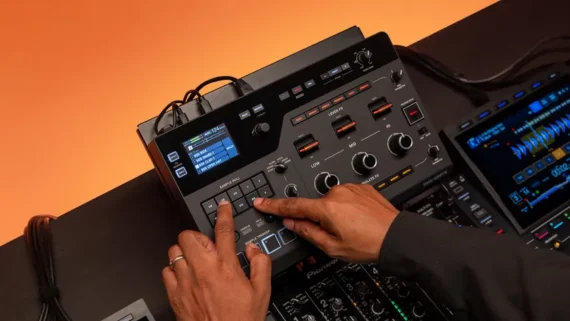
The third main section of the RMX-Ignite is its sampler, which sits to the left of the control interface. Here users have access to four sample pads, each of which is capable of playing four samples simultaneously. The sample section has a Sample Roll function that triggers samples at rhythmic intervals at different timing intervals. These intervals can be combined to create more complex rolls and patterns.

The sampler has an overdub feature that lets users capture simple single-bar loops. Samples can also be processed using a dedicated Sampler Color FX processor, with Echo, Space, Filter, Pitch, Decay and Swing modes.

The RMX-Ignite comes loaded with a factory library featuring vintage drum machine sounds. Users can easily load their own sample collections via USB or Pro DJ Link, and make use of a dedicated RMX-Ignite Sample Manager application.

The Ignite’s final major feature is its Release Echo function, controlled by a large pad to the right of the interface. This is designed to smoothly reset effects and samples back to the original dry audio, while applying an echo tail to smoothly transition out of any effects.

This works in two ways – dry, which smoothly transitions back into the unprocessed audio, and mute, which mutes all incoming audio while the Release button is pressed in order to create a more dramatic transition.

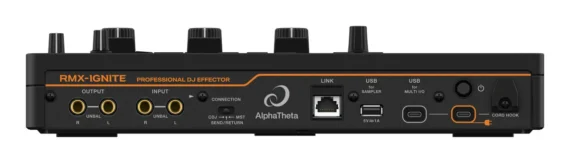
The RMX-Ignite can process audio via classic analogue connections, with stereo TS jacks for both input and output. The unit can also be hooked up digitally to AlphaTheta’s DJM-V10 and DJM-A9 mixers, by connecting a single USB cable to the mixers’ Multi I/O terminal that will function as a single digital send/return.

The Ignite supports Pro DJ Link for BPM and beatgrid sync to other DJ gear. It’s also possible to load samples directly from USB drives or SD cards plugged into players connected via Pro DJ Link.

AlphaTheta is also touting the jump in audio quality compared to previous RMX units, with Ignite offering 96 kHz/64-bit DSP processing, along with 32-bit A/D and D/A converters from ESS Technology on the input and output.

The RMX-Ignite is out now, priced at £1,039/€1,199 including VAT or $1,299 excluding tax. Visit the AlphaTheta site for more.


Electro-Harmonix Effects Interface Hardware Plugin® Is First-of-its-Kind Equipment Bridging The Pedalboard-Plugin Gap!


Ahead of the 2026 NAMM Show, Electro-Harmonix has introduced Effects Interface Hardware Plugin.

As recording technology has become cheaper and more accessible, the line between guitarists and producers has become increasingly blurred. With its new Effects Interface Hardware Plugin, Electro-Harmonix is aiming to make bridging that gap easier than ever.

The Electro-Harmonix Effects Interface Hardware Plugin® is a first-of-its-kind piece of equipment purpose-built for making use of pedals and other physical guitar equipment with your DAW easy and seamless.

Additionally, the Effects Interface breaks your favorite plugins out of your computer for use in your full guitar rig. No need for special converters or direct boxes, the Effects Interface handles your signal and delivers it with care between your hardware and software via a simple USB-C connection

This can be done in one of two ways. In its Hardware Plugin mode, the Effects Interface acts as an external effect loop, routed via its associate plugin that sits in a DAW’s insert chain.

Alternatively, in Pedalboard mode the Effects Interface can be used to incorporate software effects into a hardware chain. Here audio is sent into a DAW through the input plugin, processed using any software effects, and then sent back out to an amp or pedalboard.

The inputs and outputs are designed to operate at pedalboard-friendly levels, allowing audio to travel to and from a chain of effects pedals without the need for additional converters or DI boxes.

According to EHX, “Effects Interface handles your signal and delivers it with care between your hardware and software via a simple USB-C connection.”

In either mode, the device’s foot switch can be used to bypass the effect like a traditional stompbox.

The Effects Interface has stereo inputs and outputs, but can also operate in dual-mono mode, allowing users to set up two different effects routings simultaneously.

The level of its inputs and outputs can be controlled via both the hardware and software UI. The device also has a headphone output with its own volume control allowing for direct monitoring.

As well as being used as part of a stompbox effects chain, the Effects Interface can also function as a traditional audio interface for recording and monitoring via its ins and outs.

While the device is primarily aimed at guitarists, it’s not hard to imagine how it might also appeal to synthesists and bedroom producers looking for an easy way to take sounds out-of-the-box for a little hardware processing.

The Effects Interface Hardware Plugin operates in 3 distinct modes:

  • Hardware Plugin Mode: Send tracks/signal from your DAW through you pedals/hardware just like you were using a plugin.
  • Pedalboard Mode: Run your instrument into your DAW, through your plugins, and back out to your signal chain, effectively turning your plugins into a pedal.
  • Audio Interface Mode: use the Effects Interface as a traditional 2-in/2-out USB audio interface

The Electro-Harmonix Effects Interface is out now, with a US street price of $359. Visit the EHX site for more information.

Keith Emerson Moog Modular Reissue + Memorial Panel At 2026 NAMM Show


Ahead of the 2026 NAMM Show, the Bob Moog Foundation (BMF) has announced that it will honor the late Keith Emerson at the event, which runs from Thursday January 22, 2026 to Saturday January 24, 2026.

At the Show, you’ll be able to see one of five Keith Emerson Moog Modular System (KEMMS) reissues at the BMF booth.

Keyboardist Andrew Colyer (Circuline) and synthesists Erik Norlander, Rachel Flowers, and Lisa Bella Donna will be demonstrating the modular in the BMF booth. In addition, two educational and historical presentations about the modular will be given by one of its co-designers, Brian Kehew.

Visitors to the booth will be able to learn about Keith Emerson and the story behind the creation of the KEMMS with an informative display, which is being created specifically for this year’s NAMM Show. So, if you can’t make one of the scheduled demonstrations, you’ll still be able to immerse yourself in the history of Emerson and his massive modular system.

TEC Tracks panel – Celebrating Keith Emerson

The Foundation will also present a TEC Tracks panel, Celebrating the Legacy of Keith Emerson, on Friday at 4 pm.

Panelists for this discussion include Emerson’s fiancée Mari Kawaguchi, Brian Kehew, Rachel Flowers, Steve Porcaro of Toto, and Rich Walborn, former Moog Music engineer and Emerson’s modular tech on the 1973-1974 Brain Salad Surgery tour.

The BMF’s Michelle Moog-Koussa will moderate the panel.

The panel takes place from 4 pm – 5pm on Friday, January 23rd in the Hilton’s California B room.

“As we enter the tenth year since Keith’s passing, having the replica of his modular Moog synthesizer on display at the Bob Moog Foundation’s NAMM booth feels profoundly meaningful – a tribute to Keith’s unique bond with Dr. Robert Moog and the ongoing work of the Bob Moog Foundation. What moves me most is that people will be able experience the instrument up close, standing before the very creation that shaped Keith’s voice and forever changed modern music.” – Mari Kawaguchi

The Bob Moog Foundation is an independent non-profit, dedicated to preserving the legacy of synth pioneer Dr Robert Moog. Key projects include The Moogseum, preserving Bob Moog’s archives, and STEM programs on the Science of Sound and Synthesis.