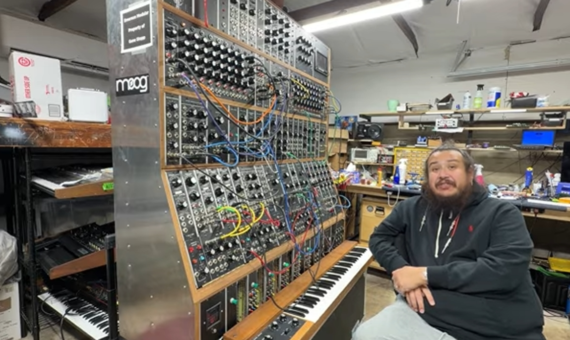
In the video, synth technician Rob Rosen (Rosen Sound) offers a behind-the-scenes look at the rare Emerson Moog Modular.
Rosen discusses the restoration process and demonstrates some of the features that are unique to Emerson’s modular system. He repaired the system at the request of the Bob Moog Foundation, which will be featuring it at their booth at the 2026 NAMM Show.
This unit is the prototype for the Emerson Moog Modular reissue, created by the late Gene Stopp. Stopp was a Moog modular specialist, and recreated Emerson’s Moog with the help of Moog engineers.
If you’re going to NAMM, make sure to stop by the BMF booth to check it out. Keyboardist Andrew Colyer (Circuline) and synthesists Erik Norlander, Rachel Flowers, and Lisa Bella Donna will be demonstrating the system. In addition, two educational and historical presentations about the modular will be given by Brian Kehew.
The Foundation will also present a TEC Tracks panel, Celebrating the Legacy of Keith Emerson, on Friday at 4 pm.
Ahead of the 2026 NAMM Show, being held Jan 22–24 in Anaheim, California, Roland has introduced the CR-78 Software Rhythm Composer, a plugin emulation of their CR-78 drum machine.
Released in 1980, the CR-78 was what Roland calls “the world’s first computer-controlled programmable drum machine”. It was a transitional device, halfway between pre-programmed organ-top beatboxes and pioneering drum machines like the TR-808 and TR-909.
The machine itself may have had a relatively low profile, but its sound became well-known thanks to the CR-78’s use on hits such as I Can’t Go For That (Hall & Oates), Vienna (Ultravox) and, most notably, Phil Collins’ In The Air Tonight.
Now the CR-78 has become the latest instrument from the Roland archives to join the company’s plugin roster, which is available via the Roland Cloud. And not only is it designed to bring the sound of the original hardware to your DAW, but it’s also been enhanced with modern sequencing features, individual sound mixing and tuning, tempo sync, drag-and-drop audio/MIDI support and various other things.
As you’d expect, Roland has gone for an interface that closely resembles the original hardware – you can choose between the wood panel and black vinyl covering variations – and there are direct access controls for rhythm patterns, instrument sounds, shuffle, fills, volume balance, fade-in/fade-out, and more.
Roland CR-78 Software Rhythm Composer Audio Demos:
There’s also a detailed Pattern view where you can fine-tune your rhythms and sounds, and mixer controls can be found on the Kit screen.
If you have a Roland Cloud Ultimate membership, you’ll have access to the CR-78 already, and the Lifetime Key is currently on sale for $49 (regular price $199). It runs on PC and Mac in VST/AU/AAX formats.
Find out more on the Roland website.
Ahead of the 2026 NAMM Show, being held Jan 22–24 in Anaheim, California, Roland has introduced its most comprehensive model yet: the Go:Mixer Studio, a compact audio interface and mixer designed to provide high-quality sound in a portable setup.
Roland says that the GO:MIXER STUDIO is “ideal for musicians and Instagram or TikTok creators, and delivers studio-quality audio for iPhone, iPad, and desktop recording.”
Go:Mixer Studio offers 12 input channels and six outputs, and you can record at up to 24-bit/192kHz quality. There are also built-in effects – a 3-band EQ, a compressor and a reverb – which can be used for recording or just monitoring, along with features designed to make it easy to integrate with video production. Mixer setups can be stored in 16 scene memories.
The selection of inputs cover most eventualities: there are two XLR mic/line inputs with mic preamps; a dedicated guitar/bass input; and 1/4-inch inputs for stereo sources such as a keyboard, electronic drum kit or anything else you might be wanting to record. Further stereo sources can be plugged into the aux input, which has TRRS support for bidirectional audio with mobile devices. There’s also MIDI I/O.
Monitoring connectivity includes a 1/4-inch headphone jack and a further mini-jack output for your wired earbuds. This supports a headset or inline mic, giving you a further recording source to work with. If you’re back in the studio, you can use the 1/4-inch line outputs to plug into your speaker setup.
The Go:Mixer Studio’s control panel looks nice and clean, with just a few knobs and buttons below the display. You can take control using the Go:Mixer Cam iOS app, for iOS, Mac & Windows, which enables you to capture both multitrack audio and video. Every input can be mixed from here, and you can also export the multitrack audio files for use in your DAW or video editor.
PC and Mac users can also take advantage of the Go:Mixer Editor, which puts all of the device’s parameters on a larger display.
Power can be drawn from your device, an adapter or a USB battery pack (there are two USB-C ports so you can connect and plug in a power supply at the same time) and you can mount the Go:Mixer Studio on a tripod if required.
Features:
Portable mixer and audio interface for performance video creators and music artists
Capture high-quality audio anywhere with an iPhone/iPad or a macOS/Windows computer
Studio-grade sound quality with support for recording rates up to 24-bit/192 kHz
Intuitive panel knobs and color display for easy operation
Onboard EQ plus compressor and reverb modeled after popular studio processors
Up to 12 total input channels and six outputs (three stereo pairs)
Two XLR inputs for mics or line-level devices
High-gain mic preamps and support for 48 V phantom power (requires 15 W power from a mobile device, computer, or USB adaptor/battery)
Stereo line-level input, high-impedance guitar/bass input, and aux input with TRRS (bi-directional) capability
Versatile audio outputs include 1/4-inch stereo output jacks, a 1/4-inch stereo headphones jack, and a mini headphones jack with headset mic support
Save complete mixer setups in 16 scene memories for fast recall
Loop Back function for playing along with backing tracks from your mobile device via USB-C
TRS MIDI I/O with MIDI Thru functionality
USB-C ports for device connection and independent power
Versatile power options: bus power, external adaptor, or USB mobile battery
Integrated mount for a tripod
GO:MIXER Cam app for iOS enables you to record and mix multitrack audio alongside video
GO:MIXER Editor for macOS and Windows provides real-time access to GO:MIXER STUDIO functions on the computer’s display
The Roland GO:Mixer Studio is available now priced at $299, and you can find out more on the Roland website.