Make Noise Announces New Universal Skiff System + More


At the 2026 Buchla & Friends show, Make Noise has announced the New Universal Skiff System, the MultiWave MIDI Inlet Module and more.

The New Universal Skiff System is a compact modular music synthesizer devoted to multi-channel modular synthesis, using control voltages to create ‘poliphonic’ sound events.

The MultiWAVE provides eight dual wavetable oscillators, the PoliMATHS provides eight complex function generators, and a pair of QXG modules combine for eight channels of low pass gate with stereo mix animation. Together, these three modules enable poliphonic patching from a simple set of controls.

In addition to the 8 channels of Polimaths for modulation, the MultiMod creates eight time-shifted variants of a single control signal, for deeper modulation capabilities within the New Universal Skiff System.

QPAS provides Multi-Mode Multi-Peak Stereo Filtering, and the XOH provides a final stereo mix and line-level or headphone outputs for monitoring and/or performance.

The system also includes a USB-C input that can be used for Activation of MultiWAVE channels via MIDI or MPE signals from a USB MIDI host (such as a computer running a DAW or MIDI sequencer).

Features:

  • The New Universal Synthesizer System modules come together in a unified system!
  • Voltage controlled eight channel dual wavetable oscillator: MultiWAVE
  • Voltage controlled eight channel complex function generator: PoliMATHS
  • Voltage controlled low pass gate/mixing: QXG (x2)
  • Voltage controlled flock of inter-related modulators: MultiMod
  • Voltage controlled Multi-Mode Multi-Peak Stereo Filtering: QPAS
  • Stereo Mixing and Final Outputs: XOH
  • Activate MultiWAVE via MIDI/MPE using USB-C input with a USB host
  • 3U Skiff outfitted with USB-C input and our new 2-Zone Bus Board
  • Ships with 15 patch cables

Pricing: $2399 (Retail value: $2681)

The MulitWAVE MIDI Inlet music synthesizer module is a passive expansion module that adds USB MIDI access to the MultiWAVE. It enables Activation of MultiWAVE channels via MIDI signals from a USB MIDI host (such as a computer running a DAW or MIDI sequencer).

The MultiWAVE MIDI Inlet is required for MIDI control of MultiWAVE outside of the New Universal Skiff System.

Features:

  • Activate MultiWAVE via MIDI/MPE using USB-C input and a USB Host
  • Easy access to MultiWAVE USB functions (firmware updates, custom wavetable uploading)

Pricing: MSRP: $35

The N.U.S.S. Bundle presents the core modules of the New Universal Synthesizer System at a special price for installation into a Eurorack case of your choice.

Features:

  • Voltage controlled eight channel dual wavetable oscillator: MultiWAVE
  • Voltage controlled eight channel complex function generator: PoliMATHS
  • Voltage controlled low pass gate/mixing: QXG (x2)
  • Voltage controlled flock of inter-related modulators: MultiMod
  • USB/MIDI integration for MultiWAVE: MultiWAVE MIDI Inlet

Pricing: MSRP: $1669 (Retail value: $1850)
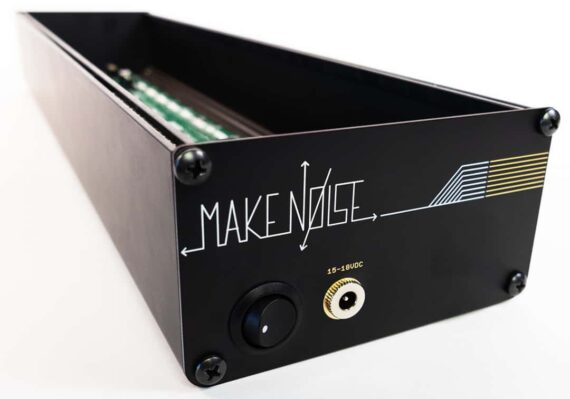
The 2-Zone Skiff is an updated take on original Make Noise Skiff, introduced in 2009.

The Skiff has been updated to meet more demanding power standards, with a 2-Zone Bus Board providing nearly double the power of its predecessor, plus the multi-zone design making it easy to isolate noise-susceptible or noise-causing modules from each other.

The low-profile power headers are shrouded for easy and efficient module installation.

As before, the Skiff’s powder-coated aluminum construction is extremely durable.

Features:

  • Black Powder Coated Aluminum
  • 2-Zone Bus Board provides ample power and module isolation
  • 16 Shrouded Power Headers
  • 40 Sliding Square Nuts, 40 Black M2.5 Screws
  • Side Mounted On/Off Switch
  • 5V Power included
  • Select Bus and Eurorack Bus Compatible
  • Universal AC Power Adapter works worldwide
  • Pricing: MSRP: $349

Visit the Make Noise site for details on the New Universal Skiff System and all their modules.


Noise Engineering Releases Multi Repetitor Algorithmic Percussion Sequencer


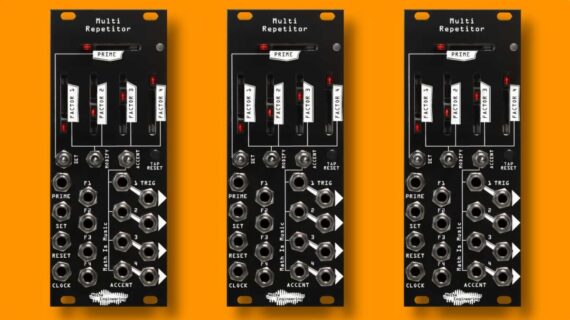
Noise Engineering has released Multi Repetitor, an algorithmic trigger sequencer for Euroack systems.

They describe it as “a sequel to their classic Numeric and Zularic Repetitor trigger generators.”

Multi Repetitor has been completely rethought from the originals, and takes the core features of the version one designs into a whole new realm. Rhythm generation starts with the three rhythm banks: choose from Zularic, Numeric, or the newly developed Euclidean-derived linear rhythms, then use the Prime fader to scroll through base rhythms on the fly.

Like its predecessors, it features four trigger outputs, now with dedicated performance faders that modify the rhythm output.

The newly rethought – and reversible – interface based adds extra parameters for more control of all four outputs.

While it keeps the clock and reset inputs, Multi Repetitor also features an internal tap-tempo clock for standalone sequencing. Finally, this version adds four accent gate outputs to the interface. The impetus for these changes, according to the team, was to make the module fit better into compact percussion systems while still being a fun generative sequencer for larger systems.

While it’s possible to get deep into rhythmic modification with the extensive patterns, modification algorithms, and accent options, Multi Repetitor is designed to be a plug-and-play rhythm sequencer. Noise Engineering said that one of their goals was to make it easy to tweak parameters by ear and jam with no preparation required.

Features:

  • Standalone play: tap in a tempo, patch up the outputs, and you’ve got a groove
  • Sequence triggers and accents for up to four voices in your systems
  • Choose from Zularic, Numeric, or Euclidean-derived base rhythm banks
  • Select different base rhythms from the banks using the Prime fader
  • Use three different algorithms to modify each output’s rhythm with the performance faders
  • Modulate your rhythms with full CV control over faders and banks, and keep things in sync with external clock and reset inputs
  • Plug-and-play operation: simple interface designed for performance is easy to use out of the box

The Multi Repetitor is available now, priced at $320 USD.


Exploring Touché, Don Buchla’s Rare Polyphonic Keyboard Instrument


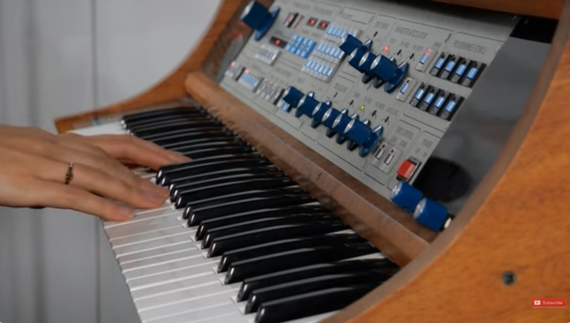
Electronic musician Sarah Belle Reid shared a new video, exploring an extremely rare electronic instrument called the Touché, created by Buchla and Associates in 1980.

Filmed at the Buchla Archives in Vancouver – an organization dedicated to the preservation of Donald Buchla’s work – the video offers a rare opportunity to hear and see an instrument that very few people have ever encountered firsthand.

Reid’s video begins with an overview of how the Touché grew out of Buchla’s earlier computer-controlled instruments of the 1970s, including the 300 Series systems. From there, the video offers a detailed walkthrough of Touché’s sound architecture, including many musical demos.

In the following video, below, Reid shares a short live performance with the Touché.

About The Buchla Touché

Only around five Touché are known to have been built, and very few remain functional today. Because of this, the instrument has remained largely absent from both public performance and documentation. Reid’s video helps bridge that gap by sharing the Touché’s sound, design, and historical context with a wider audience.

While Don Buchla is best known for his modular synthesizers such as the 100 and 200 Series, he also created a number of non-modular, computer-based instruments like the Touché that explored new relationships between performance, software, and sound.

The Touché was conceived by Don Buchla in collaboration with composer David Rosenboom. It is a bi-timbral, eight-voice polyphonic keyboard instrument that combines digital sound generation, analog processing, and computer-mediated control.