UDO Audio DMNO Multitimbral Polyphonic Synthesizer Offers “A New Approach To Analog”
British synth manufacturer UDO Audio has announced the release of a new synthesizer: DMNO.
Joining the Super 6, Super 8 and Super Gemini in UDO’s product line-up, DMNO is a polyphonic, multitimbral and hybrid analogue/digital instrument made up of two fully independent four-voice synths, each with its own dedicated set of front-panel controls. The front panel controls offer direct access to key synthesis parameters.
DMNO merges UDO’s hybrid sound with a cutting-edge, playful, and performative control architecture. It features eight-voice polyphony, dual hybrid binaural synth-engines, and an entirely new per-voice Dynamic Multi-Core Stereo Filter system. The new design offers an expanded palette – from extreme, overdriven textures to rich, organic analog warmth.
The designers say that the UDO Audio DMNO offers “a new approach to analog”.
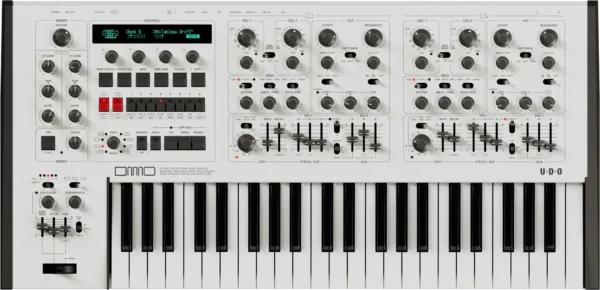
DMNO features a selection of eight Play Modes that determine how the two synth engines interact and how the 44-note keyboard interacts with them. These range from traditional options that allow patches to be layered or split across the keys to creative configurations such as Series mode, which goes semi-modular by unexpected routings one synth’s output into the other’s oscillator, and Chaos mode, which assigns notes randomly to either synth:
- Single – Play only one DMNO.
- Dual – Play both DMNOs simultaneously.
- Split – Split keyboard into DMNOs 1 & 2.
- One-Two – First key press is DMNO 1, following are DMNO 2.
- Cycle – Alternate between DMNO 1 & 2.
- Random – Random DMNO 1 / 2.
- Chaos – Random DMNO and curated note randomisation.
- Series – DMNO 1 audio output is used as a complex oscillator and routed into the DMNO2 oscillator mixer.
The two fully-featured independent synthesizers (DMNO 1 & 2) take centre stage, each complete with its own dedicated set of front panel controls. Both DMNOs (timbres) are driven by two ultra high sample rate, high resolution FPGA-powered digital oscillators, each routed through a versatile stereo analog filter.
The DMNO features a unique screen – a high-contrast electroluminescent glass vacuum fluorescent display (VFD). The display gives you immediate control and feedback for patch and performance management, instrument voicing, filter exploration, effects controls, and a sequencer.
Available waveshapes cover sine, saw, square, triangle and pulse, along with 3 user-assignable complex waveforms. Each synth engine offers two tempo-syncable LFOs with 10 waveshapes (including 2 user-assignable shapes) that can be assigned to multiple destinations via the synth’s modulation matrix. There’s also cross-modulation and PWM onboard.
The UDO Audio DMNO offers USB audio interface functionality, enabling a direct 2-in 2-out connection to your computer or DAW. The audio I/O options include an external audio input with variable-gain preamplifier, gate generator and envelope-follower integrated into the mod matrix.
As mentioned, DMNO is eight-voice polyphonic, dropping to four “super voices” when the synth’s Binaural Mode is engaged, which gives each stereo channel its own voice with independent tuning and modulation. Each of DMNO’s voices runs through a newly-designed Dynamic Multi-Core Stereo VCF with LP, HP, BP, all-pass and phase shifter modes, overdrive, keyboard tracking and multiple routing options. DMNO features a 32-bit DSP digital effects engine that covers delay, reverb, EQ, overdrive, distortion and chorus.

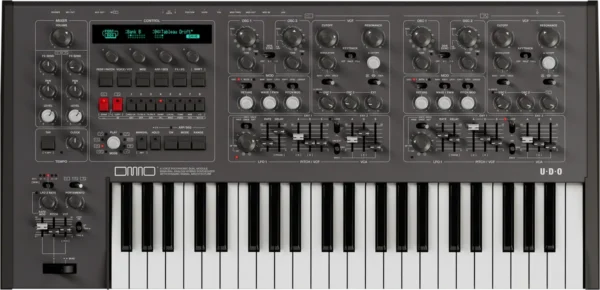
DMNO is equipped with a 44-key Fatar keybed with channel aftertouch and a two-axis bender, and can be programmed via its 64-step sequencer and multi-mode arpeggiator. The synth also boasts a high-contrast electroluminescent vacuum fluorescent display – a first for UDO, who opted to go screenless on their previous synths. DMNO is available in black and white editions, the latter giving off some unmistakable Oberheim Two Voice vibes.
“All DMNO’s features come together to form an instrument more than the sum of its parts – one that fully embodies, and elevates, the UDO ethos: ‘The Power of Play’,” reads UDO’s press release. “Where the Super Series synths knock politely and enter with elegance, DMNO kicks the door down. It is unapologetically bold, deeply expressive, and (most importantly) immensely fun. Lose yourself in the world of DMNO, with it’s no-compromise build quality and components, creative connectivity options, and an unparalleled hybrid architecture capable of delivering subtle warmth alongside extreme tones that always remain musical.”
Features:
- 8 voice polyphonic, with 4 ‘super’ voices when in Binaural mode. Binaural mode gives each channel (ear) a full synthesizer voice with independent detuning and modulation, creating an expansive, rich and texturally wide sound.
- 2-Part Multitimbral, comprising 2 independent hybrid synthesizers, each with its own dedicated set of front-panel controls.
- 8 selectable ‘Play Modes’ that immediately reconfigure DMNO’s signal flow, redefining how its two independent synth engines interact with one another.
- Dynamic multi-core stereo analog VCF with parallel, series and stereo connection modes — featuring multiple filter modes for each connection type.
- Hybrid architecture: FPGA-based high-resolution digital oscillators paired with an analog signal path and a high-quality DSP effects engine.
- 44-key FATAR keybed with aftertouch.
- 2-in 2-out 24-bit USB digital audio interface.
- Stereo external audio input with a variable-gain preamplifier, gate level detector, and envelope-follower input to the modulation matrix.
- Stereo auxiliary output that can be assigned to either DMNO 1/2, USB digital audio from the connected host, or the effects send bus.
- Two individual user-assignable CV & gate/clock outputs via 1/8”/3.5mm sockets.
- High quality long-lasting electroluminescent glass vacuum fluorescent display (VFD) with dedicated rotary controls. Designed for immediacy with no deep menus and limited ‘hidden’ controls.
- 32-bit DSP digital effects chain including delay, reverb, EQ, overdrive
- distortion and chorus.
- Onboard 64-step sequencer with intuitive control via onboard display.
Here’s a video overview from Bistronica 25, via Sonic State.
The UDO Audio DMNO is expected to be available later this year, priced at £2,499/€2,969/$3,500.


