Groove Synthesis Intros 3rd Wave Desktop Wavetable Synth Module, Adds MPE Support
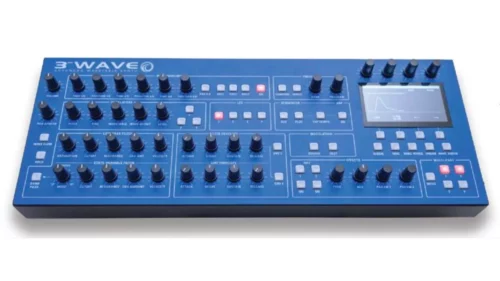
Groove Synthesis 3rd Wave synth module does away with the keyboard and is ready for your desktop. The Advanced Wavetable synth, a more compact version of the PPG-inspired instrument is just around the corner.
Drawing on the heritage of the classic PPG range, the 3rd Wave synth has something for nostalgia fans and more forward-thinking producers alike. And following the launch of the keyboard version, manufacturer Groove Synthesis has now taken the obvious next step and released a desktop model.
The company says that the 3rd Wave Desktop Module offers “all the power, all the features, all the ins & outs, and all the awesome sound of the keyboard”.
You probably know what’s coming next: 3rd Wave desktop offers all the power of the fully-fledged model, but in a smaller form factor and at a lower price. So, you’re getting a 3-oscillator, 24-voice, 4-part multitimbral wavetable synth that sits on your desk rather than your keyboard stand.
Each oscillator can host a PPG-era wavetable, a high-res “complex” wavetable or an analogue-modelled waveform. You can also create up to 64 of your own wavetables in the Wavemaker, sampling live into the keyboard if you wish.
Sound-shaping options include two analogue filters and a modulation matrix, and onboard composing can be done using the built-in pattern sequencer. You can use up to two effects per part, and there are four LFOs and six envelopes.
In addition, they’ve added MPE support to the 3rd Wave.
Features:
- 3 High-resolution Digital Oscillators Per Voice
- 64 total user wavetable positions with 48 wavetables that contain 64 waveforms per table (32 legacy PPG waves with room for another 16 of this type)
- 32 original 8 bit wavetables from the PPG 2 series instruments with room for 16 more user created 8 bit wavetables
- 7 high-resolution modeled analog waveforms (sine, saw, triangle, supersaw, pulse, white noise, pink noise)
- VCO sync
- Linear FM
- 6-stage wave envelope per oscillator with variable time and position that can be looped
- Optional wave flow section that allows for no wavetable as well as no waveform interpolation
- Upper wavetable mode as with the original PPG 2 series
- Unison mode and chord mode with variable voice count
- 1 Analog Low-pass Filter
- 1 State-Variable Filter
- 4 ADSR+ Delay Envelopes
- 4 Low-Frequency Oscillators
- 2 Digital Effects, including BBD, stereo delay, tape delay, chorus, phaser, flanger, distortion pedal, rotating speaker, ring mod, room reverb, hall reverb, super plate reverb – most modeled on famous hardware devices
- Syncable to master clock BPM
- Parameters modulatable via mod matrix
- Sequencer and Arpeggiator
- 16-slot Modulation Matrix Per Multi-Part
- 500 factory programs. User rewritable
- Connectivity:
- 4 Stereo outputs
- Headphone out
- MIDI In, MIDI Out, and MIDI Thru
- USB port for bidirectional MIDI communication
- Audio Input for creating user wavetables from external audio source
- Audio Input can also route audio through the filters, output chain, and effects
- Sustain/footswitch input
- Volume pedal input
- Expression pedal input
Groove Synthesis shared 3rd. Wave Advanced Wavetable Desktop Synth audio demo:
The 3rd Wave desktop synth module will be available in November priced at $3,495. Find out more on the Groove Synthesis website.