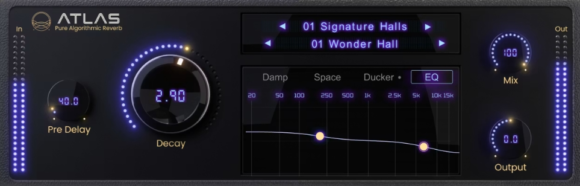
Waves Audio has introduced Atlas Reverb, a new algorithmic reverb effect for Mac and Windows.
The plugin provides controls for shaping the behavior and placement of the reverb within a mix, including parameters for adjusting depth, dimension, and movement.
Features:
Algorithmic reverb engine based on classic DSP processing
Controls for adjusting depth, dimension, and movement
Designed for use within full mixes and individual tracks
Preset-based workflow
Available through the Waves plugin ecosystem
Supports Waves Central installation and management system
Available as a plugin for macOS and Windows systems
Supports Audio Units, VST, VST3, and AAX plugin formats
Compatible with major DAW applications supporting supported plugin formats
Waves Atlas Reverb is available now for $99.99 USD (normally $149)
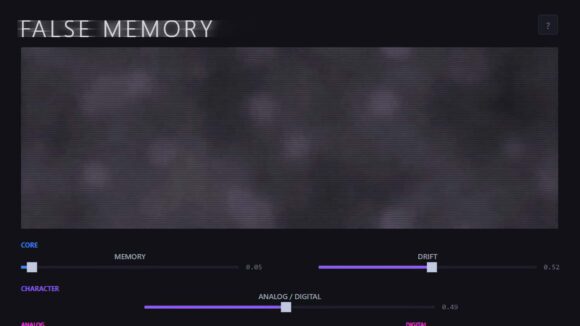
All The Machines has introduced False Memory, a real-time audio disintegration effect.
False Memory is an effects plugin designed to progressively degrade incoming audio, using two parallel processing paths:
The Analog path focuses on tape-style pitch instability, reel-to-reel saturation, and VHS-inspired tracking behavior.
The Digital path applies aliasing, circuit-bent artifacts, and block-based data corruption.
A single Analog/Digital control blends the two engines, with additional controls for pitch drift, degradation intensity, spectral smearing, residual echoes, evolving processing, and parameter randomization.
The plugin is available for macOS, Windows, and iOS as a standalone application and in native plugin formats.
Features
Parallel Analog and Digital processing paths
Analog processing includes tape wobble, reel-to-reel saturation, and VHS tracking artifacts
Digital processing includes lo-fi aliasing, circuit-bent glitches, and data-mosh style block artifacts
Analog/Digital control blends the two processing engines
Drift control adjusts pitch and timing instability
Damage control sets the overall degradation intensity
Fog processor smears the frequency spectrum with Tonal, Inharmonic, and Evolving modes
Ghosts processor introduces echoes, imprints, and granular remnants from previous audio
Evolve function automatically increases the amount of degradation over a user-defined period from one to sixty-four minutes
Randomize function generates new parameter combinations
False Memory is available now for $3.99 on iOS and €19 for the desktop version.
reFX, the developer behind the Nexus virtual instrument, has announced the release of a new hybrid software synth that brings together physical modelling and subtractive synthesis with a broad array of additional features and capabilities.
Rippler is a software synthesizer built around a combination of modal synthesis and subtractive synthesis techniques.
Physical modelling synthesis is a technique that can emulate the acoustic properties of physical objects and instruments, or be pushed to create experimental sounds that reimagine real-world timbres in new and creative ways.
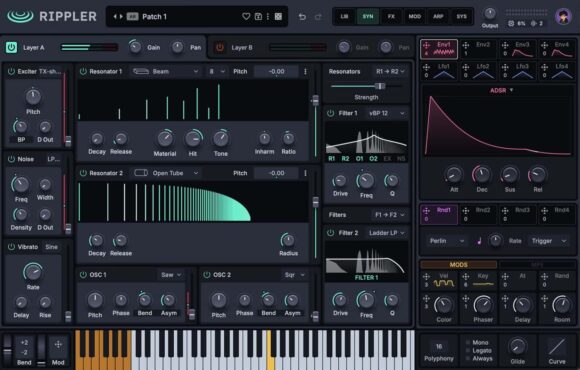
The instrument uses banks of resonators to generate sounds without samples, with bi-directional energy coupling between resonators and two independent synthesis layers. Each layer can use parallel or serial resonator routing, with additional oscillators, filters, modulation sources, and effects processing.
In its Exciter section, Rippler gives you the choice of 32 onboard samples, user-imported samples, sidechain input or a custom impulse editor to shape its initial signal, and there’s also the option to use a noise generator to feed the resonators, alongside the exciter or on its own.
These run into dual resonator modules, which feature a choice of 12 models that simulate different acoustic instruments and objects: String, Beam, Squared, Bell, Membrane, Plate, Drumhead, Djembe, Vibraphone, Marimba, Closed Tube, Open Tube. These can operate in parallel or in series, the latter mode using bi-directional coupling to let the two resonators exchange energy as they would in an acoustic instrument.
There’s also a Manual resonator mode that replaces the physical model with a custom partial series that can be drawn in by hand, and lets you store resonator configurations as snapshots and morph between them in real time.
Rippler is also equipped with two conventional oscillators with Phase, Fold and Asymmetry controls that can be layered with its physically modelled output to “blend, enhance or solidify your sound”. Both these and the physical modelling engine pass through dual filters, which offer a choice of 27 filter types spanning low-, high-, band-pass and notch filters with multiple slopes, along with vintage-style models, ladder types and a formant-shifting Vowel filter.
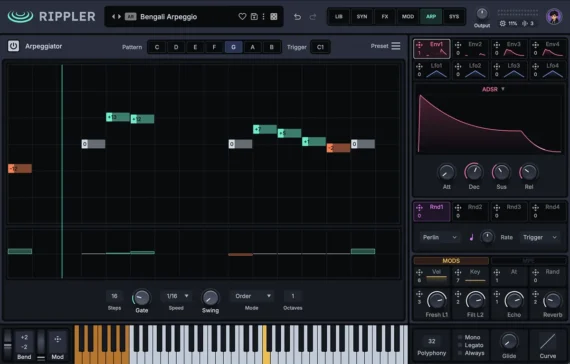
This entire signal path can be duplicated, giving you two layers each made up of dual resonators, oscillators and filters, all running into the effects and master output. Rippler features a broad selection of 13 effects covering delay, reverb, chorus, compressor, distortion and more, which can be applied per-layer or globally. There’s also a sophisticated arpeggiator and sequencer onboard with modifier lanes that introduce variation to pitch and velocity.
Rippler supports MPE, aftertouch, micro-tuning, MIDI tuning systems, and audio input routed into the resonator system.
Features:
Modal synthesis engine using banks of resonators to generate sounds without samples
Bi-directional energy coupling between resonators
Dual-layer synthesis architecture with parallel and serial resonator routing
Two oscillators and two filters per synthesis layer
Twelve acoustic models based on mathematical formulas and FEM analysis
Models include String, Drumhead, Beam, Djembe, Squared, Vibraphone, Bell, Marimba, Membrane, Open Tube, Plate, and Closed Tube
Multiple modulation sources can be assigned to parameters
Drag-and-drop modulation routing system
Custom modulation response curves using Mod Mapping
Modular effects architecture with 13 master effects and 12 effects per layer
MPE support with per-note pitch bend, pressure, and slide control
Aftertouch support
Micro-tuning support using Scala .scl and .kbm files
MIDI Tuning Standard (MTS) support
Audio input routing into resonators synchronized with played notes
Manual Mode for user-defined tuning and resonator configurations
441 sound presets
32 exciter samples
10 arpeggiator presets
64 LFO shapes
Available as Audio Unit, VST3, and AAX plugin formats
Compatible with macOS and Windows systems
Rippler is descended from RipplerX, a free and open-source physical modelling synth from developer Tiagolr, who has partnered with reFX to develop and release a commercial successor.
reFX Rippler is available now for $99 USD (normally $129).