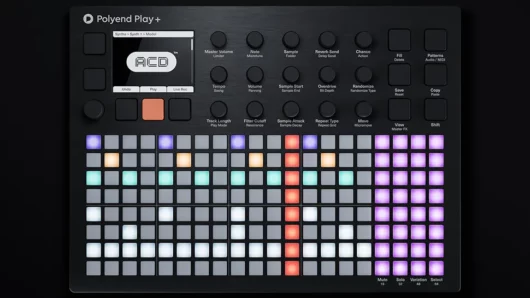
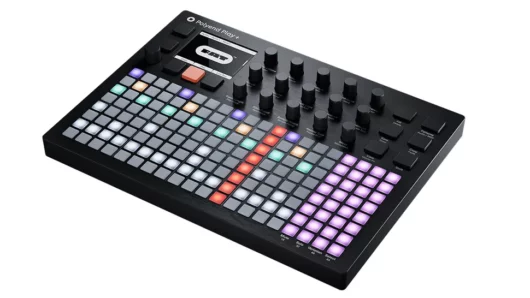
Polyend Play+ introduces four synth engines, turning the sample and MIDI machine into a fully-fledged groovebox. Now you can furnish your beats with analogue-style and FM sounds, and there’s also multitrack USB audio streaming.
In 2022 Polyend announced the original Play, a fascinating sample-based groovebox and MIDI sequencer that was pretty much universally beloved by anyone who could get their hands on one.
The new Play+ model goes a significant step further by adding four built-in synth engines, giving you far more creative options.
The synths are powered by an upgraded processor, which has also enabled Polyend to add stereo sample playback and multitrack audio streaming over USB.
The list of synth engines kicks off with ACD, an emulation of a single-oscillator monophonic analogue instrument. FAT promises to deliver the “powerhouse” vintage warmth of classic analogue synths, while VAP is a virtual anlogue instrument with a dual-oscillator design and modulation matrix.
Finally, there’s the cheekily named WTFM, a 2-operator FM synth with wavetable-based oscillators and a 3x feedback system. That said, we’re told to expect more synth engines in future updates.
Polyend reckons that the switch from mono to stereo samples will take you on a “more nuanced and expansive sonic journey”, which makes sense, and Play+ comes with new stereo sample packs. These are in addition to the already expansive library of more than 5,000 samples.
The new multitrack USB audio support, means that up to 14 stereo audio tracks can be sent to your DAW separately, ready for processing in any way you like. This also gives you the opportunity to process individual tracks with external effects during a live set.
Despite these enhancements, Play+ is said to stay true to the spirit of its predecessor’s workflow, enabling you to sequence tracks on a 8×16 step grid. Parameters can be sequenced on a per-step basis, and there are multiple effects, play modes and randomisation options. There’s a new piano roll for building melodies, and scale filtering can force Play+ to input and output only notes that fit the selected scale.
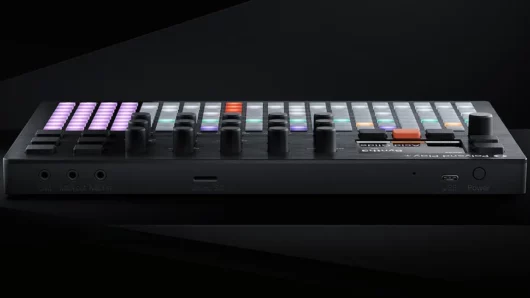
Connectivity options include MIDI I/O, stereo line/headphone out and USB-C. A 16GB MicroSD card comes in the box.
Play+ can be ordered now from the Polyend website for $799/€799. Upgrades from Play cost $399/€399.
Today, after awaited years, Behringer finally shared an official intro video for the UB-Xa, its flagship knockoff of the classic Oberheim OB-Xa.
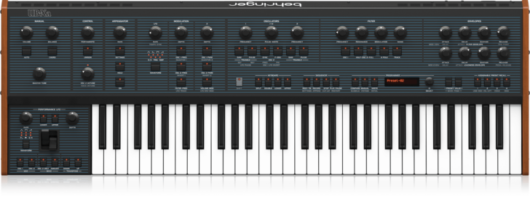
The Behringer UB-Xa is a 16-voice, bi-timbral analog polysynth, featuring a 61-note keyboard with velocity and polyphonic aftertouch.
The long-awaited uber-synth may make some heads explode, because of the fact that it’s designed and marketed as an inexpensive copy of the OB-Xa, but also priced and positioned as Behringer’s first flagship synthesizer.
Behringer’s 1st. Flagship Synthesizer
The UB-Xa is priced and positioned to compete with professional analog synths from Korg, Dave Smith, Oberheim and others.
It’s a 61-note keyboard, a big, knobby front panel and 16-voices of retro-inspired analog polyphony. Other features typical of flagship synths include support for splits and layering, an arpeggiator, a step sequencer, three full-size MIDI connections and five pedal inputs.
And the audio demos show that the UB-Xa is capable of being a great-sounding synth.
The icing on the cake is polyphonic aftertouch, putting the UB-Xa into the company of the limited number of synths that have ever been made that support poly aftertouch.
It’s also a $1,499 Knockoff
Unlike the other flagship synths on the market, though, the Behringer UB-Xa is also clearly a knockoff design:
The UB-Xa copies the Oberheim OB-Xa’s name, swapping one letter;
The UB-Xa copies the look of the OB-Xa, from the typefaces, to the logo, to the color scheme;
The UB-Xa copies the synth engine of the OB-Xa, even including recreations of the OB-Xa’s original patches; and
The UB-Xa is explicitly marketed as an inexpensive copy of the OB-Xa, described as an ‘amazing value’ for an ‘incomparable classic recreation’.
The UB-Xa also compete’s against Tom Oberheim’s own vision for modern Oberheim synths. His Oberheim OB-6 is an updated take on Oberheim’s SEM synth voice, with modern performance features and dual effects engines. And his OB-X8 is designed to be an evolution of his classic polysynths, building on the OB-X, OB-SX, OB-Xa, and OB-8.
Competing goals resulted in some Unusual Design Choices
The competing goals of creating a flagship synth and creating a knockoff of a vintage design mean that there are some unusual design choices in the UB-Xa.
On the positive side, increasing the polyphony to 16 voices and adding a keyboard with polyphonic aftertouch gives the UB-Xa synthesis options and expressive capabilities that the original didn’t have. As a result, the Behringer UB-Xa looks like it will be one of the most capable analog polysynths ever created.
On the other hand, the UB-Xa does not have many of the features that you’d expect to find in a modern flagship synth.
The Korg Prologue 16, for example, is similarly priced, but has 50% more oscillators, a more flexible hybrid synth engine, analog distortion and compression, dual multi-effects engines and more. The Yamaha MODX6+ is priced the same as the UB-Xa, but offers 16 times as much polyphony, deep performance options, a powerful effects engine, a vocoder, the ability to process external inputs and more.
Behringer’s own Deepmind 12 costs about half as much, but offers a more flexible synth architecture, four effects engines, and modern features like tablet control and WiFi support.
Behringer’s design choices mean that the UB-Xa has the limitations of ‘flagship reissue’ synths like the Sequential Prophet 5 rev 4 and Oberheim’s own OB-X8x, but without the reputation.
Buyers of those instruments are willing to pay a lot for a keyboard with relatively limited synth engines, because the synths deliver classic analog sound, they were developed by the original designers, they’re made by companies with established reputations for making high end gear and they give people the chance to own a synth that they may have been dreaming about for decades.
But, Behringer can’t do some of these things, so they’re limited to competing as the budget take on the ‘flagship reissue’ idea.
What do you think of the Behringer UB-Xa?
The Behringer UB-Xa looks like it will be another hit for Behringer, because it takes their successful business strategy into new market territory.
Behringer has described their business strategy as being a ‘Market Follower’, with this definition:
“The market follower effectively rides on the market leader’s coattails, while positioning its brand just far enough away from the market leader to be different.”
With the UB-Xa, Behringer is doing exactly that. They’re riding on the coattails of Tom Oberheim, copying his work to the extent that is legally possible. (The US Patent and Trademark office wouldn’t let Behringer register an Oberheim trademark in the US). This strategy will continue to rub a lot of people the wrong way.
But Behringer’s also making a nice-sounding synth. And they’re glomming on interesting features – especially the polyphonic aftertouch – that will make this ‘flagship knockoff’ interesting to a lot of buyers. So, with the UB-Xa, Behringer is being divisive as ever, but their fans will probably love it.
What do you think of the new Behringer UB-Xa? Leave a comment and share your thoughts!
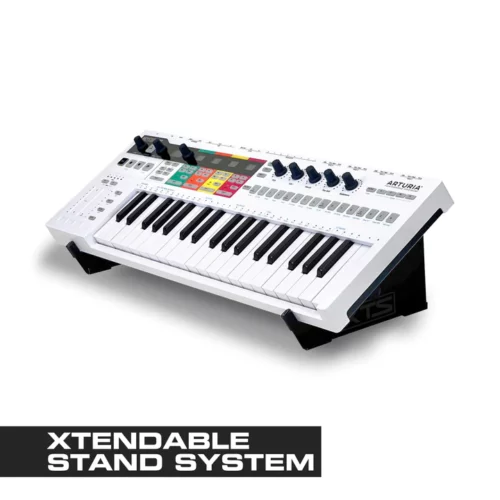
Audio accessories maker Analog Cases has announced the availability of its XTS Stands in two sizes.
XTS Stands are extendable, designed to be resized to accommodate a wide range of music production gear, ranging from smaller-sized effect pedals all the way up to larger Eurorack modular synth system cases.
They’re made with 100% solid sheet metal construction, so that up to 25 lbs/11.3 kg can be supported. Two XTS Stands sizes are available, to meet specific studio requirements. The small-sized XTS Stands are adjustable to any length between 6.6” and 10.4”, while large-sized XTS Stands are adjustable to any length between 10.5” and 18.25″.
In the case of large-sized XTS Stands, multiple pieces of gear can be held side by side by adding a separately-sold XTS Flex Tray, also available in two sizes — 13.3”/33.8 cm (capable of holding two or three small pedals or synths) and 17.7”/44.9 cm (comfortably accommodating a Digitakt alongside Elektron’s Digitone digital synthesizer, two SP-404 MKIIs, two medium-sized pedals such as Strymon’s BigSky multi-algorithm reverb or TimeLine multi-algorithm delay and looper, or up to five smaller-sized pedals).
Small- and large-sized XTS Stands are available now, priced respectively for $42.00 and $49.00, while the 13.3”/33.8 cm Flex Tray and 17.7”/44.9 cm Flex Tray (for large-sized XTS Stands) respectively retail for $29.00 and $34.00.