EP-133 K.O. II By Teenage Engineering – A Retro-Sexy, Affordable Sampler
Teenage Engineering new $299 EP-133 KO II sampler, sequencer and composer looks like a genuine knockout.
Teenage Engineering might be best-known for its more expensive audio gears.
Teenage Engineering today introduced the EP–133 K.O. II, a powerful sampler, sequencer and composer that, priced at $299, is surprisingly affordable.
Now we’re witnessing what Teenage Engineering is calling the “evolution” of the Pocket Operator with the release of EP-133 KO II, a redesigned and enhanced successor to the popular PO-33 KO1 sampler.
The EP–133 K.O. II enables you record sounds around you, sequence your samples and loops, tweak and automate filter, pitch and more, add stereo effects, compressor and punch-in effects, all on a chonky device with retro-sexy vintage calculator vibes.
This does away with the barebones design of the Pocket Operators to offer something far more refined: the EP-33 KO II looks like a fully-finished piece of audio gear rather than something that’s awaiting the fitting of a case. There’s a reworked sequencer, new punch-in 2.0 effects and a supposedly faster workflow.
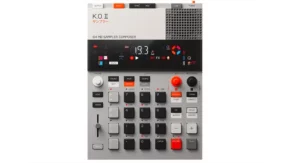
The EP-33 KO II also offers a built-in mic for instant sampling, and a built-in speaker so that you can use it completely standalone. There are 999 sample slots (the sample rate is 36kHz/16-bit), 64MB memory, a multi-functional fader and a selection of drum, bass and keys samples to get you started.
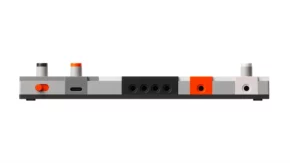
Those samples can be chopped and looped, and there’s a chromatic keys mode that will enable you to get the most out of the pressure- and velocity-sensitive keys. You can work with six stereo or 12 mono voices, and connectivity includes stereo audio I/O, sync I/O, TRS-A MIDI I/O and USB-C. This last port can be used in MIDI device mode and to provide power, which can also come from four AAA batteries if you’d prefer.
Teenage Engineering EP-133 KO II Features:
- 9 projects each with 80,000 notes
- Projects contain 4 groups, each with 99 patterns
- Patterns have 12 TRACKS for samples and MIDI
- Variable pattern length per group (1 to 99 bars)
- 12 mono / 6 stereo voice polyphony
- Use groups to mix and match patterns on the fly
- Record and automate all 12 fader assignments
- Sequence in free time or quantized with swing
- Assign any pad to one of 16 MIDI channels
- Loop mode from OB-4 with length AND slide
- 12 pressure and velocity sensitive pads
- Instantaneous timE correction and erase
- Slice samples LIVE OR AUTOmatically
- Stereo / mono sampling at 46.875 kHz / 16-bit
- Punch-in 2.0™ effects (PRESSURE SENSITIVE)
- Arrange quickly using the instant commit feature
- 32-bit float signal chain, 24-bit ADC / DAC
- SYNC IO FOR EXT. GEAR. 8TH, 16TH NOTE OR SYNC24
- 6 built-in send fx and a master compressor
- Drag and drop samples using the sample tool
Here’s a video intro from Cuckoo:
This is the most excited about a new Teenage Engineering product. Not only it is totally musician-focused, it also comes at an affordable price of $299, and should ensure that the EP-33 K.O. II is on a lot of people’s Christmas list.
The EP–133 K.O. II is available now for $299 and ships in a 10-inch collector’s case. There are other accessories like a soft carry bag for $69, on Amazon site. Find out more on the Teenage Engineering website.
“As an Amazon Associate, I earn from qualifying purchases”