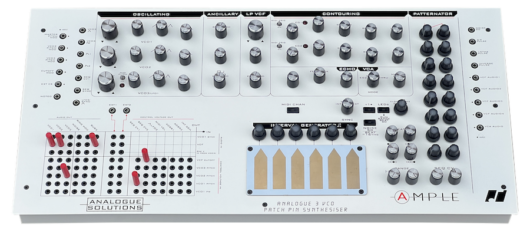
The Ample is a 3 VCO analog matrix patch pin synthesizer that pairs a traditional subtractive architecture with a big, knobby interface, a step sequencer and a touch key controller.
Manning shares his thoughts on the Ample, but also compares it to the other Analogue Solutions synths that he’s worked with.
“I would describe it as being quintessentially Analogue Solutions,” notes Manning. “It has that iconic, luxurious sound that has carried through every machine Tom has created, this time coming with a particularly beautiful LPF and an array of generous interface and performance controls.”
“While possibly not my favorite AS synth (that for me is the Impulse Command),” he adds, “this is certainly a synth worth your attention if you’re a fan of vintage tones bursting with vibrancy and soul.”
Watch the video and share your thoughts on the Ample in the comments!
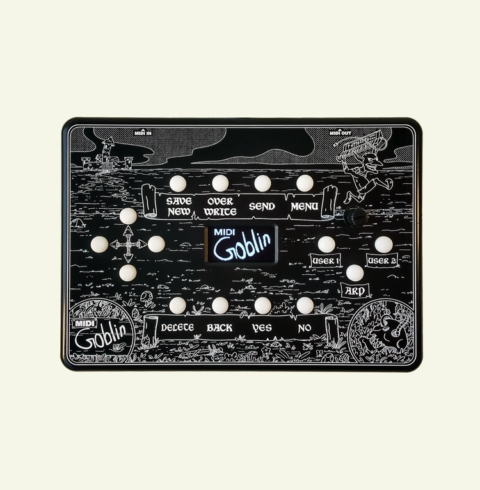
Developer Andrew Crawford shared these previews of MIDI Goblin, an open source patch saver, arpeggiator, auto-chord, arp-note, sequencer and MIDI LFO.
What Crawford say about it:
“The MIDI Goblin started off as a simple patch bank for 1 synthesizer…As time passed, more features were added and more are still being added.
MIDI Goblin will ship with a patch saver, arpeggiator, auto-chord, arp-note, sequencer and MIDI LFO app ready to use right out of the box. Users will be able to set MIDI in and out channels, and define functions for two push buttons through the MIDI goblin settings menu. User settings for each device are saved to the removable micro SD card and load automatically when their device is selected.
…it’ll also be completely open source!”
Features:
User defined devices – User’s data determines what devices are supported by their MIDI Goblin.
Patch saving – You can save and load patches to micro SD using your MIDI Goblin. The OLED screen and the ability to name patches makes the process simple. Only devices that use MIDI CC (control change) data for saving and loading patches will be compatible with MIDI Goblin’s patch storage feature.
Arpeggiator – MIDI Goblin reads MIDI Note messages arpeggiates them. Users can arpeggiate up to 8 notes, adjust speed and change modes on the fly.
Sequencer – You can create sequences on the fly of up to 32 steps. You can and, edit or remove notes, change the recording / playback mode, adjust the sequence tempo, length and save your sequence (plus playback speed) to Micro SD.
Auto-Chord – With the press of a key, you can create chords in major or minor key up to 8 notes in length.
Arp-Note – Arp-Note is a combination of the arpeggiator and auto-chord features. Press a note, hear an arpeggio. Users can define the length of the arpeggio (up to 8 notes) in major or minor keys ,and choose the direction of the arpeggio.
MIDI LFO – Using the MIDI LFO function you can automatically modulate any MIDI CC number. You can modulate the CC value based on basic waveform shapes to craft new sounds for your synth.
Andrew Crawford plans to produce MIDI Goblin via a Kickstarter project. See the project website for details.