Andrew Huang x Baby Audio Transit V2 Is More Versatile Than Ever
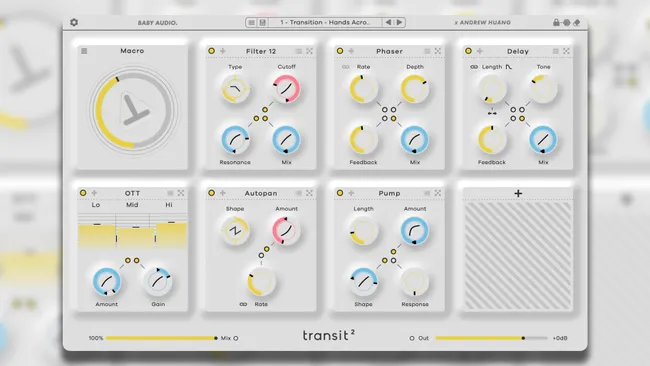

Are you spending too much of your precious time automating transitions in your tracks?

Baby Audio’s Transit 2 reinvents the best-selling transition and motion effects tool.

Baby Audio’s latest release, the sequel to the hugely popular Transit plugin, is here to reimagine your workflow and breathe life into your mixes.

Designed in close collaboration with musician, producer and YouTube creator Andrew Huang, this phenomenal plugin is much more than just an update; Transit 2 is a powerful creative tool that’s set to redefine how you add transitions, movement and dynamic effects to your music.

Like its predecessor, Transit 2 is a multi-effects workstation designed for creating breathtaking transitions without wasting time on painstaking automation. Whether you’re creating dramatic risers, soaring filter sweeps or just adding a subtle touch of motion to your mix, Transit 2 offers a convenient all-in-one solution that has to be heard to be believed. Giving you complete control over a wealth of parameters and effects, Transit 2 enables you to design transitions that are as simple or complex as you like.

The first edition of Transit swiftly became a must-have tool for producers streamlining their workflow and creating impactful transitions – but with Transit V2, Baby Audio has flipped the script, offering a host of new features that transform the plugin into a multi-effects and sound design powerhouse, along with a freshly redesigned user interface that makes the plugin a joy to use.

Transit 2’s expanded power lies in its new motion modes and effects modules, introducing four fresh motion modes that allow you to shape transitions in innovative ways: Follower, LFO, Gate and Sidechain. In Follower mode, transitions respond dynamically to the volume of an input signal, while Gate mode lets you trigger transitions with a single click – perfect for live performance. Transit 2’s LFO mode uses a configurable LFO to sweep parameters of your choice in time with the music, creating evolving, rhythmic effects, and Sidechain can be used to trigger or modulate transitions using other elements of your track.

The plugin has also been equipped with 10 new effects, including a vintage-inspired Retro Reverb, a Loop module for instant stutter effects, and a vibrant Analogue Chorus for dialling in width and presence. The new Speaker effect emulates an old-school radio for a unique lo-fi vibe, and Mod filter conjures up a mesmerising and psych-tinged swirling effect. These, along with Transit’s selection of classic effects, make the plugin a powerful tool for creative sound design.

Like the first edition of Transit, Andrew Huang has been directly involved in developing Transit V2, and his experiences using the plugin’s first version have shaped the workflow of the sequel, an intuitive, expertly-designed tool that turns tedious tasks into a source of limitless inspiration. Whether you’re designing an unforgettable drop or adding a sprinkle of motion to a lifeless track, Transit 2 will become an essential item in your production toolbox.

Don’t miss out on Baby Audio’s intro sale! Transit 2 is available now for $79 (regularly $129) for a limited time. If you already own the original Transit plugin, you can upgrade for just $29. Test out a free trial on the Baby Audio website and discover how Transit 2 can supercharge your music-making.
Free EB-Blasphemy Is A Break Slicer, Generative Multi-effects Sampler


Bristol-based plugin developer Ewan Bristow has been turning out some fantastic free plugins this year, including a melodic resonator (EB Resonator).

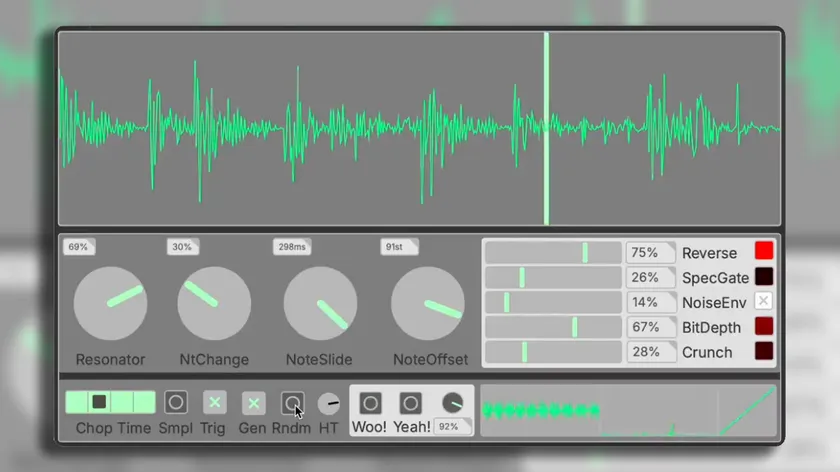
Bristow’s latest offering looks like his best yet. EB-Blasphemy is a generative, break-slicing sampler plugin with an array of sound-mangling effects built in, letting you transform drum breaks into glitchy, experimental patterns with a click of your mouse. Crank up the tempo, and it’s instant breakcore.

At the core of Blasphemy is its sample slicer, which, though Bristow describes it as an “Amen break chopper engine”, can be used to slice and dice anything from vocal lines to synth riffs to instrumental loops. Load up a sample, make sure the Gen box is checked and hit Trigger, then Blasphemy will begin replaying sample chops starting at random, tempo-synced points within the loop.

Your sample chops will first run through a resonator equipped with two probability-based parameters; the first controls the likelihood that the resonator will be applied, and the second controls the delay time. Two more dials introduce a slide between delay changes and an offset to the delay time’s randomized values.

Alongside the resonator, Bristow’s equipped the plugin with a selection of his favourite “distortive, spectral and experimental effects”, including a spectral gate, a bitcrusher and a reverser, along with an envelope follower that uses your sample’s signal to trigger a noise generator. Dial in a probability value using the sliders next to each to determine how likely it is that a given effect will be applied on each sample slice.

Any break-processing plugin wouldn’t be complete without a timestretcher, and Blasphemy doesn’t disappoint in this regard; crank up the HT dial at the bottom of the control panel and you’ll increase the possibility that each sample slice will be time-stretched. You’ll also find two buttons alongside that can be used to drop in “Woo!” and “Yeah!” samples lifted from the classic Think Break – a nice touch that the old-school jungle heads will surely appreciate.

EB-Blasphemy runs inside the free visual programming environment Plugdata, so you’ll have to install that to run it. Plugdata can be used as a standalone app or as a VST3/AU/CLAP/LV2 plugin.

Find out more and download EB-Blasphemy over at Bristow’s Gumroad page.

Secrets Behind Mort Garson’s ‘Plantasia’


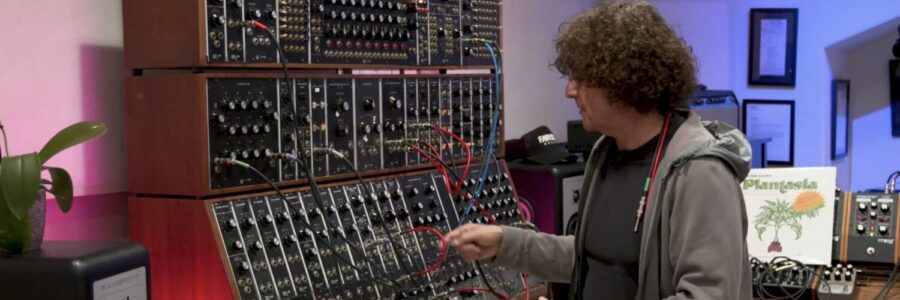
Composer and synthesist Anthony Marinelli – in his latest video – offers a unique look at recreating the sound of Mort Garson‘s Plantasia – one of the greatest ‘Moogsploitation’ albums of the ’70s.

Garson (1924 – 2008) was a multi-talented Julliard-trained musician who found success as arranger, songwriter, composer and electronic musician. Garson’s resume is beyond eclectic, ranging from 60’s lounge music (Our Day Will Come, The Love Strings Of Mort Garson) to early electronica (Electronic Hair Pieces, Signs Of The Zodiac, Mother Earth’s Plantasia) to sexploitation music (Z – Theme From Sensuous Lovers) and disco.

As ever, Marinelli brings a tremendous depth of knowledge, both of music and synthesis, to the video. He not only shows how to accurately recreate Garson’s classic Plantasia sound – but he does it with Garson’s own Moog modular.

Watch the video and share your thoughts in the comments. And, if you are not subscribed to Marinelli on Youtube, we recommend doing so, because he’s been releasing a steady stream of very thoughtful and informed videos on synthesis and the history of synths in pop music.

Video Summary:

“In this episode, I’ll break down the iconic whistle sound that plays the unforgettable melody of Mort Garson’s legendary synth album Plantasia. We’ll delves deep into how this unique sound was put together on the very same instrument Mort used: my rare 1969 Moog IIIC modular synthesizer.

After you watch this video, I’m confident you’ll be able to re-create this sound on any hardware or virtual synth.

Plantasia has become a cult favorite, widely regarded for its pioneering use of analog synths, and its recent re-release in 2019 on Sacred Bones introduced this masterpiece to a whole new generation.

Join me as I bring you the magic behind the expressive melody whistle sound on one of the best-selling albums in electronic music history!”