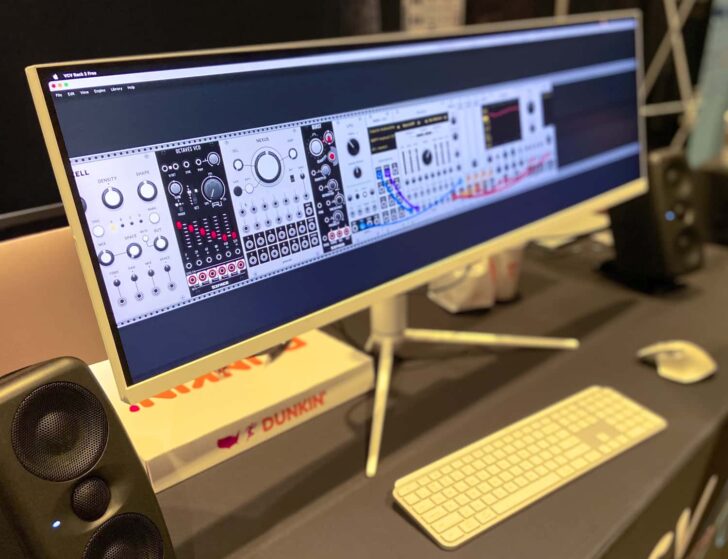
At Knobcon 2024, being held in the Chicago area Sept 6-8, developer Andrew Belt has announced VCV+, a new subscription option for VCV Rack users that gives you instant access to VCV Rack Pro and a massive library of premium modules.
VCV Rack is a free and open source modular synthesis platform that’s essentially a virtual Eurorack synth that can scale to any size. The base offering is a free download, and commercial modules are available to purchase from a wide variety of developers.
The new VCV+ option doesn’t replace existing purchase options, but it gives you an all-you-can-eat buffet of modular synthesis for $29/month or $19/month if billed annually. It lets also lets you try out a huge range of modules, risk-free, and creates a platform for simple patch sharing with other VCV+ subscribers.VCV+ includes:
VCV Rack Pro: DAW plugin and standalone application.
All VCV-branded modules: VCV Pluck, VCV Drums, VCV Pro, and more.
Official virtual Eurorack modules: Synthesis Technology, ALM Busy Circuits, and more.
Hundreds of premium third-party modules by participating developers.
VCV+ is available now for $29/month, or $19/month billed annually.
*Note: All products and modules remain available for individual sale of lifetime licenses. VCV also now offers a 7-day refund guarantee on purchases.
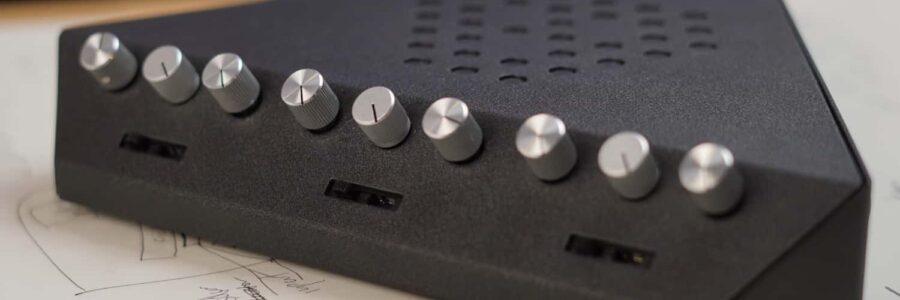
Eternal Research has launched a Kickstarter project to fund production of the Demon Box, an instrument that lets you explore the hidden world of electromagnetic frequencies.
What they have to say about it:
“With the Demon Box, you can use any object emitting electromagnetic waves to create unique sounds. By isolating these waves from ambient noise, you’ll experience the subtle dynamics of magnetic waves without the distraction of background sounds. And what you thought might be one sound could sound entirely different — for instance, listen to the sound the chainsaw made in our Kickstarter video.”
Production of the Demon Box is being funded via a Kickstarter project, and it is available to backers starting at $549. The project has already met its funding goal.
*Note: Crowdfunding projects can involve risk. Find out details on the project website.
If you are a fan of Goodhertz Tupe and Lossy, Goodherz’s latest creation is DC19, a delay plugin that does things a little differently to your average delay. Offering fine-grained, slider-based control over parameters that would conventionally be controlled with an on/off button. Goodhertz describe it as a “playable delay” that’s built “with hardware controllers and automation in mind”.
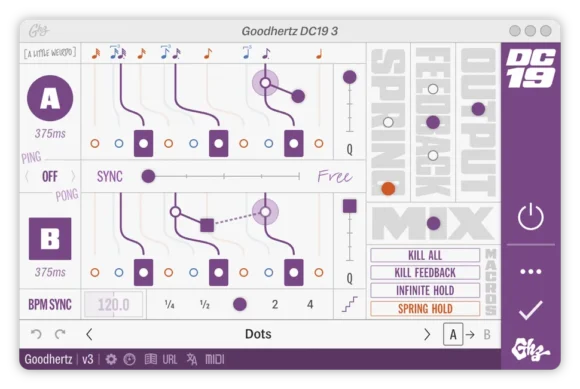
At the heart of DC19 are two delay lines, which can be configured in a number of different ways: the plugin can be used as a single delay, a dual delay, a ping-pong delay or a dual ping-pong delay, where both delay lines crossfeed their feedback together. Timing can be synced to your project tempo or entered manually in BPM or milliseconds; the chosen tempo can be multiplied via a continuous slider.
Delay times for each line can be tweaked via the central panel, with the dots beneath used to assign quantization. Sliders alongside control how much quantization is applied to the delay time, so you’re able to dial in anything from rigidly on-grid repeats to chaotically off-beat delays. A slider sitting between the two can be used to apply a degree of synchronization to both delay lines.
On the right-hand side you’ll find sliders for DC19’s spring reverb emulation, feedback, output gain and wet/dry mix. There is also handy macros for applying infinite holds to the feedback and reverb, and quickly killing the delays when things get out of hand.
Alongside the spring reverb, DC19 also features tape emulation, applying the warm and wobbly sound of magnetic tape to your delays. Tweaking the Tape Lofi control will morph between emulations of four different types of tape machine, from a Hifi 30 IPS reel-to-reel to a consumer cassette deck with degraded tape.
DC19’s tape emulation is accessible through an additional panel that also houses controls for the spring reverb, onboard filter, glide time, and panning; the plugin offers a binaural panning algorithm, which is rather cool.
Features:
Single (A) or Dual Delay (A+B) or anything in between (via the Sync/Free control)
Quantizable/selectable note sync
Together with the tempo multiplier, that means you can slide effortlessly from a 128th note to a whole note when synced to a BPM, and when unsynced
In milliseconds mode, you can slide all the way from 3 milliseconds to 8 seconds
Ping Pong Delay (A only) + Dual Ping Pong (A+B crossfeeding the feedback)
Controllable Glide time for all delays
Convenient macros for instant control of feedback and reverb
LOFI moves through several different tape machines seamlessly
Wobble invites a little chaos into your life, either in mono or stereo
Filter section for shaping delay tone
Brand new Spring Reverb section that can be applied to just the delay or the dry signal + the delay
Sophisticated spatial panning section for precise control of where each delay line lands in space
Zero latency
HQ Mode
The concept behind DC19 – having a greater degree of control over parameters that would typically be binary makes for more creative possibilities, and that is always a good thing. Pair this up with a hardware controller (or a decent LFO plugin) and there’s limitless fun to be had.
Goodhertz DC19 is available now and priced at $79. Find out more on Goodhertz website.