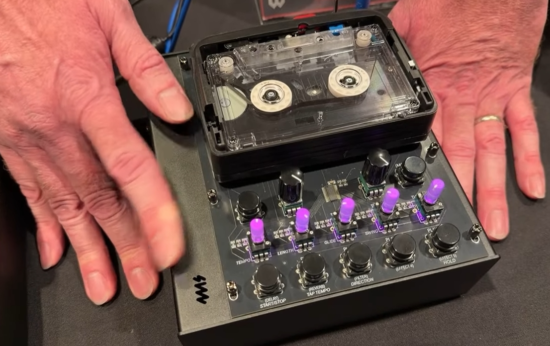
At Knobcon 2026, Mike from SISKworks was showing the Cassettone, described as a “poor man’s Mellotron”, and the Modified Tape Player Prototype, a motor-controlled cassette instrument.
Video Summary:
“Five buttons trigger playback, and each button has a knob that tunes motor speed for a different pitch. The newer prototype keeps that five-key approach and adds a Daisy microprocessor for delay, reverb, filter, harmonizer and reverse grain effects.
The control knobs adjust the last effect engaged, and the filter can self-oscillate slightly. The unit also includes a step sequencer with normal, reverse, bounce and random directions. Steps can be switched on or off, and tempo, length, glide and swing are adjustable. A hold mode latches the last key for drone use.
The prototype includes gate, CV and clock inputs, and it is planned for 1V/oct tuning. It can use tape loops or full-length cassettes, but it does not record to tape. Pricing is not set, and the final version is likely to be desktop rather than Eurorack.”
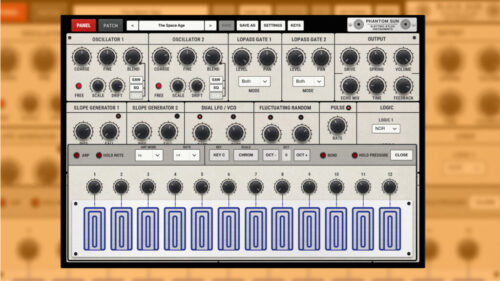
Phantom Sun is a semi-modular iPad synthesizer designed for generative patches, experimental sound design and expressive touch performance.
Phantom Sun combines oscillators, modulation sources, low-pass gates, sequencers and logic in a semi-modular environment. Instead of using virtual patch cables, its Patch page uses a Source-to-Destination system, with each destination able to receive up to four modulation sources.
The instrument is also designed for generative patches, with sequencers, random voltages, Sample & Hold and other modulation utilities that can create evolving, self-running sounds.
Features:
Semi-modular synthesizer for iPad
Source-to-Destination patching system
Up to four sources per destination
Independent bipolar modulation amounts
Two oscillators
Fixed and Free oscillator modes
Dual Slope Generators
Dual Lopass Gates
Two linkable five-step sequencers
Fluctuating Random and Sample & Hold
Logic, Clock and Pulse modules
VCAs and Switches
Touch Plate Keys
Pitch, Gate and Pressure CV from the touch interface
Echo, Spring Reverb and Drive effects
Preset and bank management
External MIDI support
Host BPM synchronization
Standalone operation
AUv3 support
Phantom Sun is available for iPad through the U.S. App Store for $9.99. It requires iPadOS 15.0 or later.
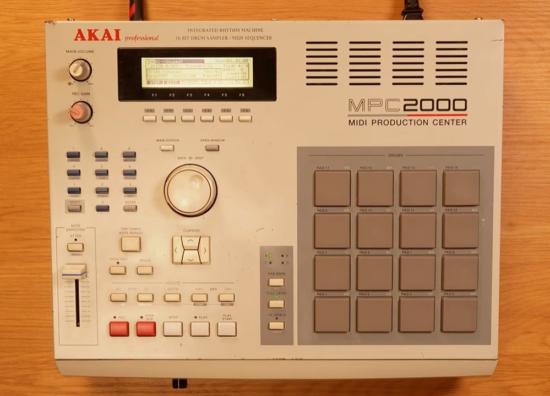
The explosion of unofficial firmware mods for classic hardware continues, with free mods for the Akai MPC 2000 and MPC 2000XL.
MPC2000 MODS is a modified operating-system project that adds features to the Akai MPC2000 Classic and MPC2000XL. Version 1.8 adds the ability to monitor an analog input after leaving the sampling screen and control sequence playback while recording.
The mod pack also expands tuning, program assignment, sample chopping, filtering, file management and sequencing functions. The installer creates a new modified OS file while leaving the user’s original OS untouched.
Features:
Input Thru monitoring
PLAY/STOP controls during sampling
Extended Tune range of ±360
Program Transpose up to ±36 semitones
Four independent mute groups
Parameter copying to pad banks or entire programs
Folder support on the MPC2000 Classic
TRIM slider enhancements
Per-track program assignment on the Classic
Sample Regions for 16, 8 or 4 regions
Lazy Chop for creating regions during playback
LPF and HPF controls
Optional larger HFE data-disk support
Empty HFE image creation
MPC2000 Classic SYS, IMG and HFE output
MPC2000XL modified BIN output
macOS 12+ support
Apple Silicon and Intel support
Windows 10+ 64-bit support
Original OS remains untouched
MPC2000 MODS v1.8 is available as a free download for the Akai MPC2000 Classic and MPC2000XL. The installers require the appropriate original Akai OS files and are available for macOS and Windows. The project does not write directly to the MPC or overwrite an existing OS file.