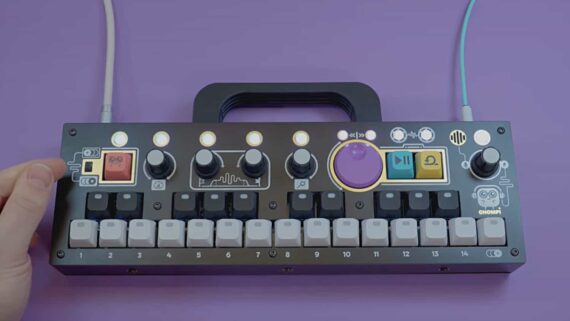
Chase Bliss recently announced that it was ending development of the Chompi sampling keyboard, saying that they were pushing against the limits of what the hardware was capable of.
Since then, Chase Bliss and Chompi Club have released the Chompi’s firmware under an Open Source license, and TemeculaDSP has turned it into a free plugin, Nibbi, that you can run in your DAW as a VST, Audio Unit, or AAX plugin.
Record and sample sounds, play them across the keyboard, layer tape-style loops, and get weird with lo-fi saturation, wow and flutter, delay, reverb, and filters.
While a big part of the appeal of the Chompi is its immediacy and tactile control of sound, the decision to open source its firmware promises to give the design new life.
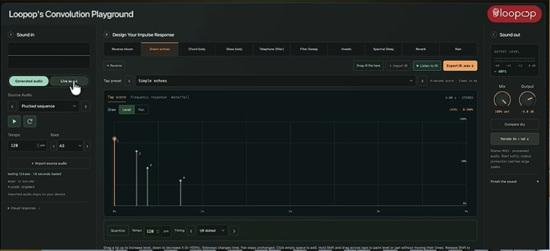
In his latest loopop video, host Ziv Eliraz demos a Convolution Playground, a new browser-based application that lets you explore the sound design possibilities of impulse responses.
Convolution Playground is free to experiment with, but you need to be a Patreon subscriber to use the export function.
Here’s what Eliraz has to say about it:
Turn audio files into effects. Explore ten ways to design an impulse response, from reverse blooms and drawn echoes to chord bodies, filter sweeps, vowels, spectral delays, reverbs, and rain. Try the built-in sounds, drag in your own audio, or select Live audio to process an instrument. Switch between Waveform, Frequency response, and Waterfall to see what you hear. Your imported audio stays on your device.
The free version includes all the sound-design controls and Listen to IR. Exporting your impulse responses as WAV files is available to WaveShaper members on Patreon.
Already a WaveShaper member? Open the export-enabled edition here. Watch the video tutorial about this app here.
Universal Audio launched its Volt series of audio interfaces in 2021, promising “classic studio sound” at an accessible price point and providing an affordable alternative to the company’s popular Apollo X line.
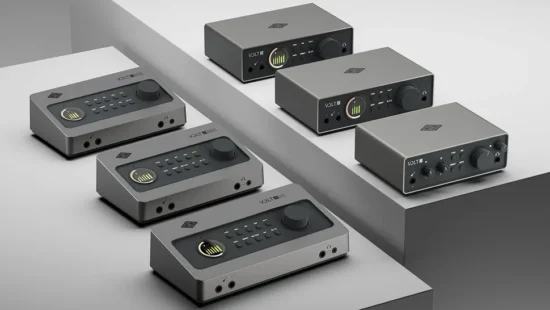
Five years on, the company is unveiling the second generation of Volt interfaces, a six-strong range split between the Volt Gen 2 and Volt Max lines, stretching in price and I/O from the $149 2-in/2-out Volt 1 Gen 2 through to the $499 12-in/6-out Volt 4P Max.
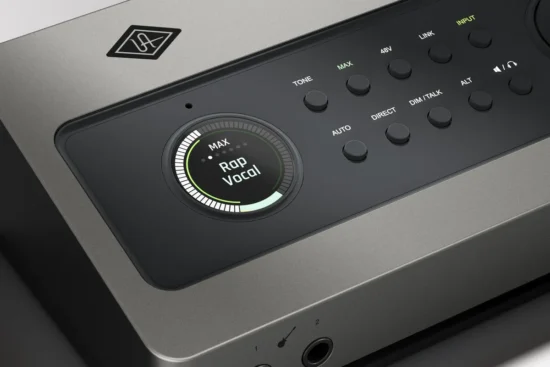
The headline addition is UA’s Tone Shaping Preamps, which offer three switchable character modes at the input stage. Warmth, Focus and Shine modes emulate vacuum tube, solid-state and British Class A designs respectively, applying analogue-style colouration before the audio reaches your DAW.
The three Volt Max models (Volt 2 Max, Volt 4 Max and Volt 4P Max) go further with Max Processing, a set of six “one-touch” compression presets based on UA’s well-loved emulations of 1176, LA-2A and VCA-style compressors.
Though the first-generation Volt 76 series featured 1176-style analogue compressors, these have been dropped in Volt’s second generation and replaced with onboard digital compression (exclusive to Volt Max) that provides a broader variety of styles. UA says this runs in real-time with no added latency, and that the preamp modes and compression presets can be paired up for more than 18 tonal combinations per channel.
The entire Volt range has also received a visual refresh, ditching the retro wooden side-panels in favour of a sleek and minimalist design that’s closer to the Apollo range with its muted grey colour scheme.
Every model, save for the entry-level Volt 1, features a handy full-colour Smart Display for monitoring levels and settings at a glance. These models also benefit from smart features such as Auto-Gain and Clip Protection, and can automatically detect mic, line and instrument sources for quick and easy set-up.
All six interfaces are USB bus-powered and capable of 32-bit/192kHz conversion, with ADAT input and MIDI I/O on the Volt 4 Gen 2 and all three Max models. The Max line also adds a built-in talkback mic, and the Volt 4 Max and 4P Max feature speaker switching.
As with the previous generation, there’s a generous software bundle included. The UAD Volt Studio Bundle gets you 15 plugins: UA’s LA-2A and 1176 emulations, Showtime ‘64 and Lion ‘68 amp sims, Anthem and PolyMAX synthesizers, Topline Vocal Tune and more. Also included is UA’s recently-updated Luna DAW, Celemony’s Melodyne Essential and a three-month trial of FL Studio Producer Edition.
“Every artist has a sound they’re chasing,” Universal Audio CEO Bill Putnam Jr. said in a press release. “We want Volt Gen 2 to give people the confidence to explore that sound, experiment, and keep creating, whether they’re recording their first song or working on their tenth album.”
Getting Started with Volt Gen 2 + Volt Max:
Find a full breakdown of I/O and pricing for each model in the range below.