Say Hi To Pivot ‘No-nonsense FM Synth’


Modern FM synths tend to be more user friendly thanks to their improved interfaces, but the underlying complexity of frequency modulation remains.

With the launch of Pivot, plugin developer Fors aims to address this. “Years of research, development and deep love of FM synthesis has gone into picking just the right balance of flexibility and simplicity,” says Fors.

Pitched as a ‘no-nonsense’ FM synthesizer, Pivot strips back the complexity usually associated with FM synths resulting in an instrument that aims to be approachable and user-friendly, whilst still capturing the essence of what makes frequency modulation synthesis so appealing.

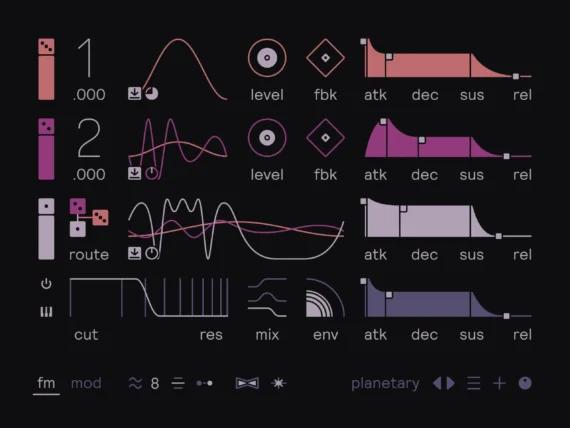
Pivot is based around three operators, which Fors claims provides “a great balance of being able to make complex timbres while being quick to program.”

These operators are combined with a resonant 4-pole filter that can morph continuously between low-, high- and band-pass modes. Pivot also features two LFOs and two ADSR envelopes, each of which can be routed to up-to six destinations at once in the flexible mod matrix.

Unlike most FM synths, Pivot has no algorithms – the term commonly used for different configurations of operators – and instead allows users to continuously route its top operator’s output between the other pair. According to the developer, this setup “makes sound design a truly explorable process where you don’t have to make any decisions up front.”
Pivot is available in VST3, AU and Clap formats for PC, Mac and Linux. The full version is priced at $39, but can be picked up for an intro price of $29.30 until 20 July.

Rather than offering a demo version, Fors has released a free Lite version of Pivot with just two operators and no mod matrix. Both versions are available now from the Fors site.

 

Donald Trump Raises Import Taxes On Goods Made In Vietnam by 500%, Including Macs, iPads & Airpods


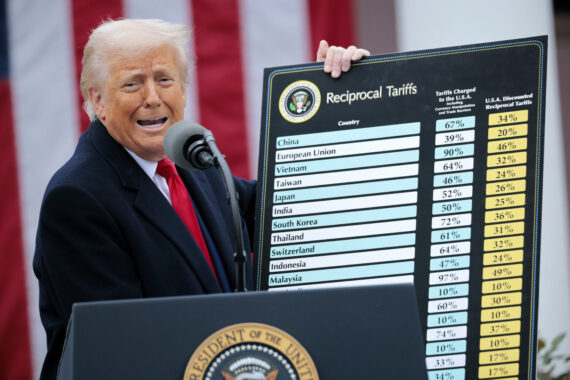
President Donald Trump announced today that he’s increasing tariffs on Vietnamese-made goods more than 500% over what they were at the beginning of his administration, a move that’s likely to result in higher costs for the many musicians that use Apple devices:

While the President says in his announcement that Vietnam will pay these taxes, this appears to be a false statement. Tariffs are taxes paid by Americans that import goods.

Tariffs are popular with some politicians, because tariffs can be used strategically to punish bad international actors, and because tariffs can be used to raise your taxes, without it showing up on your annual tax bill. But economists and fiscal conservatives are overwhelmingly against steep tariffs, because they historically have resulted in higher prices, decreased trade and long-term harm to US economic growth.

In this case, the import taxes Apple pays on importing the products it makes in Vietnam are increasing to 20%. So, it seems likely that Apple will pass at least some of the cost of this tax hike on to American buyers.

Apple Insider’s William Gallagher writes:

“The 20% rate that Apple must now pay on imports of the iPad, Apple Watch, and almost all AirPods, is dramatically higher than before. While Trump previously threatened a blanket 46% tariff on Vietnam, prior to his “Liberation Day,” the tariff was less than 4%.”

Why This Matters To Musicians

Musicians tend to use Apple products at a much higher rate than average, because of the company’s traditional focus on content creators.

Musicians tend to use Apple products at a much higher rate than average, because of the company’s traditional focus on content creators.

In addition, the fact that iOS has been optimized to support audio and MIDI effectively and with minimal latency has resulted in it dominating the world of mobile music making applications.

Earlier this year, Apple shifted manufacturing of its products to Vietnam, where possible, in response to the Trump administration’s trade war with China.

At their earnings call in May, Apple CEO Tim Cook said “For the June quarter, we expect Vietnam to be the country of origin for almost all iPad, Mac, Apple Watch, and AirPods products sold in the U.S.”

This move allowed the company to avoid raising prices for American buyers. With Trump’s latest tariff hike, though, it looks like Apple’s strategy won’t allow the company to avoid big tax hikes in the long run on the goods it sells in America.

What do you think of the Trump administration’s tax hike on Vietnamese imports? Do you think it will lead to higher prices on the Macs, iPads and the other devices Apple makes in Vietnam?

Share your thoughts in the comments!

Free ‘Microphone Emulation’ Plugin, Toyphonic Micraliser, For International Joke Day ’25


Caelum Audio’s Toyphonic Micraliser is the plugin nobody asked for. This hilariously bad mic modelling plugin is free for International Joke Day.

1st July marks International Joke Day (who remember?) and plugin developer Caelum Audio is celebrating the occasion with the release of a hilariously – and deliberately – bad plugin that the company promises will “transform your music into something only a toddler could appreciate”.

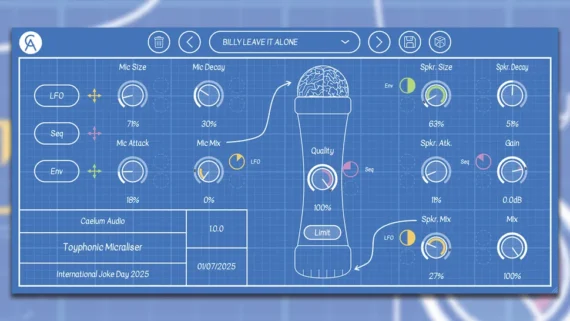
Toyphonic Micraliser is a mic and speaker modelling plugin that emulates the tinny and unpleasant sound of cheap and undesirable gear. Imagine a children’s toy microphone that your three-year-old accidentally dropped in the bath run through a budget Bluetooth speaker, and you’ll get the idea. As Caelum Audio puts it, “if your singing sounds like a dying cat, this finally kills the cat.”

The plugin’s “ultra-realistic, precision-tuned” mic and speaker modelling is based on “painstakingly captured” impulse responses that can be shaped via Size, Attack and Decay controls, and there’s also a Quality control onboard that introduces an appropriately nasty-sounding bitcrushing effect.

For a free plugin that’s intentionally poor, Toyphonic Micraliser actually offers plenty of modulation options, including an LFO with four waveforms, a 64-step motion sequencer and envelope follower, all of which can be assigned to eleven destinations. “Just because your music is flat and boring doesn’t mean the automation has to be too,” explains Caelum Audio.

A selection of 15 “locally sourced and organic” presets are available – included, Caelum Audio says, “so your AI-reliant selves don’t have to think beyond the blinking and breathing part of your day” – and a randomize button instantly generates new presets by randomizing the plugin’s controls.

While Toyphonic Micraliser doesn’t sound great – it does have some potential as a tool for lo-fi sound design, if that’s your kind of thing. “We cannot be held liable for any personal threats or harm you may encounter upon being encouraged to sing into the Toyphonic Micraliser,” warns Caelum Audio. “You should have known better, you silly sausage.”

Toyphonic Micraliser is available now for macOS, iOS and Windows in VST3/AU/AAX/AUv3 formats. Find out more on Caelum Audio website.