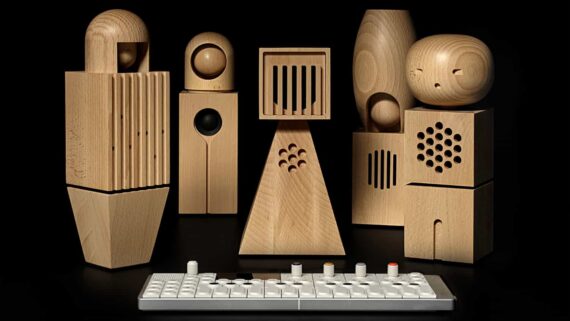
Teenage Engineering let us know that their Choir – a collection of 8 wooden virtual vocalists that ‘sing’ with synthesized voices – is featured as a vocal ensemble in the soundtrack to the movie, Elio.
Elio is the latest animated film from Pixar, and is about a lonely 11-year old boy that ends up going on adventure in space.
In January 2025, composer Rob Simonsen contacted Teenage Engineering about using their Choir on the soundtrack:
“We were looking for an otherworldly sound—something that sounded relatable, that echoed vocalizations, communication that humans could understand, but felt like it was from another world.
I came across these choir dolls and heard their sound. It was beautiful—electronic, but human. Each body is handcrafted. They have a robotic but organic sound at the same time. It felt like a perfect answer to what we were looking for.”
Teenage Engineering provided 24 choir dolls, and developed new firmware to evenly distribute musical notes across the choir.
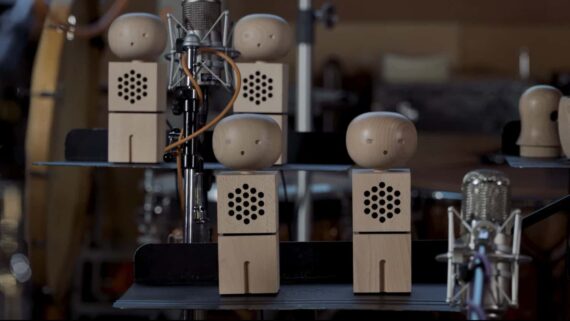
Recording took place at the Sony scoring stage in Los Angeles, where the Choir dolls were mic’d similarly to a human choir and recorded in the same acoustic space:
Simonsen used the Choir as part of the sonic identity for The Communiverse, a futuristic interplanetary organization. The Choir is arranged similarly to a traditional choral ensemble, but the results have a distinctive synthesized character.
An example of the Choir in use can be heard in the following track, around 3:25 in:
This is the first time, that Teenage Engineering is aware of, that the Choir has been featured in a major soundtrack.
Information about the Choir is available at the TE site.
FL Studio 2025 brings ChatGPT-style AI assistant that offers music production advice and helps you use the DAW.
Image-Line has announced the latest update for FL Studio, its flagship DAW, bringing with it a host of new features that includes several assistive tools aimed at helping music-makers “jumpstart their creative process”.
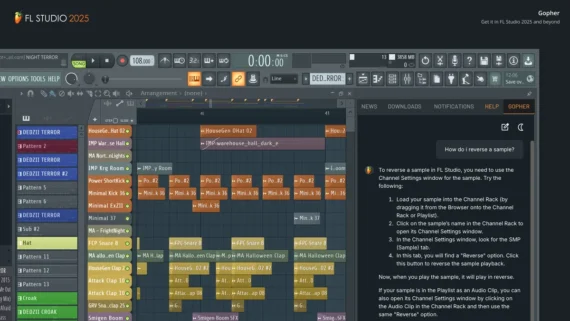
The headline feature in FL Studio 2025 is Gopher, an AI assistant trained on FL Studio’s reference manual and knowledge base that provides instant answers to music production questions in the user’s native language.
Providing everything from FL Studio support to more general advice on production, mixing, songwriting, theory and more, Gopher is designed to offer quickly accessible guidance without having to leave the DAW.
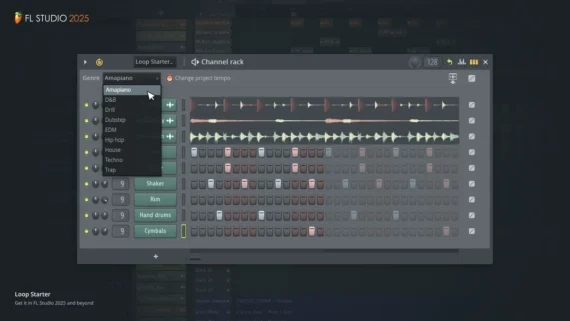
Also new in FL Studio 2025 is Loop Starter, a feature that helps users quickly generate new ideas via FL’s Channel Rack. Pick a genre from a list of nine different styles that includes amapiano, drill, trap and EDM, and Loop Starter will automatically load up a stack of tempo-synced loops from FL Cloud’s sample library to Channel Rack and create editable step sequencer tracks loaded with one-shots.
Ideas can be instantly re-generated on a per-track basis, enabling users to quickly audition sounds until they find a combination that works as a starting point for a production, which can then be exported to the Playlist. Loop Starter is included with all editions of FL Studio and makes use of samples from FL Cloud’s free tier, so you don’t need a subscription to use it.
FL Studio 2025 also brings a simple but commonly requested improvement: more Mixer Tracks. FL’s Mixer has historically topped out at a maximum of 125 tracks, but Mixer Tracks can now be added and removed, with support for up to 500. Audio Clips have also been updated, adding the ability to stretch, pitch and reverse audio directly from the Clip Properties window.
FL Studio’s latest update also introduces Emphasis, a multi-stage mastering limiter plugin that’s exclusive to the DAW’s All Plugins Edition, and Mobile Rack, a collection of 36 low-CPU instruments and effects from FL Studio Mobile, now available on desktop.
Image-Line has also replaced Image-Line Remote with FL Studio Remote, a new and improved application for iOS and Android that enables you to control the DAW from your mobile device.
FL Studio 2025 is now available as a free unlimited trial or a free update for all license holders.
Find out more about the update on Image-Line website.
It has been a while since we’ve seen any new music production gear released from AlphaTheta, the brand previously known as Pioneer DJ.
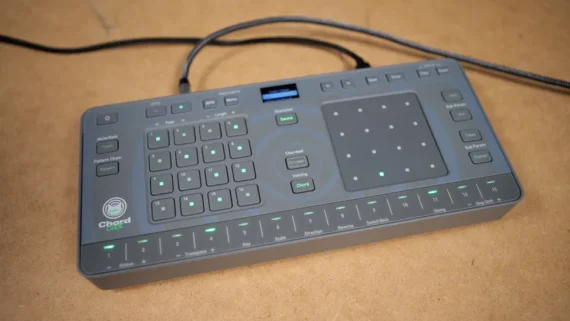
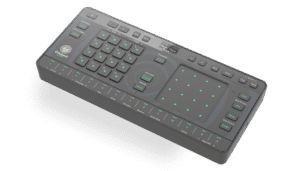
AlphaTheta, today has released Chordcat, a new music production tool ‘Find Harmony, Spark Creativity’ – some fresh and inspiring sequencing ideas, paired with an underwhelming sound engine.
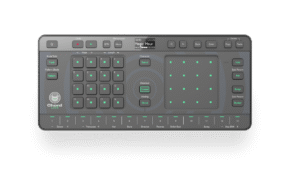
Chordcat is a compact, budget-friendly groovebox that puts chord sequencing at the centre of its workflow. It has eight individual tracks each of which can sequence sounds selected from 145 sample-based instruments and 16 drum kits.
Each track has its own polyphonic sequencer with a maximum of 128 steps. These allow for patterns to be input and edited step-by-step or via live recording. Chordcat also allows for basic parameter recording using its XY pad.
Its most notable features, however, are those that focus on chord sequencing. Chordcat features a scale mode, chord function and pre-made chord sets for quickly creating progressions. It also has an innovative Chord Cruiser feature, designed to automatically suggest chord combinations in order to inspire new compositional ideas – particularly handy for those lacking in musical know-how.
Chordcat is an incredibly convenient feeling piece of hardware – it’s only a touch over pocket sized and very light, meaning that it’s definitely something that can easily be thrown into a backpack and used on the go. It can be powered by either AA batteries or USB-C, which adds to the portability.
The headline feature of Chordcat is its Chord Cruiser mode. This is designed to automatically suggest combinations of chords. It’s fairly simple to use in operation – the user selects an initial starting chord using the key/scale functions, and then the 16 buttons of the XY pad light up to present a varying number of compatible chords that could work next in a sequence.
These chords can be auditioned using the XY pad buttons. The user can then select their favourites to assign to the buttons along the bottom edge of the UI. Once assigned these chords can be quickly triggered and sequenced with a single button press. There is also a selection of pre-defined chord sets, which are separate from the Chord Cruiser mode.
Chordcat’s other interesting sequencing feature is the Running Direction function inherited from the Toraiz Squid. This can be used to alter the direction in which a sequence moves around the grid of 16 steps, with right, down, clockwise and counterclockwise options, along with the option to reverse sequences and have patterns bounce back and forth. This is a really fun feature, and a great way to quickly turn a pattern on its head or alter the way that Chordcat’s eight tracks are interacting.
Also, there’s a broad range of sounds on offer, including banks of synth tones, pianos, keyboards, basses and multiple drum kits, the selection within these categories is a little vanilla and there’s little in the way of editing capabilities.
Each sound can have its low pass filter and amp envelope controlled via the XY pad, but there’s not much depth here. The filter has just controls for cutoff frequency and resonance, and the envelope has just attack and release. What’s more, in the case of drum kits, these parameters are shared across every sound in the kit – that is, if you want to shorten the release time on a hat, it will apply to your kick as well.
There are a few effects to add a little character. Chordcat features an arpeggiator, delay and ducker, each of which can be controlled via the XY pad. Kits can have reverb applied via a send too, as well as have their individual levels and pan position adjusted.
AlphaTheta has also released a Chordcat Manager application that promises to make it easy to export and import sequences from the device via USB. In short, Chordcat features some genuinely fresh and inspiring sequencing ideas, paired with an underwhelming sound engine.
Chordcat Groovebox Full Overview video:
Chordcat is out now priced at $299. Visit the AlphaTheta site for more.