Win A Vintage Minimoog Signed by Todd Rundgren


The Bob Moog Foundation has unveiled its fall fundraising raffle.

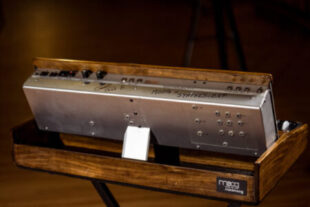
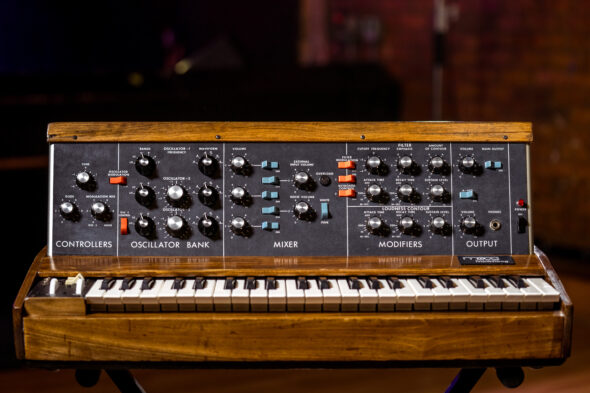
Now through September 29, the BMF is raffling a fully-restored vintage Minimoog Model D synthesizer, serial number 4605, originally manufactured in Moog Music’s Williamsville, NY factory in the early 1970s. This Minimoog was restored by current Moog Music engineer Tim Johnston.

The legendary sound of the iconic Minimoog spans decades of popular music, including the early synthesizer works of Todd Rundgren, who signed the Minimoog while also inscribing “Moog = Synthesizer” on the back of the synth. The Minimoog is valued at $6,500.

Since its first commercial use in 1970, the famed Minimoog has been a timeless interplay of engineering, artistry, and creativity. It offers a wonderfully accessible configuration of targeted modules similar to those used in famed Moog modular synthesizers, one of which, the Moog System 55, was employed with epic effect in the mid-1970s by Rundgren and keyboardist Roger Powell while recording and performing in the band Utopia, as well as in Rundgren’s solo efforts.

Todd Rundgren is a prized member of the musical community, having written and performed on seminal classic hit songs including Can We Still Be Friends, Hello It’s Me, and the iconic Bang the Drum All Day. His production credits include a mind-bending collection of notable artists and bands. Among them are The Tubes, Patti Smith, Grand Funk Railroad, Hall & Oates, Badfinger, The Psychedelic Furs, Sparks, Cheap Trick, and Meatloaf (Bat Out of Hell). The Minimoog that carries Todd’s signature represents his storied history that helped to shape an entire generation of music.

“The Moog modular synthesizer and the Minimoog helped define my sound,” noted Todd Rundgren. “I am thrilled to have signed this fully restored vintage Minimoog for the Bob Moog Foundation in support of their educational efforts, including Dr. Bob’s SoundSchool, which inspires thousands of elementary school students through sound every year.”

Raffle tickets are $25 each, 5 for $100, 12 for $200, and 35 for $500. Buy tickets here.
Funds raised from the raffle will be used to expand the Bob Moog Foundation’s hallmark educational project, Dr. Bob’s SoundSchool, which has inspired over 35,000 elementary school students through the science of sound. The raffle also helps support the Bob Moog Foundation Archives and the Moogseum, an immersive, experiential museum located in Asheville, NC, which brings the science of sound and synthesis alive for people of all ages through Bob Moog’s pioneering legacy. The Moogseum opened in May 2019 and has since welcomed over 45,000 visitors from all over the world. The museum is still recovering from the long-term financial impact of Hurricane Helene.

The raffle begins Monday, September 8th at 7:00 am EST and ends 11:59 pm EST Monday, September 29th, 2025. Raffle tickets are $25 each, 5 for $100, 12 for $200, and 35 for $500 and can be purchased at this link. The raffle is open internationally. More information is available on The Bob Moog Foundation website.
 

Terrain Synth Explores New Territory For Sound Design


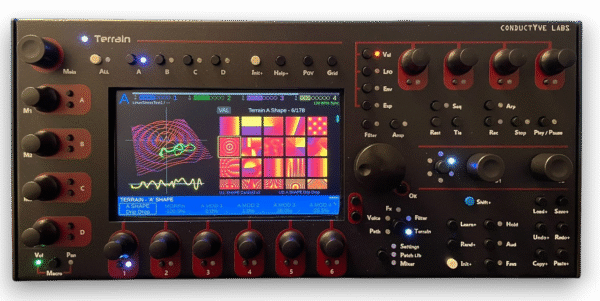
At Knobcon 2025, held Sept 5-7 in the Chicagoland area, Conductive Labs previewed a new instrument, Terrain Synth, along with an interesting new approach to synthesis.

Conductive Lab CTO Steve Barile explained that Terrain Synth is new hardware synth that’s based on Terrain synthesis.

Here’s how Terrain synthesis works:

  • Terrains are essentially 3D maps of a landscape. You can think of Terrains like a topographic map that reflects the altitude of the land it maps.
  • As you move a point across the Terrain, you can sample the ‘altitude’ of the map. This series of samples creates a waveshape – similar to the way that exercise trackers can map over time the altitude of hikes or rides that you take.
  • The resulting waveshapes are a function of both the Terrain map and the path that you take across the Terrain.

The Terrain Synth lets you select from a library of Terrains and a library of paths, which results in a huge variety of waveshapes to start with. But it also lets you modulate the Terrain and path, and even to customize these options.

It gets much deeper than this, too. You can control the angle of your path, combine two terrains per voice, use multi-layer terrains and more. Other synthesis options include suboscillators; deep modulation options with LFOs, envelopes and more; several varieties of noise; a wide range of effects; layering; and more.

The Terrain Synth is also four-part multi-timbral, with 8 voices per part. This makes it a great partner for Conductive Labs’ NDLR, which is designed to let you sequence four different parts.

The Terrain Synth also has a dedicated mixer, so you control panning, volume and effects for each voice. It also lets you control how the four parts map to your keyboard, supporting splits, layering and more.

Conductive Labs have also designed the Terrain Synth to fit into modern electronic music studios, with support for DIN & USB MIDI, along with 6 CV/Gate patch points.

Here’s an overview with Conductive Labs CTO Steve Barile, via CatSynth TV:

Features:

  • Unique terrain oscillators
  • 32-note polyphony, with 8-voices per timbre
  • Four timbres that can be split or stacked
  • Two morphable terrains per voice
  • Up to 7x unison per voice
  • Two sub-oscillators (-1 & -2 octaves) per voice
  • White Pink, Blue & Brown Noise
  • Oscillator sync, phase distortion, mirroring and windowing
  • 17 math-based terrains with infinite resolution
  • Dozens of image-based terrains
  • User-loadable terrains
  • 18 morphable paths with infinite resolution
  • Dedicated mixer for timbre layers
  • LFO, Envelope and Expressive-matrix per parameter
  • On-board effects, including Delay, Ping-Pong Delay, Reverb, Shimmer Reverb, Chorus, Flanger, Phaser, Stereo Phaser, Overdrive and Decimator
  • Dedicated sequencer, arpeggiator and audition buttons
  • Hundreds of sortable presets
  • Onboard preset librarian
  • 36 quick access patch favorites
  • Multi-level patches, Init, Copy & Paste
  • Infinite encoders
  • 7″ IPS display
  • Selectable terrain view angles and color schemes
  • MIDI IO via 5-pin DIN, USB Host and USB Device ports
  • 6x CV/Gates
  • 3x expression pedal inputs
  • Left/Right balanced stereo and headphone (w/volume control)
  • Desktop/4U rack configurations

Terrain Synth Audio Demos:

Conductive Labs is planning to fund initial production of the Terrain Synth via a crowdfunding project. Barile said that they expect to open up orders within the next couple of weeks. You can sign up to be notified when this launches at the Conductive Labs site.

In the meantime, check out the details and overview, and share your thoughts on the Terrain Synth in the comments!

muSonics Previews Four Voice 5U Modular Synth At Knobcon 2025


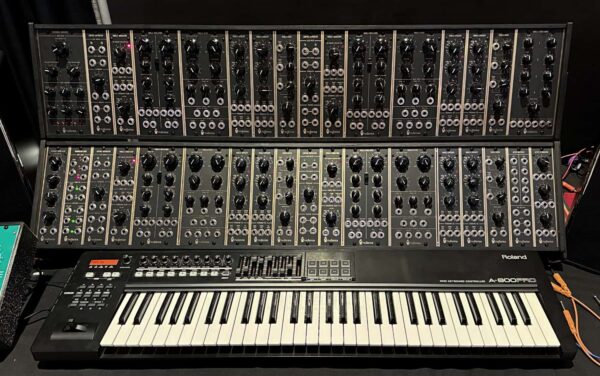
At Knobcon 2025, held Sept 5-7 in the Chicagoland area, muSonics previewed their latest creation, the Four Voice polyphonic synthesizer in MU format.

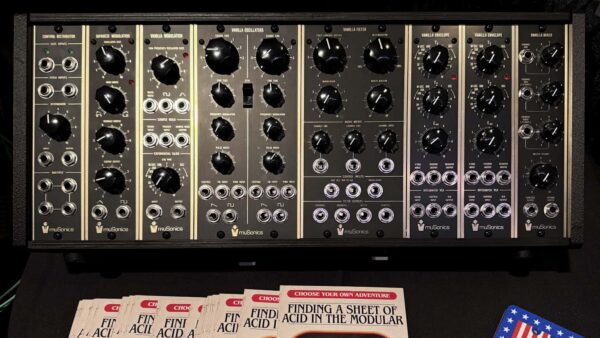
The muSonics Four Voice is a fully-modular system, with internal normalization. It builds on the company’s previously introduced Vanilla Synth, a MU format synth, inspired by classic Tom Oberheim designs.

The Four Voice essentially combines four Vanilla Synth voices in a single case, with a few additional models to handle polyphonic control.

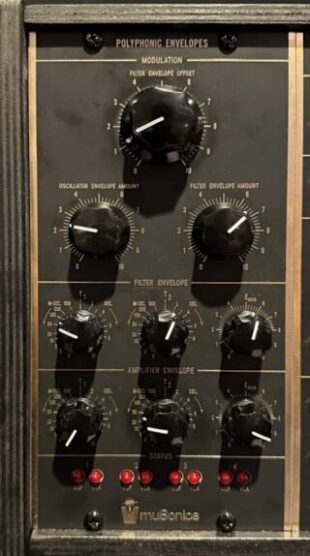
The muSonics Four Voice features four of the company’s Vanilla Synth voices, plus some new modules, like the Polyphonic Envelopes module, that let you play the system as a polysynth

Like the Oberheim Four Voice that it takes inspiration from, the muSonics Four Voice is built from four completely independent synth voices.

This means that each voice has its own dedicated set of controls, and that creating a polyphonic patch requires adjusting the setting on each of the voices. This is more work than tweaking a computer-controlled poly design, but the result is that each voice has slight variations, creating a very rich and interesting sound.

It also means that you can configure the voices with distinct sounds and use the system as four multi-timbral voices and in other combinations.

Unlike the Oberheim Four Voice, the muSonics Four Voice is fully modular, and made up of individual MU modules. This means that you can treat it as four individual modular synthesizers, expanding the sonic possibilities immensely.

And you can treat the system as a large modular system, using modules from multiple voices to create complex patches to expand your sound design options.

The muSonic Four Voice is a dotcom-style Moog format design, meaning it offers the traditional look and usability of ‘man-size’ modules, but with modern power and CV/Gate standards and connectivity.

Large controls let you precisely dial in sounds. Clear layout makes it easy to understand the signal flow. And knobs are sized hierarchically, with the largest knobs reserved for parameters that you’re more likely to want to adjust in performance.

It’s clear that muSonic’s Suit and Tie Guy has put a tremendous amount of thought into the design. All this would be meaningless, though, if it sound great – which it does.

A video overview, via CatSynth TV, with muSonic’s Matt Baxley:

The system that muSonics introduced at Knobcon is a prototype and the format may change. Suit said that he’s considering reducing the width of the case and making the system a little taller, so that all controls are in easy reach of one hand.

Details on pricing and availability are still to come at the muSonics site.