Arturia Pigments 7 A Free Upgrade, Adds New Effects + More
Arturia has introduced Pigments 7. Pigments 7 adds experimental filters, a noisy effect, punchier envelopes and a stylish new look for the Play View
Its last major update, Pigments 6, landed in January of this year, adding features including a physical modelling engine and a vocoder. Now, a little less than eleven months later, Arturia has unveiled Pigments 7, a major update to their flagship software synthesizer.
Pigments 7 they say delivers “punchier sound, sharper control, and deeper playability”. It features the audio-reactive Play View, new filters, Corroder FX, streamlined modulation, and 250 fresh presets, samples and wavetables.
For one thing, Pigments 7 adds several new sound design tools to the synth’s already-comprehensive suite of features. The most notable of these are a trio of new filter modes, named Rage, Ripple and Reverb filters.
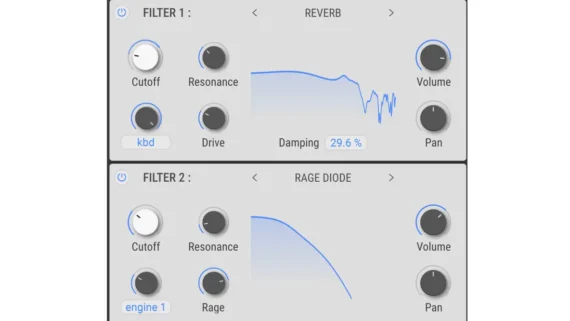
The first of these, the Rage filter, includes a feedback loop in order to create distortion effects, with a variety of saturation styles on offer. Coupled with the ability to boost the resonance, Arturia suggests that this can create gritty acid tones by modulating or sequencing the cutoff.
The Ripple filter, is a phase-based modulation filter that Arturia says can “achieve frequency based phase offset, creating laser transient sounds to ringing high ends, great for modern sound design.”
Completing the trio is the Reverb filter, a particularly interesting module that combines elements of filtering and spatial effects. Arturia describes this as capable of “timbre-thickening space and weight designed for modern bass design”.
It’s also capable of creating swept non-tonal FX by modulating the cutoff and, at higher resonance levels, can create metallic-sounding tones.
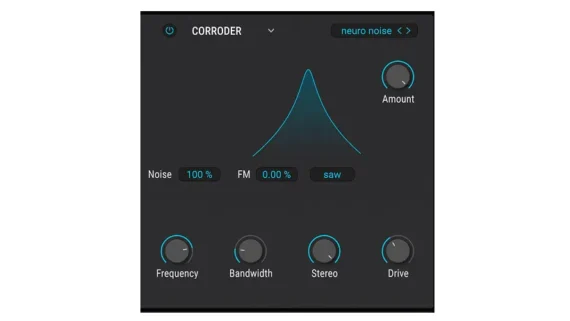
Alongside these new filter modules is a new Corroder effect. This is a new distortion tool that combines elements of noise and frequency modulation that can be targeted at a specific frequency band using the onboard filter.
Pigments 7 also introduces an overhauled design for the Play View. This is the simplified UI window that offers users top-level control over presets without the complications of the full synth engine.
Here, it’s reworked to offer an audio-reactive representation of the sound on offer, designed to provide quick visual cues for the character of each preset. According to Arturia, this new Play View is aimed at allowing users to “quickly grasp tone, timbre and intention behind each preset, helping you browse presets and find your sound.”
There are under-the-hood improvements throughout Pigments as well. According to Arturia, this version now offers “updated default amplitude behaviour with smoother, S-shaped envelopes that reduce clicks and deliver cleaner, harder-hitting transients.” It’s said to be lighter on the CPU too, optimised for creating layered, complex and effects-rich sounds.
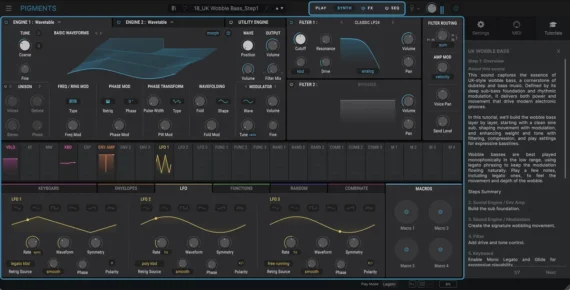
Along with these updates, Pigments comes with fresh content including 150 new presets, 50 wavetables, 30 samples and 20 noises. There are also new in-app sound design tutorials that will teach users the fundamental theory behind its synth sounds.
What’s new in Pigments 7:
- Redesigned Play View: A new audio-reactive interface that helps users preview and understand a sound’s character, with responsive type-specific animations and quick-edit controls.
- New Creative Filters:
- Rage: Feedback-fueled distortion for powerful, driven textures.
- Ripple: Phase-based motion for fluid movement and character.
- Reverb: Timbre-thickening space and weight designed for modern bass design.
- New FX module: A modulation-driven Corroder effect that adds controlled grit, from FM-tinged edges to filtered grain and wide distortion, while preserving the identity of the dry signal.
- Enhanced punch & presence: Updated default amplitude behavior with smoother, S-shaped envelopes that reduce clicks and deliver cleaner, harder-hitting transients.
- Modulation & CPU improvements: Visual modulation range displays for easier editing, plus optimized processing for more headroom in complex, layered, FX-heavy patches.
- New creative content & tutorials: 150 presets, 50 wavetables, 30 samples, and 20 noises, alongside new in-app, use-case sound design tutorials.
As with previous updates, Pigments 7 is available for free for existing users, who can update now via Arturia’s Software Center app.
For new users, Arturia Pigments 7 is available now with an intro price of $99 (normally $199) until 6 January 2026.