ELTA Music Polivoks-8 Polyphonic Synthesizer (Sneak Preview)
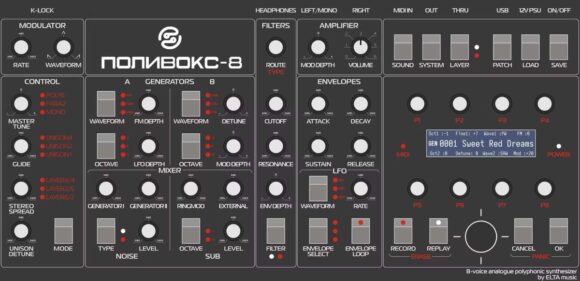

ELTA Music shared this sneak preview of the Polivoks-8, an eight-voice polyphonic, dual-VCF, bi-timbral analog synthesizer. They plan to make it available in both desktop and 4U rack-mount formats.

Inspired by the soviet Formanta Polivoks, they say that “the Polivoks-8 combines authentic analog circuitry with modern flexibility and control, delivering a bold, distinctive sonic character for the studio or stage.”

Here’s what they’ve shared about the Polivoks-8:

Features:

  • Oscillators – Each of the eight voices features two fully analog oscillators with FM, Sync, and Ring Modulation capabilities, plus a dedicated sub oscillator per voice. Choose from the classic trio of analog waveforms with PWM and fixed pulse options. An analog noise generator provides both white and pink noise.
  • Filters – Each voice is equipped with two analog voltage-controlled filters that can be freely routed in serial, parallel, or any blend in between.
    • VCF 1: A classic Polivoks-type filter, originally designed by Vladimir Kuzmin for the iconic Formanta Polivoks synthesizer. Built around genuine soviet K140UD12 OTAs, it delivers a distinct character – aggressive, expressive, and alive. It features 12 dB low-pass and 6 dB bandpass responses, controllable input saturation, and true analog FM for deep timbral shaping.
    • VCF 2: An improved ladder-style filter offering a 24 dB low-pass response with resonance drop compensation, ensuring smooth, consistent behavior across all resonance settings.
  • Amplifier Section – Each voice includes three VCAs: one master VCA plus a stereo pair for pan modulation, enabling dynamic spatial movement and immersive sound design.
  • Envelope Generators – Three independent envelope generators per voice are pre-routed to the VCF, VCA, and VCO. Each can be freely re-patched, with multiple curve types available for precise control over contour and its response.
  • LFOs – The Polivoks-8 features one global analog LFO (modulated triangle waveform)and eight per-voice LFOs with a wide selection of waveforms – including the ability to create and save user-captured waveforms per patch, offering limitless modulation potential.
  • Arpeggiator & Sequencer – Each patch or timbre includes a classic arpeggiator and step sequencer, both fully programmable for intricate rhythmic and melodic motion in bi-timbral mode.
  • Joystick Modulation – A built-in analog joystick allows expressive real-time control. Movements can be recorded and replayed as modulation sources or even used as custom LFO waveforms, adding another layer of performance creativity.
  • Sound Storage – Store up to 1024 patches (256 factory + 768 user slots) across eight sound banks with 128 patches per bank.
  • Connectivity
    • Audio: Mono input for external signal processing, stereo main output, and stereo headphone output.
    • MIDI: Classic 5-pin DIN I/O/T plus high-speed
    • USB MIDI I/O for seamless integration with modern setups.
  • Control Panel – The interface features high-quality, 360° endless encoders for all parameters and a dedicated master volume potentiometer. Durable Digitast-type switches ensure a solid, tactile feel. Crisp 3.2-inch monochrome OLED for clear visual feedback rounds the control.

Details on pricing and availability are to be announced.
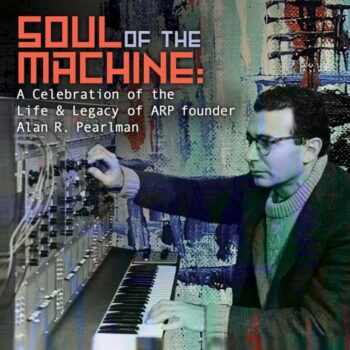
Soul Of The Machine, New Album Celebrates 100th Anniversary Of ARP Founder Alan R. Pearlman


The Alan R. Pearlman Foundation is celebrating the centennial of its namesake, ARP founder Alan R. Pearlman, with a new 36-track album, Soul Of The Machine.

Soul Of The Machine is a 2-CD set of tracks featuring the sounds of classic ARP instruments, ranging from the powerful ARP 2500 modular system, to the 2600, Odyssey, Pro Soloist and Omni.

The album, curated by Steve Roach and Chris Meyer and mastered by Robert Rich, features music by a “Who’s Who” of synthesists.

Martin Gore’s “Kino” combines Depeche Mode’s signature rhythmic power with a uniquely lyrical and sweet atmosphere. “Mr. No” reveals the classic electro-pop sound of John Foxx.

Soundtrack composer Mark Isham showcases his signature pulsating energy and evocative moodscapes in the mini-suite “Musings – in Two Parts.” Lisa Bella Donna takes listeners on an extended journey into timeless wonder in the epic “Conclusions.” JG Thirlwell’s “Sphere” is a synth freakout ricocheting between ominous sci-fi atmospheres and searing beats. And Panic Girl offers “Drifting Whispers,” a somber and uplifting neo-retro journey into a past that never was.

Other artists on the collection include Michael Brückner, Phil Cirocco, Rupert Greenall, LaMar “Kronick” Mitchell, Jeff Rona, Drew Schlesinger & David Torn, Don Slepian, as well as tracks by the collection’s curators Steve Roach and Chris Meyer of Alias Zone.

Roach mapped out the music so that CD 1 represents a sonic journey and CD 2 provides a showcase of the depth and breadth of what ARPs can do. After both CDs were finalized, there were more tracks than room on the CDs. These additional songs are collected as a bonus digital supplement to the physical CDs.

You can preview Soul of the Machine below, and purchase it at Bandcamp:

The compilation supports the Alan R. Pearlman Foundation, a 501(c)(3) not-for-profit organization that celebrates the legacy of inventor, musician, entrepreneur and engineer Alan R. Pearlman by making his innovative inventions publicly accessible and by inspiring future generations to imagine and create.

Hans Zimmer Debuts ‘The Largest Modular Synthesizer In The World’


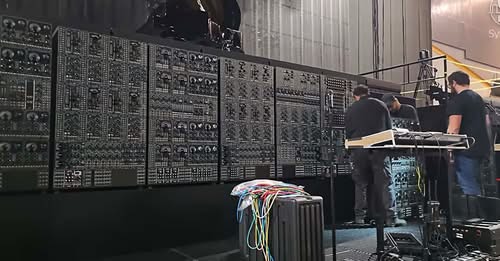
New synth maker SynTesla shared this video, highlighting their work for Hans Zimmer to create “the largest modular synth in the world”.

The system, aka Giorgio III, is a massive 5U modular synthesizer, created by SynTesla (Pierre-Jean Tardiveau) in collaboration with Yusynth (Yves Usson) for Zimmer’s 2025/2026 world tour. The system is completely uncompromising and over the top, or as SynTesla describes their synths, ‘Unnecessary, Therefore Essential’.

Here’s what Tardiveau has to say about the custom modular synth:

“This synthesizer is undoubtedly the largest modular synth in the world, consisting of 12 cabinets measuring 5 x 5U + 1 x 3U in height. Only 10 cabinets are installed on stage, with two others serving as back-up behind the scenes.

This monster represents 10 months of hard work in total.

23 types of modules were designed and produced in large numbers. To give you an example, the synth is composed of 3 separate units of 4 voices each, for a total of 12 voices, with 2 VCOs, 2 DCOS, 2 filters, 6 DADSRs, 6 VCAs, 1 resonator, 4 LFOs, buffered multis, logic, attenuators, attenuverter, mixers, wavefolders, gate delays, summing mixers, etc. etc…

The modules were manufactured in France by Syntesla and designed by Yusynth and SynTesla. They were assembled in Los Angeles at Hans Zimmer’s studios and then shipped to Germany for final assembly on the tour stage.

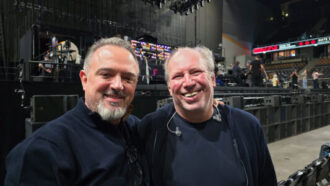
Hans-Zimmer-Pierre-Jean-Tardiveau-in-front-of-Giorgio-III-the-largest-modular-synthesizer-in-the-world

When the synth arrived in Oberhausen, Hans Zimmer had never seen it before (he was rehearsing in London while it was being assembled in LA), and I can promise you that his smile in the photo is not fake (neither is mine).

The electrical part of the cabinets was also designed and built by SynTesla. It includes an oversized power supply with a capacity of 10 amps, an active filter that provides perfectly stable and clean voltage, and a power distribution board in SynTesla and DotCom format, as well as an integrated voltmeter and ammeter. The whole system has several levels of safety.

This made it possible to connect each cabinet to a solid-state relay socket controlled by DMX from the lighting console. The robustness of the device allows the whole or part of the system to be switched on and off in sequence, depending on the pieces being played on stage.”

Zimmer is featuring the modular system in his ‘Next Level’ live concert series. Here’s a video, via C3|Nik, catching it in action:

Tardiveau has been sharing previews of his work on Facebook, but the SynTesla site is currently a placeholder.

“I’m extremely honored to have been chosen, along with my fledgling company, to work on a monumental project with one of the biggest names in the music industry,” notes Tardiveau. “This is a rare opportunity for me, a real boon for SynTesla, and I’ve chosen to devote myself fully to it. This will mean postponing the opening of the SynTesla boutique and the release of related products by several months.”

We’re looking forward to seeing what SynTesla has in store for synthesists.

Watch the videos, and share your thoughts on Hans Zimmer’s Giorgio III modular synthesizer in the comments!