Neumann VIS Lets You Create Immersive Audio In Apple Vision Pro


Neumann has introduced VIS (Virtual Immersive Studio), a spatial audio positioning controller application designed for Apple Vision Pro.

VIS lets you intuitively control Logic Pro in a three-dimensional augmented reality environment. Instead of relying on abstract 2D interfaces, you can now see, touch, and move sound sources in three-dimensional space. Audio objects appear as visual elements in augmented reality, allowing you to position them naturally with hand gestures.

“VIS is not just an app — it’s a new way of thinking about sound,” says Neumann CEO Yasmine Riechers. “It brings immersive audio to life, making it tangible and intuitive.
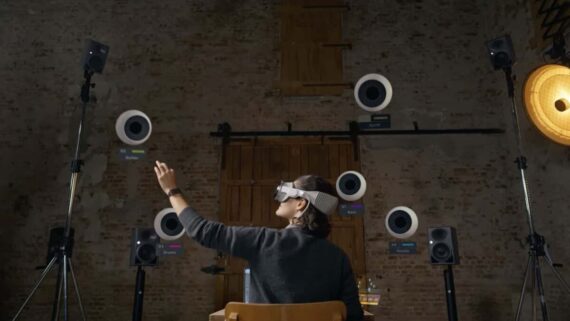
VIS connects directly to Logic Pro on Mac, appearing as a device within the application. Once paired, users can view Logic Pro on a virtual screen inside Apple Vision Pro, resize it, and place it anywhere in their environment. Thanks to Apple Vision Pro’s low-latency pass-through technology, users can interact with their physical equipment while immersed in a virtual mixing space.

VIS supports both loudspeaker and headphone monitoring. For mobile or headphone-based workflows, it includes RIME, Neumann’s proprietary plug-in for spatial audio playback up to 7.1.4. RIME leverages Apple Vision Pro’s advanced head tracking to deliver an exceptionally realistic monitoring experience, making immersive production possible in any setting — from professional studios to remote locations.

“With VIS, we wanted to make immersive audio mixing feel as natural as playing an instrument,” says Jorma Marquardt, Product Manager at Neumann. “By combining spatial computing with intuitive gesture control, we’re giving creators a tool that turns technical workflows into expressive, creative experiences. It’s not just about mixing sound — it’s about shaping it in space.

Features:

  • 3D visual interface for spatial mixing on Apple Vision Pro
  • Gesture-based positioning of sound sources
  • Full integration with Logic Pro on Mac
  • Visual overview of all audio objects
  • 3 degrees of freedom head tracking
  • Support for loudspeaker and headphone monitoring via RIME

System Requirements: Apple Vision Pro with visionOS 26 or newer, Mac with macOS 26 or newer, Logic Pro 11.2 or newer, Devices must be connected to the same Wi-Fi network.

Neumann VIS is available now as a free download.
Behringer BDS-3 Is The New Name For Their Simmons SDS-3 Copy


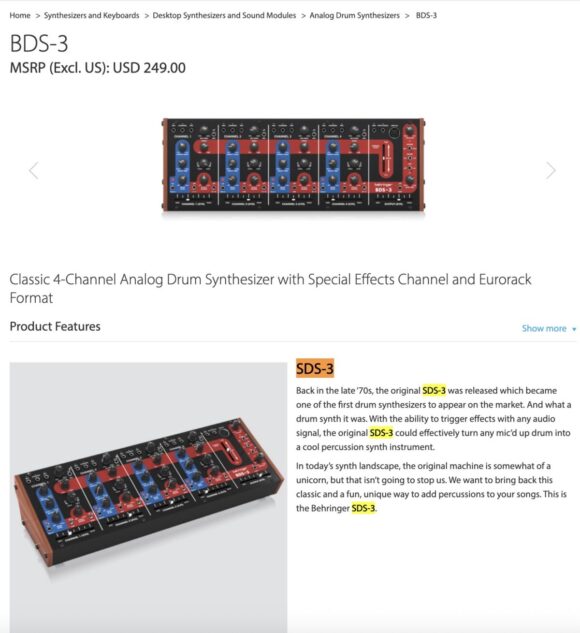
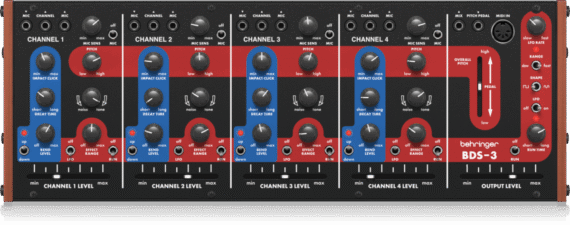
Today, Behringer has announced the BDS-3 4-Channel Analog Drum Synthesizer.

If it looks familiar, it’s because it’s a renamed version of the Behringer SDS-3 they introduced two weeks ago, a knockoff of the Simmons SDS-3 Drum Synthesizer.

The Behringer SDS-3 can be used as a standard analog drum module, but also features Mic inputs that let you trigger the drum channels using drum mics. The module also supports basic MIDI control for sequencing.

No word on why they’re changing the name, but their site suggests that the change might have been a little rushed:

The Behringer BDS-3 analog drum synthesizer should be available to pre-order at some retailers soon, priced at $249 outside the US, and $319 in the US, about 30% higher.


Ashun Sound Machines Launches Diosynth Wind Synthesizer


The Hydrasynth from Ashun Sound Machines (ASM) is one of the great synth success stories of recent years. First launched in 2019, the original model was a digital polysynth that put a fresh spin on wavetable synthesis.

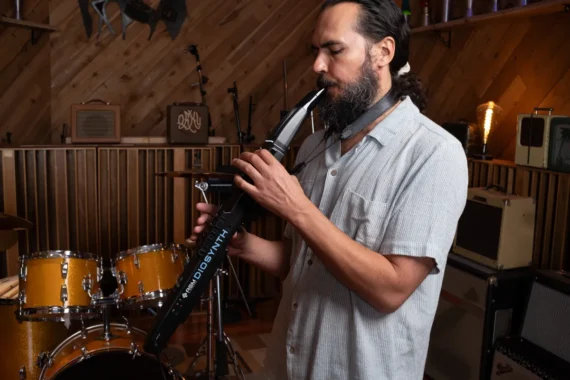
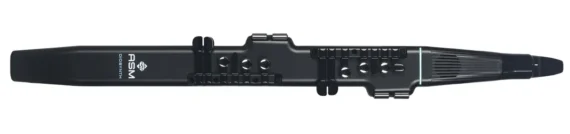
Now the company has returned with its first non-Hydrasynth product – Diosynth. Diosynth is an expressive wind synthesizer that combines sample and synthesis engines in order to produce a variety of acoustic and electronic tones.

Designed with wind players in mind, Diosynth features mechanical keys that replicate the feel of real sax and wind instruments—avoiding the flat button-style controls found on other wind synths. Multiple fingering modes, scale/key locking, and octave keys covering over eight octaves, provide a familiar and versatile playing experience.

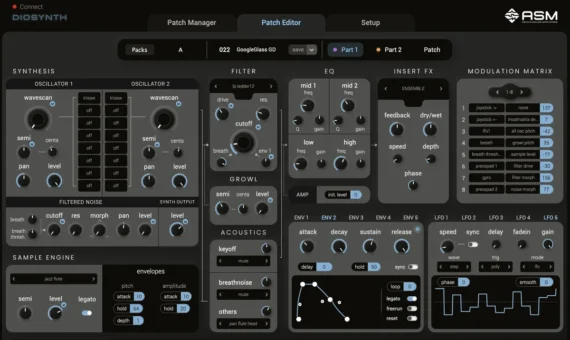
Diosynth’s sound engine is based on the Hydrasynth, but with the addition of a sample playback oscillator. This expands the instrument’s sound design possibilities into more emulative territory, letting you create patches using sampled sounds, or combining realistic acoustic sounds with wavescan oscillators – and then running the result through a 16-mode filter. These multiple oscillators can be used to create layered and split sounds.

For the Diosynth, ASM sampled 128 unique reed, brass, fipple, and string-based sounds, including rare instruments such as the contrabass flute, Eb Tubax, and Peruvian llama whistle. Diosynth includes 384 factory patches and 768 total patch locations, covering everything from traditional wind instruments such as saxophones, trumpets, and flutes to synth leads, basses, and tempo-synced electronic textures.

Diosynth is powered by an included USB-C adaptor or by two 18650 rechargeable batteries (not included). For advanced sound design, the Diosynth can make use of a companion app that runs on desktop as well as Android and iOS. Each unit comes with a hard-shell case, cables, and accessories, along with a stand for convenient storage.

For expression, Diosynth includes breath and bite sensors, an internal gyro, X/Y joystick, two pressure pads, and three programmable switches. Connectivity features include ¼” stereo output, headphone jack, both with dedicated volume controls, MIDI DIN In/Out, USB MIDI & Audio In/Out, Bluetooth MIDI In/Out, and Bluetooth audio-in for playing along with music streams. Users can listen via the built-in speaker or headphones.

Here’s a live performance by Matt Marantz and his quartet, featuring the Diosynth wind synthesizer. Also featuring Simon Jermyn on bass, Luke Marantz on Rhodes, and Eliza Salem on drums:

The Diosynth is due to ship in December priced at $1,349/€1,449/£1,249. All units include a hard-shell case, cables and a storage stand. Visit the ASM site for more.