Developer Nick Culbertson has introduced a new DIY synth project, MiniTeensy, that’s a 6-voice polyphonic VA synth, inspired by the iconic Moog Minimoog Model D.
“This project is a good representation of the surprisingly decent audio quality and limitation of microcontroller synths,” notes Culbertson. You can preview MiniTeensy via the above demo video.
MiniTeensy is an open-source project, based on the Teensy 4.1 microcontroller. The synth offers comprehensive synthesis options, with USB audio/MIDI and intuitive menu control.
Features:
6-voice polyphony with 3 oscillators per voice (18 total)
6 waveforms per oscillator
Noise shared white/pink noise
24dB Moog-style ladder filter with ADSR envelopes
Independent LFO with pitch/filter/amp targets
Macro knob system – remap filter knobs to LFO controls
USB Audio + MIDI – single cable to computer
20 hardware encoders + LCD for real-time control
20 Presets – 80s Brass, Saw Keys, Bass sounds, Pads, and more
Multiple play modes – Mono, Poly, Legato with glide
The synth is available now as an open-source DIY project now on GitHub.
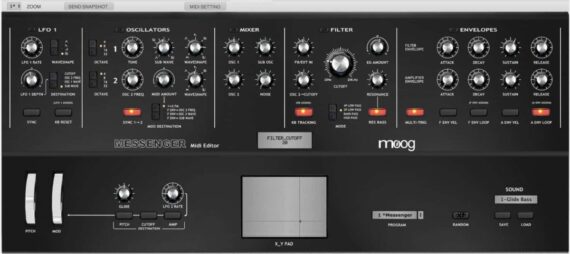
Developer Momo Müller has introduced a third-party MIDI patch editor for the Moog Messenger synthesizer.
The Messenger Editor gives you direct access from your DAW to the Moog Messenger parameters, allowing you to integrate it into the DAW project.
Features:
Complex sound changes can be made easily and quickly.
Change Messenger Sounds directly from Editor.
The Controllers can be automated.
X-Y modulation of all parameters.
You can randomize patch parameters of the Moog Messenger to produce new sounds
Each area has its own random function.
You can use your Moog Messenger as a sound module in your DAW.
A Editor sound bank with 30 new sounds is included.
The Editor are available for:
PC: As VST2 and Standalone for 32bit and VST2, VST3 and Standalone for 64bit Windows.
MAC: As VST2, VST3, AU and Standalone, compatible with MAC Intel and Silicon.
The Messenger Editor is available now for € 6.90/ $ 7.
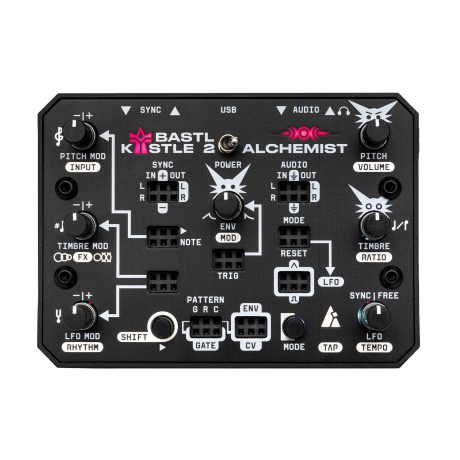
Today, Bastl Instruments has introduced the Kastle 2 Alchemist – a compact, patchable, hybrid-synthesis monophonic synthesizer.
The Kastle 2 Alchemist is the spiritual successor to the original Kastle Synth, which was introduced in the fall of 2016 and later updated to Kastle 1.5 in 2017. It also inherits DNA from the Kastle Arp from 2023.
The Alchemist offers a range of Bastl-brewed Synth Modes – Filter, FM, Supersaw, Hypersine, and GlitchNoise – which can be combined with its internal effects and a versatile Pattern Generator. Rhythms and scales are fully customizable via the web-based app, and expanded MIDI USB compatibility adds even more flexibility.
The Kastle 2 Alchemist is the third firmware release for the Kastle 2 hardware platform, joining the FX Wizard multi-effects processor and the Wave Bard stereo sample player. The firmware is fully cross-compatible across all devices in the Kastle 2 Series – meaning the Alchemist firmware can be loaded onto previous Kastle 2 units and Citadel modules, and vice versa.
Here’s a no-talk, all sounds demo of the Alchemist:
The Kastle 2 Alchemist is available now for €160 ex. VAT