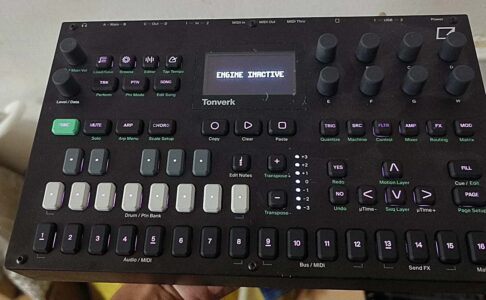
Elektron has released Tonverk 1.1.0, a free firmware update that adds a new granular machine and more.
New in Elektron Tonverk firmware 1.1.0:
Features:
Grainer – Grainer is a SRC machine that lets you chop and sculpt your sample from the smallest fragments of sound into entirely new sonic forms. You control grain amount, size, density, position, randomness, spread, direction, and more – with three Play Modes that shift it from drifting pads to tempo-synced stutters to smooth, oscillating layers. Dive in and explore – you’ll likely manipulate your own wild sounds into existence. Jump over to the FLTR page and dial in Grainer’s unique dual shelving filter to take things even further. Each voice can run up to eight grains, and with every one of Tonverk’s audio tracks able to use eight voices, the Grainer potential is massive. It’s granular made polyphonic, tactile, and expressive.
Shape is a special machine added to enable the shaping of sound on the bus and send tracks. These can be utilized via additional parameters on the filter page, offering a dual shelving filter with low shelf gain, low shelf frequency, high shelf gain and high shelf frequency. You can also head to AMP to access ADSR or AHD envelopes and stereo width control on these tracks.
Bus compressor Sidechain source – Choose what the compressor listens to when shaping the bus mix. Select any track (TRK 1–8) or the external inputs as the sidechain source – letting kicks carve space, external signals drive movement, or any element in your pattern control the dynamics of the whole bus track.
Post FX pan control – Open up the FX Setup and gain the ability to pan the track’s sound after the effects stage, affecting the entire output of the track. This is available for all audio tracks, as well as the buses and sends.
Other fixes and improvements:
The USB MIDI input and output is now functioning as intended (alongside the previously fixed MIDI over DIN), meaning you can create multisampled instruments yourself with ease, via the Auto Sampler.
Undo/Redo functionality is also accessible for paste/clear operations of patterns and track sequences, with deeper Undo/Redo powers to come/in the pipeline.
The sample browser’s look and feel have been sharpened too, part of a number of general improvements to navigation, performance, and stability.
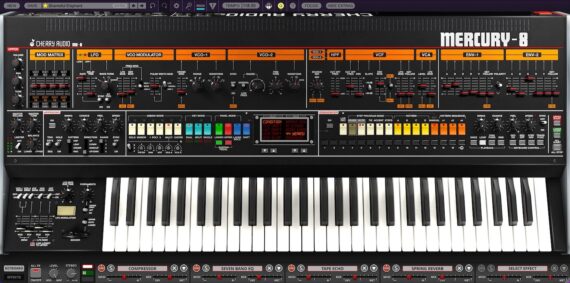
Cherry Audio has introduced Mercury-8, a new virtual instrument for Mac and Windows that’s based on the sound of the classic Roland Jupiter-8.
They say that Mercury-8‘s synth engine has been modeled to “capture the sound and behavior that made the JP-8 so legendary”. Mercury-8 also goes expands on the original’s design by offering expanded polyphony, versatile modulation options, studio-quality effects, and expressive performance capabilities.
Described as a “faithful replication” of the original hardware, Mercury-8 nonetheless implements a handful of modernized features that augment its creative potential. “Mercury-8 is not just another recreation of the legendary classic synthesizer,” reads a press release from Cherry Audio. “It transforms one of the greatest analogue synths of all time into a fresh and inspiring tool for today’s musicians and producers.”
Mercury-8’s virtual analogue synth engine leverages “advanced circuit and behavioural modelling” to deliver its take on the Jupiter-8 sound, integrating analogue drift and aging controls to more effectively capture the vintage vibes we all know and love. Multi-voice modes allow for per-voice variations in pitch, filtering, panning and envelopes to introduce additional analogue-style character.
Expanding the polyphony of the original, Mercury-8’s dual-layer architecture allows for 16 polyphonic voices per sound layer, each of which can be split or stacked across the keyboard. Analogue-modelled high- and low-pass filters imitate the curves of the original synth and offer a choice of 12dB and 24dB slopes in true Jupiter fashion, and modulation capabilities have been bolstered by a four-slot modulation matrix with 25 sources and 43 destinations.
In addition, Cherry Audio has implemented a powerful effects engine made up of three independent effects chains that can each host up to five effects from a selection of 20, including new chorus, pan and pulse effects alongside flanger, compressor, reverb, delay, distortion, ring mod and EQ. And there’s a syncable and transposable arpeggiator onboard, along with a 16×4 polyphonic step sequencer per layer.
Mercury-8 ships with a selection of 600 “out of this world” presets, including recreations of the Jupiter-8’s original bank of 64 factory patches. If you’re lucky enough to own a MIDI-modded Jupiter-8 retrofitted by Encore Electronics, you’re even able to import and export patch data via SysEx between software and hardware.
Features:
The “ultimate JP-8 emulation”, based on circuit and behavior modeling techniques.
Dual-layer voicing architecture, with 16 polyphonic voices per layer. Keyboard split and stacked layer modes allow two simultaneously playable layers, with separate per-layer controls for all parameters, including synthesis, modulation, patterns, and effects
Two oscillators per voice for each layer deliver thick, vibrant tones with classic waveforms, sync, and accurate exponential FM cross-modulation
Triangle, ramp, sine sawtooth, noise, and square or variable pulse waveforms with pulse width modulation
High-pass and resonant low-pass filters for each layer faithfully recreate the legendary Jupiter curves, with 12 dB and 24 dB slope options
Two full ADSR envelopes per layer with velocity, independently assignable to filter, amp, and modulation for expressive control and dynamic sound shaping
Tempo-syncable LFO for each layer, with retrigger option
Analog Drift and Condition Controls to fine-tune the “age” of the synth from pristine new to unstable vintage, with adjustable VCO, VCF, VCA drift, and envelope slop
Solo, Unison, Poly-1 and Poly-2, Multi, and single-key Chord Memory assign modes
Multi-voice mode that adds adjustable “mini synth” trimmers to provide subtle or extreme voice variation in pitch, panning, filter, and envelopes to tones and patterns
Repurposed “digital display” interface with clickable access to extended features such as trigger and note priority, unison voices, multi-voice modes, condition, and drift
Over 600 original presets, along with the recreation of the 64 original JP-8 factory patches (with enhanced versions) and the eight factory setups, all accessible in a convenient preset browser. Also included are template presets that serve as ideal starting points for sound design in Mercury-8, and a MIDI controller mapping compatible with the Jupiter-X hardware synthesizer
Comprehensive modulation matrix with four slots and simple click-to-assign functionality: 25 sources and 43 destinations with optional “Via” controls, including Mercury-8’s integrated effects
Syncable and transposable arpeggiator for each layer with Arp, Leap, Order, and Random modes, and Swing, Chance, and Feel to add degrees of randomness to arpeggiated patterns
Syncable and transposable 16×4 polyphonic step sequencer for each layer with Start, Stop, Auto Start, and humanize options, with accurate DAW clock and step synchronization
Three independent customizable chains of effects, one for each layer plus a global layer, with an individual effects modulator for each layer
20 studio-quality effects that can be arranged, saved, and recalled within their effects chains, which are compatible and can be shared with Cherry Audio’s Trident Mk III synthesizer:
BBD Flanger, Compressor, Digital Delay, Digital Reverb, Distortion & EQ, Dual Delay, Dual Ensemble, Dual Phaser, Envelope Filter, Flanger & Chorus, Galactic Reverb, Lo-Fi, Lushverb, Ring Modulator, Seven Band EQ, Spring Reverb, and Tape Echo. New in Mercury-8 are DCO Chorus, Panner, and Pulser.
Persistent mini UI Effects controls for on/off, solo, bipolar modulator amount slider, and dry/wet mix for each effect. Global FX on/off, level, and stereo expand
Utility panels to easily copy, paste, swap, and move layers, effects chains, and sequencer data between presets
Directly import original JP-8 patch bank SysEx data (Encore Electronics format) via drag-and-drop
Export Mercury-8 preset data to SysEx data (Encore Electronics format)
Standalone virtual instrument and plug-in versions included
User-adjustable oversampling control
Complete MIDI control and DAW automation for all controls, with easy-to-use MIDI learn and mapping (Preset and Global)
Cherry Audio’s popular Focus zoom-in feature, as well as standard UI zoom and resize via drag
Complete documentation available directly online from the instrument or in downloadable PDF format
Mercury-8 Audio Demo:
Mercury-8 Comprehensive Walkthrough:
Mercury-8 is available now for $69. It is also available as part of the company’s Synth Stack 6 collection, which bundles 36 instruments worth a combined $1,687 together for only $599.
Sinevibes has introduced Cache, a new multi-effects processor for Linux, Mac and Windows that lets you ‘play’ effects in real-time via MIDI.
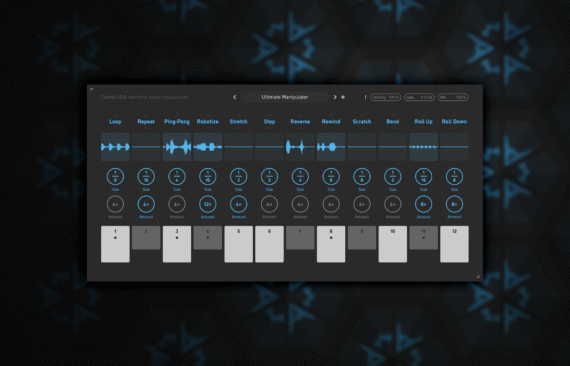
Cache for Desktop builds on their Cache for KORG NTS-3 kaoss pad, expanding on the concept with 12 MIDI key zones and 12 different buffer-based effect algorithms, which you can combine in any way you please.
Cache constantly records all incoming audio, and processes it live through multiple buffer-based algorithms, including repeat, robotize, time stretch, stop, reverse, rewind, scratch and more.
The plugin lets you set up any custom combination of 12 effects and then trigger them via MIDI note events.