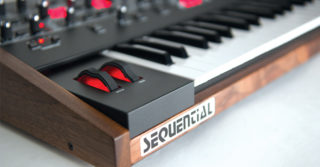
Sequential has released a free OS update for the Prophet-6 and the OB-6 that adds MPE support, Vintage Mode and more.
Sequential says that the updates ‘significantly enhance the expressivity of both instruments’.
Here’s what is new;
Support for MIDI Polyphonic Expression (MPE). This enable the Prophet-6 and OB-6 respond to MPE-driven controllers, including the LinnStrument, Expressive E Osmose, Roli Seaboard series and others.
Improved aftertouch curves for enhanced expressiveness, when using the Prophet-6 and OB-6’s own keyboard.
Prophet-5 Rev 4-style “vintage” mode. This gives the Prophet-6 and OB-6 a ‘looser, more organic sound’ that emulates the behavior of vintage synthesizers, where the behavior of individual oscillators, filters, and envelopes vary from voice to voice.
GForce OB-E synth plugin brings back the Oberheim 8-Voice. 8 SMEs in one massive instrument.
GForce Software has unveiled its magnum opus, the OB-E. A plugin recreation of Oberheim legendary 8-Voice synthesizer, this packs eight of Oberheim classic SEMs into a single unit, giving users a monstrous polyphonic instrument. Each monophonic SEM offers two ADS envelope generators, two VCOs with pulse and sawtooth waveforms, one LFO, and a multimode filter. Bring these together and you have a massive 8-voice polysynth. The OB-E offers complete per-voice control – though you can edit all SEMS at once – and programming is much easier than on the original hardware. GForce has also added an 8-step sequencer and a routable stereo delay. The UI is fully scalable.
Used in Mono mode, OB-E gives you just one Synthesizer Expanded Module (SME) to work with, a good place to start if you want to learn the programming ropes. Switch to Poly mode, and all eight SEMs become visible. Used in Unison mode, and each SEM can be set to different tunings.
The OB-E ships with 600 factory patches, the majority of which have been designed to fit in your mix – though there are a few showstoppers to demonstrate the instrument’s standalone capabilities as well. These have been categorized and tagged to enable you to find the sound you are looking for easier.
The OB-E supports polyphonic aftertouch and is MPE ready. You can also split the upper and lower SEMs across the keyboard. And is offered as a Mac VST/AU/AAX plugin – which will gauge interest in a PC version.
OB-E is available now for the introductory price of £130 plus tax, rising to £150 plus tax on 8 March.
Roland might not be too keen on releasing direct hardware reboots of its classic analogue synths, but it is certainly got no problem doing it in software. Roland has introduced the JUNO-60 software synthesizer, the latest software instrument available through Roland Cloud.
Manufactured between 1982 and 1984, and one of the defining synths of that decade, the Juno-60 is a much-loved polysynth with a single DCO, sub-oscillator and VCF. In addition, there is also that famous Juno chorus effect.
The software synth is powered by its ACB (Analog Circuit Behaviour) modelling technology and promises to recreate the original synth’s “odd quirks and charming limitations”. Additionally, there are some new features ; – example, you can choose between the standard Juno-60 filter and the high-pass filter circuit from the Juno-106. Other enhancements include an extended oscillator range and a second envelope. As on the original, you get two chorus modes plus a third ‘secret’ one that’s accessed by pressing both chorus select buttons at the same time, and there is now an extra chorus option based on the sound of the BOSS CE-1 pedal, along with Reverb, delay, flanger and overdrive effects as well.
The JUNO-60 Software Synthesizer can operate as a VST/AU/AAX plugin on PC and Mac. The Juno-60 also supports Roland’s Plug-Out format, meaning that it enable you to use it in the company’s System-8 hardware synth. In addition, you can also use the System-8 or Roland Boutique JU-06/JU-06A to provide hardware control of the plugin.
The JUNO-60 is part of the Roland Cloud Legendary series, which is available on the Ultimate subscription tier of the service. Anyone with a Roland account can also purchase the plugin outright via the Lifetime Keys option for $149.
The JUNO-60 Software Synthesizer is available now via Roland Cloud. Find out more on the Roland Cloud website.