The latest episode of Auteur Cinema takes a look at David Lynch‘s Eraserhead – considered by some to be the ultimate cult movie.
How Eraserhead Changed Sound Forever features Lynch and others, discussing how he and sound designer Alan Splet created the unique audio landscape of the film.
With Eraserhead, Lynch made sound equal to cinematography. While the film never reached a large audience, it nevertheless has had a profound influence on cinema, game design, and music.
Video Summary:
“Despite opening to little interest, over the years Eraserhead has become an increasingly influential film, particularly in the field of sound. In this essay I explore how David Lynch, alongside legendary sound designer Alan Splet, created the industrial soundscape of Eraserhead and how it has and will continue to influence artists across all mediums.”
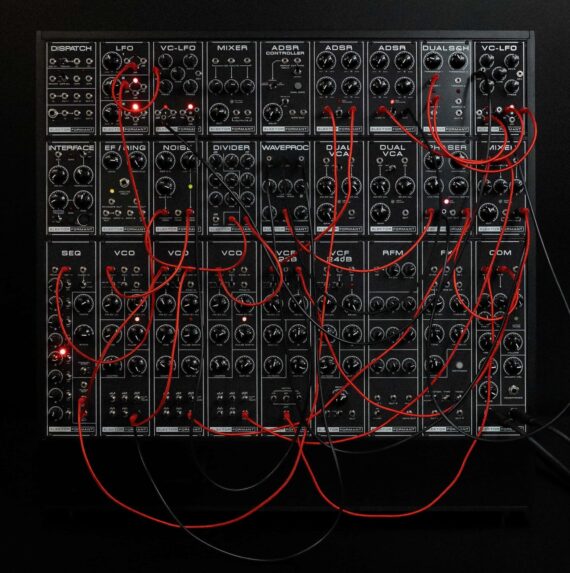
In May 1977, Elektor magazine published the first of a series of articles that document building the Formant modular synthesizer. The Formant, designed by C. Chapman, was designed to an affordable DIY alternative to the commercial modular synths of the day.
Last year, Erica Synths introduced a modern reissue of the Formant modular, with 27 module kits available for DIYers.
Carr shares an overview of the Formant modular, history of the system, sound demos and more.
Topics covered:
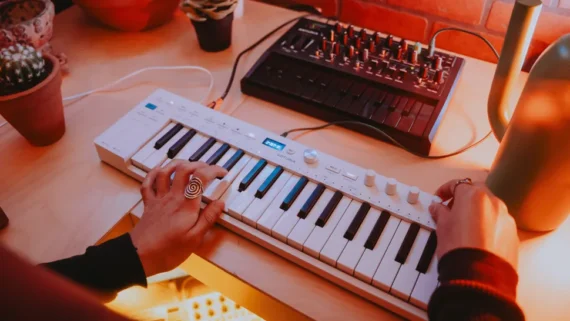
Arturia KeyStep 37 Mk2 with redesigned interface, extended connectivity and generative tools.
Following the launch of its KeyStep Mk2 MIDI controller keyboard in November last year, Arturia has unveiled the KeyStep 37 Mk2, bringing many of the features from the Mk2 over to its 37-key big brother.
KeyStep 37 Mk2 has been equipped with more physical controls – an upgrade that Arturia says “drastically enhances its playability” – while expanding connectivity via USB-C and introducing a more sophisticated sequencer and arpeggiator with generative capabilities.
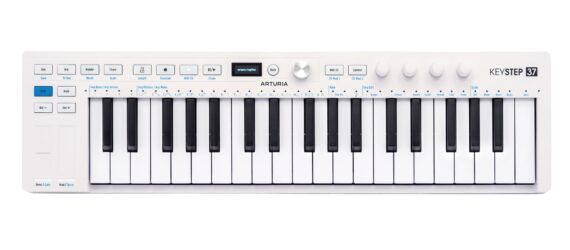
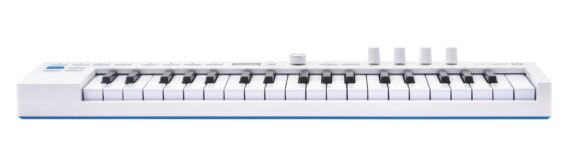
KeyStep 37 Mk2 is equipped with the same 37-key slim keybed with velocity and aftertouch as its predecessor, but has been kitted out with a strip of 39 LEDs above the keybed that provides visual feedback on notes played by the keyboard.
The top panel has received a significant redesign and now features an OLED screen, a clickable encoder for navigation and editing, and dedicated buttons for KeyStep 37’s Chord Mode and Mutate function, which allows for one-touch transformation of patterns and sequences. These are joined by transport controls, dual touch strips and four assignable encoders.
The sequencer has been updated with support for unquantized recording and pattern chaining, and the arpeggiator has been equipped with eight new modes. Scale and Chord Modes have been brought over from the KeyStep Mk2, while the generative Spice and Dice functions (lifted from the MicroFreak) enable you to create randomized variations on sequencer and arp patterns in real-time.
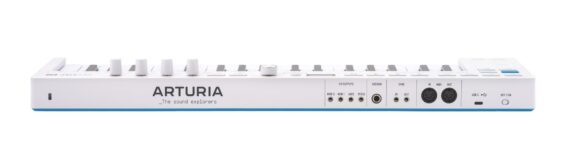
On the hardware front, Arturia has added a power switch, traded the USB Micro-B connection from the KeyStep 37 Mk1 for a USB-C port, and thrown in a second CV output. All told, KeyStep 37 Mk2 features four 3.5mm CV outputs, MIDI In/Out over 5-pin DIN, analogue sync in/out and a 1/4″ sustain pedal jack.
Main Features:
37‑note Slimkey keyboard with velocity & aftertouch
2 capacitive touch strips for pitch‑bend & modulation
Polyphonic step sequencer: up to 64 steps, 8‑voice polyphony
16‑mode arpeggiator with generative pattern styles
Mutate, Spice & Dice tools for live variation
Chord & Scale modes for instant harmony
OLED display with clickable encoder & RGB LED feedback
4 encoders + Control button. Hands-on, mode-aware editing for Seq, Arp, Chord, and Mutate
MIDI CC button with 4 banks. Access 16 assignable MIDI CCs available across all modes
4 controllable CV/Gate outputs (Pitch, Gate, Mod 1, Mod 2) assignable to velocity, aftertouch, mod wheel & more