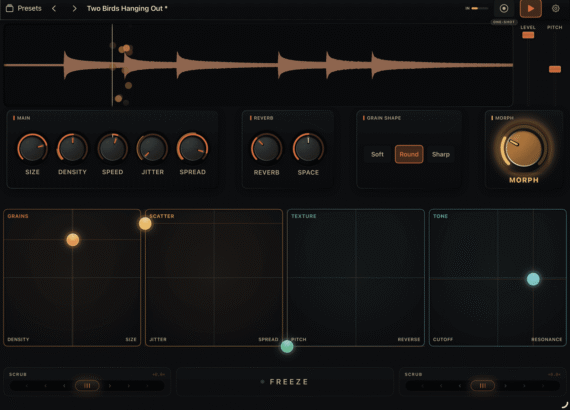
Plastic Factory has introduced Grainsmith Field, a new granular synthesizer for iPad and iPhone.
They say the idea behind Grainsmith Field was to make granular approachable, so it sounds great, and you can play it without digging through menus
Features:
Four XY performance pads control paired parameters (Density/Size, Jitter/Spread, Scan/Reverse, Cutoff/Resonance), with a Morph macro that sweeps several at once
Area Select: long-press the waveform and drag handles to bracket exactly the region the grain cloud plays, with live feedback as you drag
Live Mode: capture audio from a mic or instrument input and granulate it in real time, freeze the cloud, scrub the waveform, export WAV to Files
Instrument mode: play the grain engine from a MIDI keyboard with four-voice polyphony and an attack/release envelope
AUv3 + standalone: loads in AUM, Logic for iPad, and GarageBand with full parameter automation and saved session state
Reverb, filter, grain-shape windows, factory presets, and a compact iPhone layout
Grainsmith Field is available now with an intro price of $9.99 USD.
In the video, synthesist and developer Stretta demonstrates Smol Sequencer, a browser-based modular sequencing environment.
Video Summary:
The video explores how how small sequencer modules can be interconnected to create evolving musical patterns.
Learn to manipulate note values, introduce randomization, and utilize pitch class rotation for scale-based composition, all before sharing your unique musical ideas through compressed, link-based project files.
Smol Sequencer is available now as a free, browser-based application.
Arturia’s new Ocean-inspired reverb will turn your sounds ‘into a living sonic current’. Rev Ocean brings shoegaze-friendly modulated reverbs to your DAW.
Arturia has launched Rev OCEAN, modern reverb designed for fast, intuitive space creation. Rev Ocean is a reverb that, as its name suggests, takes inspiration from the sea, supposedly resulting in a plugin that can turn ‘a simple reverb tail into a living sonic current’ and ‘transform any sound into a fluid, ever-shifting sonic space.’
That description might sound a little New Age and vague – and the plugin’s UI design looks like it could be lifted from a flyer for your local aromatherapy clinic – but under-the-hood Rev Ocean features an interesting combination of reverb, pitch and modulation tools.
The plugin is built around a feedback delay network design with multiple stages of diffusion. It features three modes, labelled Abyss, Tide and Foam, which each offer a different combination of diffusion behaviour and modulation.
Abyss adds multiple reverse layers in parallel, with subtle pitch modulation used to spread these reverb tails resulting in, according to Arturia, “a harmonically rich evolving tail.”
Tide introduces independent filtering of the left and right channels of the reverb output, to create ‘wave-like’ stereo swells.
Foam has a long, slow attack and cloud-like build up designed to destroy transients and create dense, washed-out effects that are said to be perfect for shoegaze-style guitars.
Beyond the modes themselves, Rev Ocean has controls for Decay, Size and Brightness. There’s also a high/low input filter, and controls for width, transient control, ducking and pre-delay.
Features:
Multi-stage diffusion to build dense and evolving reverb tails
Three Macro Modes are provided: Abyss, Tide, and Foam