SSL releases UF1 Controller – A DAW Control Centre


Solid State Logic’s UF1 promises to “set a new standard for single fader DAW controllers” In fact, it can control up to three DAWs simultaneously.

The idea that you can take “comprehensive” charge of your DAW using a single fader controller might seem illogical, but that is the claim that the company is making on behalf of their UF1.

This new controller might be the UF8’s (much) smaller sibling, but it’s still said to pack in the features. As well as the 100mm motorised fader you also get dual high-resolution displays, soft-feel rubber keys and a weighted jog wheel, all wrapped up in a metal chassis.

You can also control your DAW’s pan settings, sends and plugins, and customise the 46 soft keys to suit your workflow. Plus, the UF1 integrates tightly with the new SSL Meter plugin and existing 360° software.
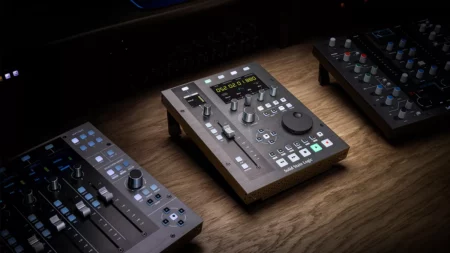
The device can actually control up to three DAWs simultaneously, and comes with profiles for Pro Tools, Logic, Cubase, Studio One, Ableton Live, LUNA, and Pyramix. Your projects can be navigated with both the jog wheel and dedicated transport controls, and you can also access your DAW’s automation modes.

The displays can show track names, parameters and the time display, or feedback from the SSL Meter plugin. A copy of this comes in the box; it can display Peak & RMS levels, K-System, stereo balance, phase correlation bar, Lissajous phase scope, 31-band RTA, VU and PPM metering.
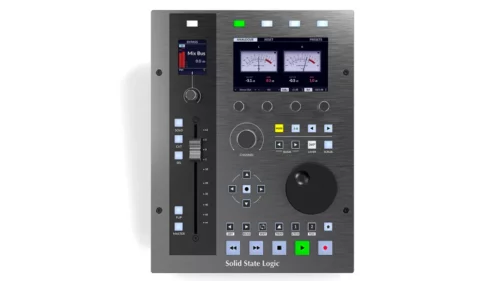
As well as being suitable for use on its own, the UF1 can also function alongside the aforementioned UF8 and the UC1 plugin controller.

The UF1 is available now priced at $699/£600/€599. Find out more on the Solid State Logic website.

NUGEN Audio releases Aligner Plug-in

NUGEN Audio had announces the availability of their Aligner plug-in, for Mac and Windows, with updated features and functionality.

Designed to enhance the daily workflow of audio engineers with convenience and speed, the plug-in can perfectly align audio with just the touch of a button.

Using more than one microphone to record a sound source will sometimes cause phase or polarity issues between different tracks, due to mic distance or any other factor that causes the audio to reach one track before the other. Oftentimes, this is almost imperceptible, but in many cases, it can result in the recording sounding thin or weak.

“With Aligner, you can avoid fixing these issues manually, which will allow more time for creativity,” says Freddy Vinehill-Cliffe, Product Specialist, NUGEN Audio. “It can be utilized in various instances, including when lining up a multitrack recording with microphones at different distances, or where the polarity of one microphone is reversed. Users can also apply the tool to ensure a microphone signal and DI signal are lined up correctly.”

Aligner features two kinds of bypass controls: one for all tracks at once and another for each individual channel. With this plug-in, users can choose which of the audio tracks they want as a reference point for other tracks to align with. Additionally, Aligner includes a polarity parameter to show if any of the tracks switched polarities while employing the plug-in. For users who prefer to align an audio track on their own, Aligner also provides the option to make sample delay or phase adjustments manually.

Initially offered as a “stealth” product for NUGEN subscribers who responded to the company’s annual survey, Aligner is now available for anyone to buy, with an improved algorithm from the original release.

Aligner is available now, with an intro price of $29 through June 28th (normally $49).

Klevgrand introduces Richter ‘Tectonic Compressor’ Plugin


Klevgrand has introduced a new audio plugin designed to go beyond ordinary compression. Klevgrand Richter is a ‘tectonic’, super-heavy compressor plugin that the company thinks is off the scale.

Richter is another Klevgrand’s compressor plugin. However, Klevgrand believes that, with Richter, it’s managed to do something a bit different. This “tectonic” device is designed to achieve earth-shaking levels of compression without creating too many audio artefacts, and all via a very simple interface.

There are just two main controls: Transients and Amount. The first controls “how the internal envelope follower will react to transients vs continuous/lasting sounds,” while the second dictates how much compression is applied.

Meaning that you use these two knobs in tandem to get the style and amount of compression that you want, whether that be on vocals, drums or anything else. A three-step boost switch can be engaged to push things even harder, and you can also adjust the makeup gain, dry/wet mix, input trim and a simple EQ. If you are looking for starting points, check out the factory presets.

The effect that Richter is having is visualised in the waveform view, but the idea seems to be that you will spend less time analysing and examining and more time tweaking and listening.

Features:

  • Superheavy compression with minimal unwanted artifacts.
  • Intuitive Transients and Amount dials.
  • Real time graph visualization.
  • Tonal control.
  • Three-step boost switch.
  • Input trim control.
  • Makeup gain, Dry/Wet mix and Output control.

Richter runs on PC and Mac in VST/AU/AAX formats and is currently available for the introductory price of $29.99 until 15 June, after which the price goes up to $69.99.

There is also an iOS version (AUv3 and iPad standalone) that is currently available for the introductory price of $4.99. This will rise to $12.99 after 15 June.