Synthesist Starsky Carr, in his latest video, shares his thoughts on the new Expressive E Osmose – a synthesizer he describes as ‘a glimpse of the future’.
Carr discusses his process of learning the Osmose as the 7 stages of enlightenment:
0:00 1 Shock – overview of the hardware
2:11 2 Realisation – whats MPE and how does it work
12:22 3 Conceptualisation – how to use it & controlling the sensitivity
15:21 4 Understanding – getting to grips with the Haken Editor
24:58 5 Rejection – some minor issues and some bigger ones
32:29 6 Acceptance – integrating into your studio
33:12 7 Enlightenment – Sunny Uplands of Synthershire
“The software can be a b*tch at first,” notes Carr, “and its so frustrating that a few tweaks to the manual would’ve saved me a day or so of headscratching.”
But his main takeaway is that, once you’ve experienced the expressive capabilities of the Osmose, “a lot of synths will feel lacking”.
Watch the video and share your thoughts on it and the Osmose in the comments!
Merkaba Electronics shared this preview of a new electro-acoustic synthesizer, String Armonica.
The String Armonica is a MIDI instrument that uses electromagnets to resonate twelve strings. Using the power of harmonic resonance, it can play up to 48 notes of full polyphony.
And, all the sounds that the instrument produces originate solely from the vibrations of the strings themselves. Nested within the body of the instrument lies a a polyphonic synthesizer, which outputs notes that resonate the strings and their octave harmonics.
How they explain it:
“The String Armonica works differently than how a guitar sustainer works. In a sustainer (Sound Stone, Ebow, etc), it will resonate a string regardless of its tuning. In order for the String Armonica to correctly work, the strings must be tuned so that they match the resonant frequency of the internal synthesizer. By adjusting the tuning pegs, you’re able to “voice” the loudness of each octave and can make certain octaves louder than others or of equal volume.
When you listen through headphones, the stereophonic output becomes evident as one set of strings is panned to the left and another to the right, creating a rich, immersive experience. However, a monophonic option is available as well.
The name of the instrument, The String Armonica, pays homage to the rare Glass Armonica, an exquisite crystal glass instrument invented by Benjamin Franklin. The resemblance in the sound produced by our instrument to that of a Glass Armonica is very similar which is why we thought of this name.
In our improvisation demonstration, we explore the instrument’s potential by adjusting the volume with an expression pedal and using the mod wheel of the MIDI controller to generate a staccato tremolo effect.
It’s important to note that this is a prototype. In its current state, it may appear a bit rough around the edges due to several adjustments and changes we’ve made along the way. The final manufactured version will be significantly more refined and less crude.”
Details on pricing and availability are still to be determined. Merkaba Electronics has a form on their website to sign up to get more information and to be notified when the instrument is available to pre-order.
“Makes the white dot spawn little golden play heads”: Brinta could be the granular sampler we all need.
Error Instruments and This Is Not Rocket Science (TINRS) team up to produce this fascinating-sounding Eurorack sampler.
Reading the description of Brinta, the new eurorack sampler collaboration from Error Instruments and TINRS, makes us feel good with the world.
‘Samples one moment, cuts it into thousands of pieces. Little grains of sound. Makes the white dot spawn little golden play heads.’ We already love it.
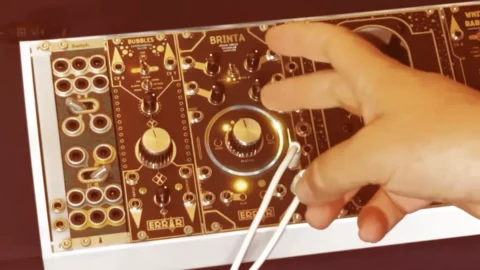
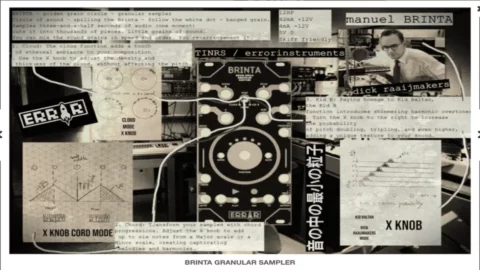
Brinta is a Eurorack granular sampler which Error Instruments describes more as an effect. The design and sampling process of Brinta are its standout features, and it’s as much about how the visuals interact with what you are doing and the sound itself as it is the end result.
When you sample audio into Brinta, a dot circles for up to a maximum of three and a half seconds recording time. The sample then ‘becomes the circle’ with different colours representing different parts of the frequency spectrum: blue for high, green for mid and red for low. When they all come together that makes white-light and white-noise.
“Once your sample is recorded the white dot can run around the circle, spawning little golden heads playing your sample. The size of the grain is how long your play head exists.”
Brinta has several different function options that make it even more enticing to use.
The first is Cloud which ‘fluffs out’ the golden play heads around the white dot to make the cloud thin, long or thick. However, we are not sure what this effect has – it’s probably more a broadening of the granular effect and making it less focussed but, either way, it has no effect on pitch.
Chord enables you to create up to six notes in a major scale (by turning the X control left) and minor scale (by turning it right). Kid B is a harmonic setting in honour of Dutch electronic and tape music pioneer Kid Baltan. Turn the X knob right and you get an increased probability of pitch doubling, tripling, quadrupling and higher for more shimmering harmonic overtones.
Among other functions are a speed control to increase the playback of the white circle playing your sample, and Pitch which has a +/- 2 octave range.
Watch the video above for how Brinta works and enjoy the enthusiasm of two of its developers. It really is quite mesmerising as they mess with some piano sounds.
Brinta will be released at the beginning of September, price at €250 plus tax.