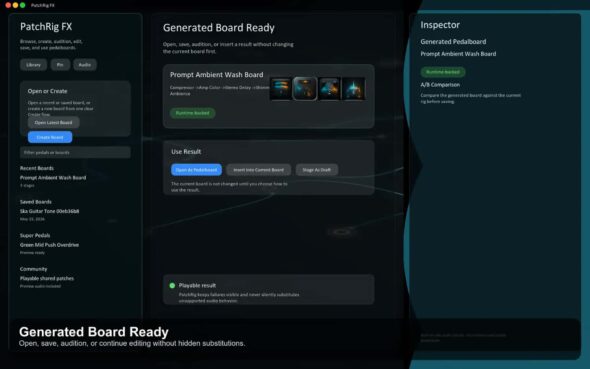
CodeFarmer developer Rob Rightmyer let us know about PatchRig FX, a new multi-effects app for iPhone, iPad, and Mac that lets you use and create custom effects boards.
Free users get curated boards, built-in audition sounds, prompt board preview, and basic reference analysis.
PatchRig Pro is optional and unlocks the full 500-board and 500-pedal library, 60 super-pedal style designs, pedal/amp/preamp/DSP designers, MIDI/instrument voices, unlimited saved boards/pedals/amps, export, iCloud sync, sharing, and community publishing.
Here’s how you can get a playable tone via prompts:
*Note: The app is not designed to be an exact artist, song, amp, cabinet, IR, recording, or preset clone tool. It creates original playable rigs from built-in audio blocks and keeps limitations visible.
PatchRig FX is available now for free with in-app purchases:
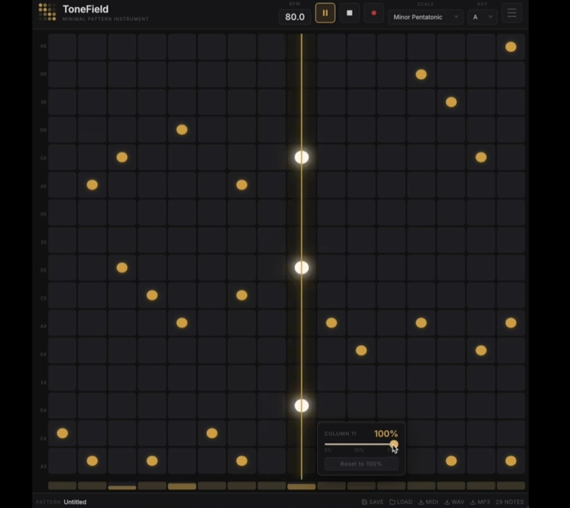
Developer and musician Matt Goodluck let us know that he’s introduced a new software instrument, ToneField.
Goodluck said that it’s inspired by an old app, TonePad Pro, that’s no longer available. Goodluck says he “rebuilt the concept from scratch, expanded it into a modern instrument and launched it as ToneField.”
ToneField keeps the minimalist pattern-based workflow that made TonePad addictive, but adds features including selectable scales and modes, probability for evolving generative patterns, live performance recording, MIDI export, audio export and pattern management.
Place dots on the grid, press play and let the music unfold. You can use the probability controls to make your patterns evolve with every loop.
Features
Original ToneField Classic sound engine — pure sine wave synthesis with precision decay
16×16 step sequencer with amber dot interface
Per-column probability for generative, evolving patterns
13 scales including all 7 modes and pentatonic variants
All 12 keys
BPM 40–180
Velocity and gate control
Delay with time, feedback, filter and mix
8 named pattern save slots
Record live performances as WAV — capture every probabilistic variation in real time
Export patterns as MIDI for Logic Pro, GarageBand and any DAW
Export audio as WAV or MP3
Live MIDI output to your DAW as the pattern plays
Transform tools — flip, rotate, shift and randomize your patterns
Jasmine & Olive Trees, Barcelona-based Euro maker – let us know about their new drum module that has a unique capability to change function through the use of panel overlays.
Doppler is a compact Eurorack percussion processor that accepts an oscillator, sample, or other audio signal and the module reshapes it into kicks, snares, hi-hats and “stranger stuff in between”.
The engine is a delay-line pitch processor, so a trigger resets the read head, it sweeps down to a target depth, and out comes that falling-pitch kick. A single knob (Mod) sweeps the whole thing continuously, from pitch-shifted chords, through the Doppler kick zone, into FM and cross-modulation for metallic, industrial hits.
Every CV input takes audio-rate modulation, so you can push it somewhere genuinely chaotic if you want to.
That One Weird Trick
Doppler changes its firmware when you lay a different overlay on top of it. No computer, no reflashing, nothing to unscrew. You set an overlay panel over the module, and instantly it’s a different instrument, with the new panel’s labels lined up with the new functions.
This is the first time we’ve seen this feature in a synth module.
The module ships with three overlays included, free.
Door is a stereo LPG that reacts to pitch and rhythm.
Doppler is the “drummerizer”.
Rubin turns it into a stereo ADSR VCA/VCF.
Lichen makes it a dual AD/VCA.
So the single module can function as a LPG, a drum voice, a stereo ADSR, or a pair of envelope VCAs, depending on which overlay is sitting on it.
The developer says that, because it’s built on a DSP platform, future “family firmwares”can be loaded to the module, as they are developed.
Features:
Doppler processes external oscillators, samples, or other audio signals into percussive sounds
The processing range moves from a clean signal through pitch-envelope processing into FM modulation
Thirteen chord voicings are available
Chord voicings include major, minor, suspended, sixth, seventh, ninth, and eleventh chords
Chord processing uses four pitch-shifted taps
The Body input handles the main signal
The Trans input provides a dedicated transient channel with an auto-tuned band-pass
VCA and LPG modes are selectable by long-press
VCA and LPG mode selection is saved to memory
An independent noise output provides a dust oscillator
The dust oscillator density tracks the character of the input signal
CV inputs are provided for Attack, Decay, Mod, and Amount
Smart Attack provides noise decay when turned to the left and a long swell when turned to the right