In the video, composer Josh Madoff discusses MIDI Polyphonic Expression (MPE), a standard that enables per-note expressive control over pitch, volume, timbre and more.
Topics covered:
00:00 Intro
00:15 What does MPE mean?
00:28 A simplified history of the keyboard
02:00 Hear MPE in action
02:43 MIDI vs MPE
04:15 MPE & software synths
05:54 MPE & hardware synths
07:42 Discovering the MPE arpeggiator
08:40 Creating an MPE super synth
09:52 Different kinds of MPE instruments
11:25 MPE playing examples
12:55 The benefits of MPE
Amazon Spring Promotion Effective February 25, 2025 to March 10, 2025, Get What You Want Now!
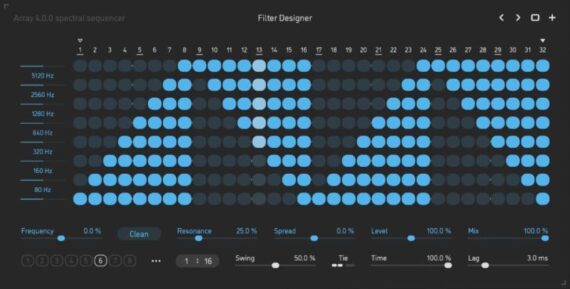
Sinevibes has released Array 4, a major update to their spectral sequencer effect plugin for Linux, Mac and Windows.
Using multiple crossover filters, Array splits audio into 8 frequency bands that are separated exactly one octave apart. Each band then runs through a gate controlled by an advanced step sequencer – allowing you to carve the audio spectrum in precise rhythmical fashion.
The official video intro:
The sequencer holds a total of 8 different gate patterns, with up to 32 steps each, and offers a wide range of timing settings for creating polymetric or polyrhythmic motion in any time signature.
The gate switches on every frequency band are shaped using a two-pole low-pass filter. Combined with the unique design of the filter section, this timing engine makes Array an versatile instrument for complex rhythmical manipulation of the sound spectrum.
Features:
Clean, neutral -24 dB/octave crossover filters that split audio into 8 frequency bands, tuned one octave apart
Optional state-variable, resonant band-pass filters per each frequency band, tuned one octave apart, with adjustable slope
Individual gate sequence per frequency band, with 8 separate sequence patterns per preset
Step sequencer with rhythmically correct swing, polymetric and polyrhythmic abilities
Two-pole analog-style lag filters for variable gate transition smoothing
Progressive bipolar pan spread between the frequency bands
One-pole lag filters on all continuous parameters for smooth, click-free adjustment
Composer & synthesist Anthony Marinelli – in his latest video – takes an in-depth look at how to recreate the sliding melody synth sound from Roy Ayers’ classic track, Everybody Loves the Sunshine.
Marinelli demonstrates how to recreate this sound using the ARP 2600, but notes that you could get similar results with a Minimoog and other synths. Along the way, he covers the oscillator tunings and performance techniques that are essential to creating this classic sound.
He also explores how the track’s arrangement makes space for the lead, complementing the song’s rhythm section.
Watch the video, and share your thoughts on it in the comments!
Amazon Spring Promotion Effective February 25, 2025 to March 10, 2025, Find Your Favourite!