Archive for November, 2026

Audio Damage Sandbender, A Four-Operator FM Synth With Wavefolding & MPE
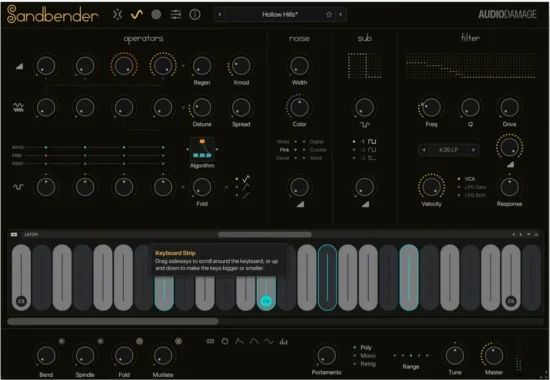

Audio Damage’s new Sandbender synthesizer combines four-operator FM synthesis with wave shaping, wavefolding, extensive modulation, and a low-pass gate, offering a different approach to programming and performing FM sounds.

Audio Damage has introduced Sandbender, a four-operator FM synthesizer that combines frequency modulation with wave shaping, wavefolding, filtering, and low-pass gate processing.

]The instrument takes a different approach to conventional FM synthesizers, adding sound-design and performance features alongside its operator-based synthesis engine.

Sandbender includes ten factory FM algorithms and an algorithm designer that allows users to draw their own operator routings. Each operator can function as both a sound source and a modulator, with tuning options that include harmonic ratios, free ratios, and fixed frequencies.

Beyond the conventional FM architecture, each operator has an independent waveshaper, while additional processing includes a wavefolder, sub oscillator, six noise types, and a stereo filter section. The synthesizer also includes a modeled low-pass gate, offering an alternative to conventional VCA-based amplitude control.

Features:

  • Four-operator FM synthesis with ten factory algorithms and a customizable algorithm designer.
  • Independent operator tuning using harmonic ratios, free ratios, or fixed frequencies.
  • Operator controls include Xmod, Regen, Detune, Spread, and a frequency range from 32′ to 2′.
  • Individual operator waveshaping that morphs between triangle, sine, and pulse waveforms.
  • Wavefolder with symmetric, asymmetric, and soft-clipping modes.
  • Sub oscillator with selectable octave divisions and independent waveshaping.
  • Six noise types: White, Pink, Velvet, Digital, Crackle, and Metal, with additional Color and stereo Width controls.
  • Eleven filter types based on state-variable, ladder, diode, and Sallen-Key designs, with low-pass, high-pass, and band-pass configurations.
  • Selectable VCA and modeled low-pass gate operation, with the low-pass gate linking brightness and amplitude response.
  • Two ADSR envelopes per voice, with adjustable attack and fall curves.
  • Two LFOs with host-tempo synchronization, delay, and per-note retriggering.
  • Two function generators that can operate as triggered envelopes, cycling LFOs, or modulation processors.
  • Sixteen-step sequencer with forward, reverse, pendulum, and random playback modes.
  • Drag-and-drop modulation routing, allowing modulation sources to be assigned directly to synthesizer controls.
  • Four assignable macro controls for managing multiple parameters and host automation.
  • GENETICS preset generator that creates variations of existing sounds using a family-tree interface.
  • PERFORM interface with two assignable performance nodes and a gesture recorder for capturing movements in loops of one to eight bars.
  • Six integrated effects, including Evil Otto multiband compression, Dubstation delay, ADverb, Quatromod, Kombinat, and Phasetwo.
  • Reorderable effects chain with individual mix controls.
  • Full MPE support and MTS-ESP microtuning.
  • Eight-voice polyphony, with polyphonic, monophonic, and retriggered monophonic modes.
  • Portamento, output limiting, and selectable 1x to 8x oversampling.
  • More than 260 factory presets organized into nine categories.

Audio Damage Sandbender is available for macOS, Windows, Linux, and iOS for $99 USD.
Bram Bos Introduces MIDGAR Creative Ambient Processor


MIDGAR combines phrase capture, distortion, spectral processing, stereo delay and shimmer reverb in a multi-stage effects processor for mobile and desktop music production.

Bram Bos has released MIDGAR, a multi-stage creative effects processor for iOS, iPadOS and macOS.

Designed as an ambience and sound-transformation tool, MIDGAR combines several independently controllable processing sections to turn relatively simple audio sources into evolving textures, rhythmic fragments and layered effects.

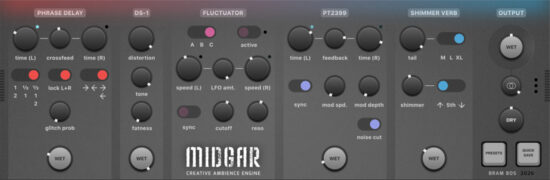
MIDGAR’s processing chain begins with a Phrase Delay that records short sections of incoming audio and plays them back at different speeds. The captured material can be distributed across the stereo field, with additional controls for creating stuttering and glitch-like repetitions.

A distortion section provides additional processing, while the Fluctuator section introduces spectral and spatial movement. The stereo delay section uses two simulated PT2399 CMOS delay chips, followed by a shimmer reverb designed to produce large spatial effects.

The individual sections can be adjusted to create different combinations of rhythmic, distorted and ambient processing. MIDGAR can be used as an AUv3 effect within compatible music applications and DAWs, or operated in standalone mode.

Features:

  • Multi-stage creative ambience and effects processor
  • Phrase Delay for recording and repeating short sections of incoming audio
  • Variable-speed playback of captured audio fragments
  • Stereo positioning and glitch-style repetition controls
  • Distortion processing section
  • Fluctuator processing for spectral and spatial movement
  • Stereo delay based on two simulated PT2399 CMOS chips
  • Shimmer reverb with independently controllable shimmer processing
  • Individually adjustable processing sections
  • AUv3 plugin support
  • Standalone operation with four built-in sounds

The combination of phrase capture, variable-speed playback, distortion, stereo delay and shimmer reverb gives MIDGAR a workflow that differs from a conventional multi-effects processor. Rather than applying a collection of unrelated effects, its stages are designed to interact, allowing captured audio fragments to be reshaped and layered throughout the processing chain.

The instrument can be used to process synthesizers, drum patterns, samples and other audio sources. Its standalone mode also provides a way to explore the effects without first loading an external audio source.

MIDGAR is available for iOS, iPadOS and macOS through the Apple App Store for $9.99. The application supports AUv3 operation in compatible hosts and requires iOS 15.6 or later, iPadOS 15.6 or later, or macOS 12.5 or later.

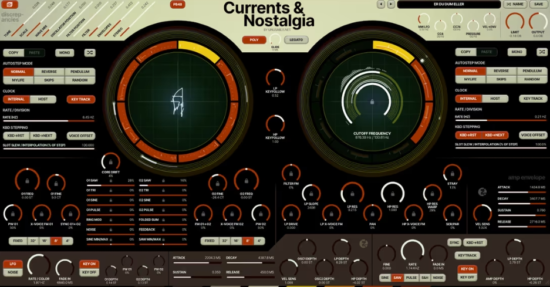
Unusable Engineering Introduces Currents & Nostalgia, A New Subtractive Synthesizer


Currents & Nostalgia is a new subtractive synthesizer that uses two independent sequencing systems to evolve oscillator and filter configurations.

Unusable Engineering has released Currents & Nostalgia, a 6-voice virtual analog synth built around a pair of circuit-modeled oscillators and an unusual system for sequencing oscillator and filter settings independently.

The developer describes the instrument as an original design inspired by classic synthesizer architecture rather than an emulation of a particular vintage instrument.

Currents & Nostalgia uses two main oscillators based on a saw-core circuit design developed for an earlier hardware project. Component tolerances introduce small differences between the oscillators, and users can control the amount of variation.

The instrument’s central feature is its two independent slot systems. One stores oscillator and waveform-mixer configurations, while the other stores filter settings. Each system can hold up to eight configurations, which can be stepped or swept through using different patterns.

The two systems can operate at different speeds, follow the host clock or respond to keyboard activity. Their operating rates can also extend into audio frequencies, creating possibilities beyond conventional stepped modulation.

Features:

  • Two circuit-modelled saw-core oscillators
  • Adjustable oscillator variation based on component tolerances
  • Independent oscillator and waveform-mixer slot system
  • Separate filter slot system
  • Up to eight stored configurations in each slot system
  • Independent sequencing speeds and patterns for oscillator and filter settings
  • Clock synchronization and keyboard-responsive operation
  • Modulation rates extending into audio frequencies
  • Parameter locks for retaining individual settings during transitions
  • 350 included presets

The independent slot systems provide an alternative to conventional modulation-matrix programming. Rather than simply assigning an LFO or envelope to individual parameters, users can move between complete oscillator and filter configurations, creating sequences that evolve through different stages of a sound.

For example, an oscillator configuration can change several times while the filter remains in one state, before the filter begins moving through its own sequence. This approach can produce repeating or evolving timbral changes without requiring a conventional step sequencer.

Currents & Nostalgia is available now for macOS 12 or later in AU and VST3 formats, and for Windows 10 and 11 in VST3 format. The price is €89, including Danish VAT.