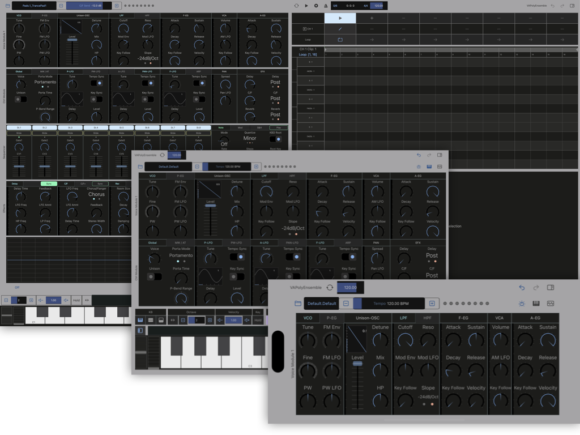
VAPolyEnsemble is part of RT Music Software’s VAPoly synthesizer lineup for Apple platforms. The instrument combines polyphonic synthesis with integrated sequencing, effects processing, MIDI support, audio export, and Audio Unit Extension (AUv3) compatibility.
Like other recent VAPoly instruments, it is designed to operate as both a standalone application and an AUv3 plugin, allowing use within compatible iOS and macOS hosts.
Features:
Polyphonic synthesizer architecture
Standalone operation for iPhone, iPad, and Mac
Audio Unit Extension (AUv3) support
Integrated piano-roll sequencer
Parameter automation editing
Multi-clip pattern workflow
Built-in effects processing
MIDI input and output support
Bluetooth MIDI support
Ableton Link support
Audio export functionality
iCloud Drive project storage
Support for external MIDI controllers
Compatibility with iPhone, iPad, and Mac platforms
VAPolyEnsemble is available now through Apple’s App Store ecosystem for iPhone, iPad, and Mac for $5.99 USD.
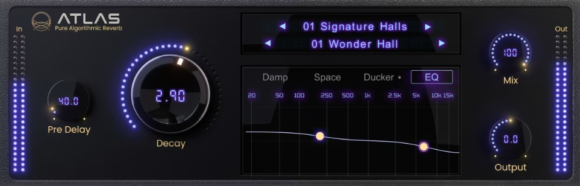
Waves Audio has introduced Atlas Reverb, a new algorithmic reverb effect for Mac and Windows.
The plugin provides controls for shaping the behavior and placement of the reverb within a mix, including parameters for adjusting depth, dimension, and movement.
Features:
Algorithmic reverb engine based on classic DSP processing
Controls for adjusting depth, dimension, and movement
Designed for use within full mixes and individual tracks
Preset-based workflow
Available through the Waves plugin ecosystem
Supports Waves Central installation and management system
Available as a plugin for macOS and Windows systems
Supports Audio Units, VST, VST3, and AAX plugin formats
Compatible with major DAW applications supporting supported plugin formats
Waves Atlas Reverb is available now for $99.99 USD (normally $149)
All The Machines has introduced False Memory, a real-time audio disintegration effect.
False Memory is an effects plugin designed to progressively degrade incoming audio, using two parallel processing paths:
The Analog path focuses on tape-style pitch instability, reel-to-reel saturation, and VHS-inspired tracking behavior.
The Digital path applies aliasing, circuit-bent artifacts, and block-based data corruption.
A single Analog/Digital control blends the two engines, with additional controls for pitch drift, degradation intensity, spectral smearing, residual echoes, evolving processing, and parameter randomization.
The plugin is available for macOS, Windows, and iOS as a standalone application and in native plugin formats.
Features
Parallel Analog and Digital processing paths
Analog processing includes tape wobble, reel-to-reel saturation, and VHS tracking artifacts
Digital processing includes lo-fi aliasing, circuit-bent glitches, and data-mosh style block artifacts
Analog/Digital control blends the two processing engines
Drift control adjusts pitch and timing instability
Damage control sets the overall degradation intensity
Fog processor smears the frequency spectrum with Tonal, Inharmonic, and Evolving modes
Ghosts processor introduces echoes, imprints, and granular remnants from previous audio
Evolve function automatically increases the amount of degradation over a user-defined period from one to sixty-four minutes
Randomize function generates new parameter combinations
False Memory is available now for $3.99 on iOS and €19 for the desktop version.