Reason Studios has announced that Reason 14, a major update to their flagship DAW, is now a available.
Key new features include an all-new Track Panel, Rack per Track architecture, and the RV-9 Reverb.
Here’s what’s new in Reason 14:
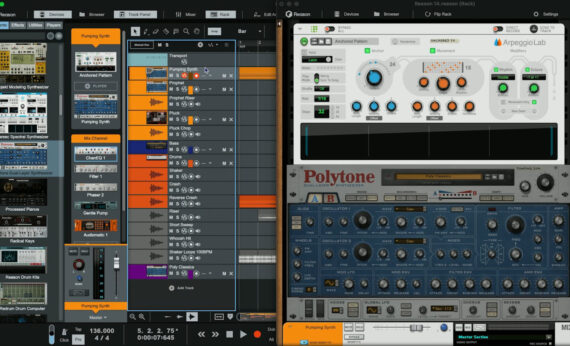
The new Track Panel provides a full overview of devices, signal chains, send levels, and panning for the selected track—reducing the need to move between views. Combined with Rack per Track, which gives each track its own dedicated Rack column, navigation becomes more immediate and intuitive
Reason 14 introduces important updates to the sequencer, including:
Track Folders for better organization
Looped clips for faster arrangement and editing
Improved piano roll editing, including velocity handles
Another key feature in Reason 14 is RV-9 Reverb Station. RV-9 combines algorithmic and convolution techniques to deliver richer, more detailed spatial effects. It includes a full range of reverb types—from realistic spaces and hardware to unique granular and spectral algorithms—along with modern features such as shimmer, ducking, and integrated EQ.
Other updates include:
Dark Mode Mixer.
MIDI note chase.
Automatic tempo detection for imported audio.
Updated Factory Sound Bank ,with over 900 new drum samples and new patches.
An updated Rack Extension SDK, with improved interface capabilities.
UJAM has introduced Symphonic Elements CHOOIR, the latest software instrument plugin in the Symphonic Elements series
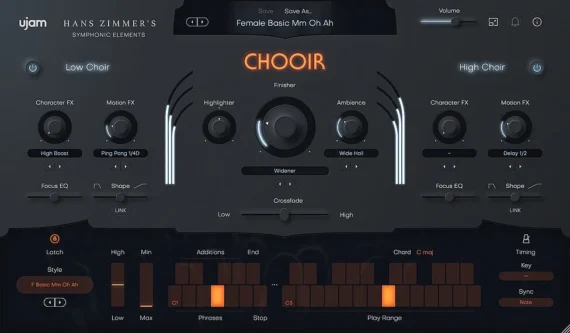
It’s designed to provide arranged choir performances, using sample content sourced from Hans Zimmer’s orchestral library. Unlike traditional choir libraries that require individual voice arrangement or word programming, CHOOIR uses a phrase-based engine to generate cohesive choir textures from simple MIDI input.
The instrument includes multiple ensemble types—male, female, and boys choir sections—with a range of vowel and consonant articulations. Users can shape the sound via plugin controls such as Motion, Character, and Finisher effects, and choose from a set of presets organized by style.
Features:
Male, female, and boys choir ensemble sample content drawn from Hans Zimmer’s personal library
Phrase-based performance engine that generates cohesive choir textures from simple MIDI input
Range of vocal articulations including a full set of vowels and consonants
Seventy predefined choir styles spanning categories like Epic, Suspense, and Ethereal
Over one hundred presets organized for musical and cinematic application
Signature UJAM effects, including Motion, Character, and Finisher for shaping output textures
Plugin formats supported include VST3, AU, and AAX on supported hosts
Compatibility with major digital audio workstations on macOS and Windows
Hans Zimmer’s CHOOIR Audio Demos:
UJAM Symphonic Elements CHOOIR is available now for US$204.12.
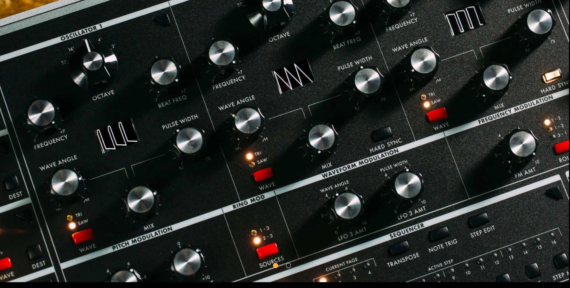
Sound designer Scott McAuley shared this preview of One, a new 50-preset soundbank for the Moog One polyphonic synthesizer.
The patches in the One soundbank, made from over 100 different sounds, include bass, bell, funk, keys, leads, organ, pads, performance, poly, sequence, strings, sweeps, and more.
Sales of the new soundbank support the The Bob Moog Foundation, a non-profit organization dedicated to preserving the legacy of synth pioneer Dr Robert Moog.
“It has been my absolute pleasure to create this bank for such a worthy cause. The Bob Moog Foundation is such a great organization run by amazing people, their passion for their work, not only preserving the legacy of Dr. Bob Moog, but providing hands-on fun and education to people of all ages through the science of sound,” noted McAuley. “I really hope this exclusive bank helps in some way to bring some extra funding to BMF in the best way I know how.”