Archive for April, 2026

Make Noise Introduces Gestural Time Extractor Eurorack Module


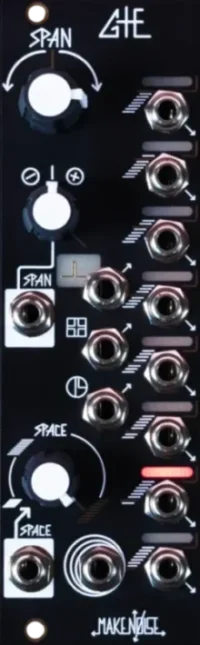
Make Noise has introduced their latest module in the New Universal Synthesizer System, the Gestural Time Extractor.

The Gestural Time Extractor (GTE) is an analog pulse extractor and Channel Index Translator. From the motion of the signal at the Span input, GTE derives up to eight individual channel pulses, as well as a GTE pulse stream, representing the speed of motion of the input signal, and two gate outputs representing activity at the even and odd channels.

The Space parameter determines the threshold proximity of the channels to each other and thereby also the sensitivity and reactivity of the GTE and other outputs.

When the Clock input is in use, the GTE’s output channel will only change upon reception of a trigger or gate, allowing for changes to easily be synchronized with other existing events in the system.

With all controls set to starter min-max positions, the GTE also operates as a Channel Index Translator for PoliMATHS and other New Universal Synthesizer System modules that generate Channel Index signals, allowing the accurate derivation of individual channel gates from activity at the respective channels of the source module.

The GTE can be used to generate repeatable and controllable rhythm and timing information from any analog synthesizer signal, whether arbitrary or targeted, and is also useful for individual voice timing signal generation within a multi-voice N.U.S.S. system.
 

Features:

  • Extract rhythms, clocks and pulse streams from any control voltage source
  • Opens up the patch programmability of the N.U.S.S.
  • Synchronize GTE to any clock source with the Clock input
  • Use GTE to synchronize any event in your system with Activations from PoliMATHS and MultiWAVE – regardless of Span mode
  • Compact and powerful analog module
  • Pairs well with MATHS, PoliMATHS or Jumbler

The Gestural Time Extractor is available now for $179 USD.
Cosmosf Saturn Stochastic Synthesizer Gets Major Update


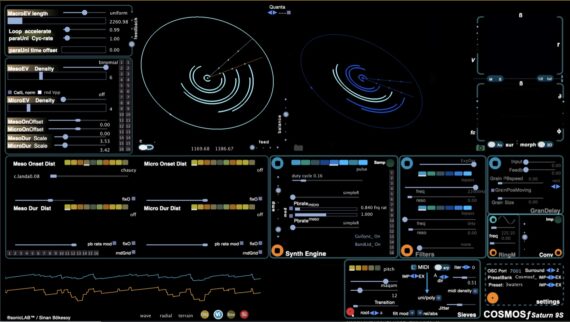
sonicLAB shared this preview of Cosmosf Saturn 9S, a major update to their real-time dynamic stochastic synthesizer.

Cosmosf Saturn 9S is designed to create complex textures with various generative event distribution processes.

Cosmosf Saturn 9S comes with a fully resizable interface, next-gen spatial audio with support of 5th and 7th order Ambisonics, delivering up to 64 channels of real-time encoded audio, and a revised file access and structure.

Cosmosf Saturn also now has native SPATAI integration, enabling AI-assisted spatial control and 3D movement.

Cosmosf Saturn 9S is available for £169 GBP through April 15th, 2026 (normally £199 GBP). It’s a free upgrade for all existing Cosmosf Saturn 8S and 7S licensees.


Is The Macbook Neo The Ultimate Budget Music Computer?


Is the new Macbook Neo the ultimate budget music computer?

In our coverage of the Neo’s introduction, we noted “This isn’t the Mac for power users, and for most ‘content creators’. ”

This in-depth review of the MacBook Neo focusing on music production, by James Zhan, challenges that assumption, and argues that it’s a great ‘first computer’ for music making.

Zhan tests the MacBook Neo with a real mixing and mastering Reaper project, with 100 tracks and 140+ plugins,  and a Logic Pro 12 project with sample libraries for an entire orchestra.

His conclusion? Zhan argues that the MacBook Neo gives you incredible value for the money, especially when you consider the price of Apple Creator Studio.

Topics covered:

0:00 Start

0:32 Music Production Tests Overview

1:17 MacBook Neo Build Quality: Incredible for the Price

1:58 Mechanical Trackpad Issue

2:26 A Different Testing Approach Than My Previous Videos

3:09 MacBook Neo Audio Processing Benchmarked Against M-Series Chips

3:25 Efficiency Core vs Performance Core Usage on MacBook Neo (A18 Pro)

3:51 My Goal for This Video

4:08 MacBook Neo Tested with a Real Mixing & Mastering Project in REAPER

8:08 MacBook Neo Tested with a Real Mixing & Mastering Project in Logic Pro 12

9:14 MacBook Neo vs M1 Max: Render Speed Test

9:53 Addressing MacBook Neo’s 8GB of RAM (unified memory)

10:17 Brief Explanation of RAM’s Role in Music Production

10:43 MacBook Neo’s 8GB RAM Tested: Full Orchestral Project

11:48 Heavy Multitasking on MacBook Neo: Logic Pro Orchestral Project + REAPER Mixing Project

12:31 Heavy Multitasking on MacBook Neo: Audio Projects + 4K Video Timeline with Colour Grade

13:29 Heavy Multitasking on MacBook Neo: Audio Projects, Video Project & RAW Photo Editing

15:02 James’ Take: Why MacBook Neo Is the Best Laptop for Audio/Photo/Video Work for the Price

15:29 Neo’s Advantage #1: Portability + Good Performance

16:18 Neo’s Advantage #2: Colour-Accurate Display (Compared Against Apple Studio Display)

17:08 Neo’s Advantage #3: MacOS Means Access to Apple Creator Studio

18:28 James’ Thoughts on Creator Studio Being a Subscription

19:10 Should You Get MacBook Air Instead?

What do you think? Share your thoughts on the Macbook Neo as a starter music computer in the comments!