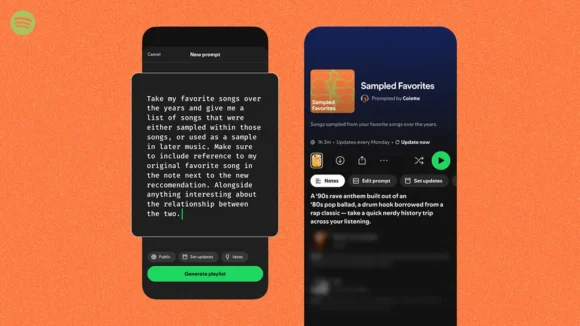
Having previously put in the hands of users from the US and Canada, Spotify is now rolling out its Prompted Playlist feature in Australia, Sweden, Ireland and the UK.
This enables you to create custom playlists from text prompts, and could be viewed as Spotify’s attempt to address concerns that, increasingly, its algorithm is dictating what people listen to. Instead, says the company, “it’s a new way to put meaningful control of the algorithm directly in your hands, with your ideas, your logic, and your creativity.”
Prompted Playlists are based not only on “real-time information about the world of music” (trends and charts, for example), but also – gulp – your entire listening, which may lead you to discover that your tastes aren’t quite as ‘credible’ as you thought they were.
Trying to find your ‘most-played’ songs at certain times in history might also highlight another problem: if you often have Spotify’s ‘functional playlists’ on in the background (for studying and sleeping, for example), you’ll quickly realise that some of the tracks on these are the ones you’ve listened to more than any other, despite the fact that you don’t even know what they’re called.
In this case, you might have to think a little bit harder about the kind of prompts you’ve giving, as just asking for lists of favourites probably won’t give you the results you were hoping for.
As you’d expect, you can use the new feature to create broad ‘mood’ playlists, but you can also be more granular in your approach. You could, for example, use a Prompted Playlist as the starting point for a DJ set – both BPM and key information is accessible, making it possible (in theory, at least) to find collections of songs that will work well together.
“We hear from listeners all the time that they love playlists, but making their own can feel daunting,” says Sulinna Ong, Global Head of Editorial at Spotify. “Our editors spend a lot of time thoughtfully curating playlists, and that level of intention can be hard to replicate when you’re starting from scratch. Prompted Playlist offers a more intuitive entry point, letting users begin with moods, moments, or ideas in their own words, and build something that feels personal.”
Currently in beta, the Prompted Playlist feature can be accessed via the Create option in Spotify.
How it works:
- Open Spotify and tap Create, then select Prompted Playlist.
- Describe what you want to hear, whether it’s a specific vibe, scenario, or cultural moment.
- Spotify will generate a playlist from your idea. From there, you can also set it to refresh daily or weekly.
Find out more in Spotify blog post.