Eventide Releases Music Mouse 2, A Modern Update Of Laurie Spiegel’s Pioneering Computer Instrument
Eventide has released a modernized remake of electronic music composer Laurie Spiegel’s Music Mouse, a groundbreaking piece of software released in 1986 that transformed the mouse into an ‘intelligent musical instrument’.
One of the first software instruments designed to run on a Mac, Music Mouse was later available for Amiga and Atari personal computers – and four decades later, Eventide has reimagined the software for today’s computers, in collaboration with Spiegel herself.
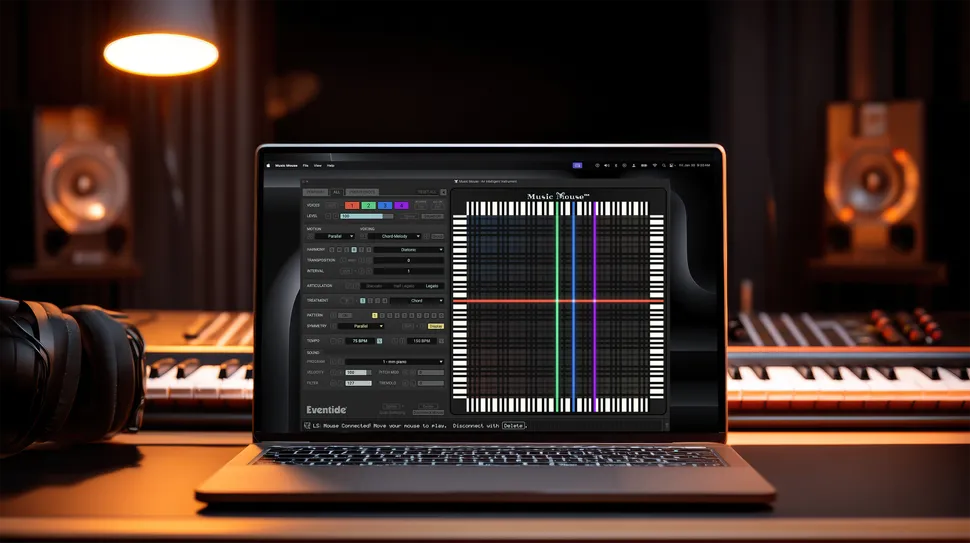
At the heart of Music Mouse is an XY note grid bordered by four keyboards, and laid on this you have four interlocking lines representing four voices. Moving the mouse – or the “polyphonic cursor” – around the grid shifts these lines across the keyboards, triggering notes that are locked to a scale chosen in the menu on the left-hand side; you can choose between chromatic, octatonic, diatonic, pentatonic, quartal and Middle Eastern.
Along with the scale options, you’ve got a whole host of additional controls that can be accessed via the keyboard. These cover articulation, transposition, chord voicing, tempo and more, along with a selection of four rhythmic “treatments” which determine how the notes generated by the mouse movements are played. You also get velocity, filter, tremolo and pitch modulation controls for the internal sound engine.
Music Mouse also features a bank of 10 algorithmic pattern sequences that, though they will play by themselves once initiated, can be interacted with by moving the mouse across the note grid. The software is equipped with a bank of retro synth presets taken from Spiegel’s original DX7 and TX7 patches, but we prefer the idea of using Music Mouse as a novel means of controlling external hardware or plugins via MIDI, which it’s fully capable of doing.
Though it’s been updated with a visual makeover, some workflow tweaks and MIDI sync, the core concept behind Eventide’s Music Mouse remains the same as it was in Spiegel’s 1984 version. It’s a playful, fun and ultra-accessible way for anybody to generate unexpected chords, melodies and arpeggios with nothing more than a mouse, and a unique interface for music creation that remains as inspiring today as the day it was released.
“Music Mouse orients you to think on a slightly larger scale of the phrase or the gesture,” Spiegel explained in a 2014 interview. “Of course, you can still wander around, making a mess for a really long time. We’ve all done that. But it’s an improvising instrument and it’s a brainstorming instrument.”
Check out a fascinating video of Spiegel demonstrating the software in 1987 below.
Eventide’s Music Mouse is compatible with macOS 10.14+ (Intel and Apple Silicon) and Windows 11. Music Mouse, then and now, uses mouse position to determine what sounds a device generates. It can be used on its own, directly from the computer, and can now play right in your preferred DAW.
Music Mouse 2.0
New in version 2.0:
- Perform live or record music into your DAW or music notation software;
- Syncs to an external MIDI clock and can lock to a DAW, hardware, or notation program;
- Expanded sound presets drawn from Laurie Spiegel’s original DX7 and TX7 patches are built in;
- Clearer visual feedback around the Polyphonic Cursor;
- Optional UI guides, hint bar, and scalable interface;
- Left- or right-handed layout options.
A performance demo, via ALM TV:
Music Mouse 2.0 is available now for $29 USD.