Korg Kaoss Pad V Brings Back Popular Touch-Controlled Sampling Effects Box
Ahead of the 2026 NAMM Show, Korg has unveiled the next generation of the long-running Kaoss Pad effects processor and sampler, Kaoss Pad V. Equipped with a redesigned dual-touch interface, new effects, a workflow improvements, and expanded connectivity, Kaoss Pad V is pitched by Korg as the most “versatile and performance-ready” model in the series to date.
A decade after the last instalment in the Kaoss family, Korg signalled a renewed interest in the concept with the release of the Kaoss Replay performance sampler in 2023 and the DIY NTS-3 Kaoss Pad the following year, but Kaoss Pad V is the first full-size, traditional Kaoss Pad to be released since the KP3+ in 2013.
The most recognizable feature of the Kaoss Pad has always been its XY touchscreen interface, introduced with the first iteration in 1999, which provides a tactile and immediate way to manipulate its extensive catalogue of effects.
Kaoss Pad V introduces dual-touch operation for the first time, enabling you to use two fingers to control two parameters at once to produce more complex and evolving textures.
Kaoss Pad V features a newly-developed Voice FX engine for creative vocal processing. Pitch-shifting, harmonizing and vocoding is all possible, along with the ability to use your voice to control external gear via MIDI. V’s sampling and looping capabilities are more sophisticated than previous generations, with up to 8 bars of sampling time, live overdubbing, and multiple playback and slicing modes on offer.
Korg has enhanced Kaoss Pad’s connectivity significantly with the V. You can use the MIC, LINE, and USB inputs at the same time to blend vocals, instruments, and computer audio. The balanced mic preamp is designed to deliver clean vocal input. You get a stereo RCA line input for hooking up with DJ gear and a dual-purpose ¼” TRS input with switchable mic and Hi-Z instrument modes, making it easier for guitarists to use the unit as an effects processor.
These are joined by a stereo RCA output, ¼” headphone out and MIDI In/Out over 5-pin DIN. There is also a USB audio interface onboard, making it easy to record, process, or stream your sound. Whether you’re capturing performances in a DAW, running effects during a livestream, or monitoring through headphones, Kaoss Pad V keeps routing simple.
Kaoss Pad V arrives with 200 effects presets, and the enhanced effect editing tools offer more advanced control than previous generations, allowing you to build up to 100 custom presets that can be stored directly on the hardware. Storage is supplied by SD card, which unfortunately isn’t included.

The Kaoss Pad V also lets you record, overdub and loop audio:
- Sample up to 8 bars (dependent on tempo)
- Overdub layers in real time Maintain loop position accuracy during playback
- Use BPM-synced Gate Hold to stay locked to the groove
- Multiple playback and slicing modes for creative rearrangement
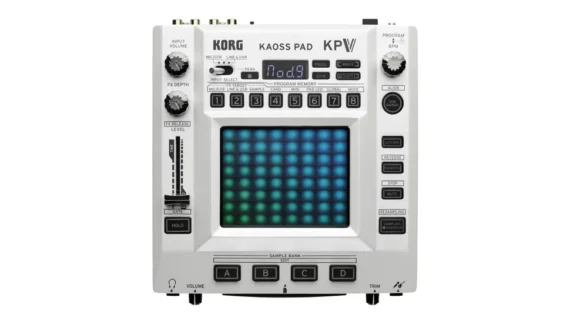
Features:
- Dual-touch performance pad for two-parameter control
- Voice FX engine for harmonies, vocoder and pitch shaping
- Hi-Z guitar and bass input for direct connection
- Integrated USB audio interface for recording and streaming
- MIC, LINE and USB inputs usable simultaneously (line in on phonos still – boo!)
- Expanded looping and sampling functions (up to 8 bars, real-time overdub)
- BPM-synced Step Hold for tight rhythmic control
- Refreshed library of classic and modern KAOSS effects
- Onboard editing with custom preset storage
- SD/SDHC card support up to 32 GB (though only 8 bar sample length)
- MIDI In/Out, RCA and TRS connectivity
Korg Kaoss Pad V Audio Demos:
Building on the long-established Kaoss Pad concept with sophisticated control, expanded connectivity, new sampling tools and vocal processing capabilities, Kaoss Pad V is a long-overdue update that makes this beloved effects powerhouse an even more powerful tool for creative sound design, studio recording and live performance.
The Korg Kaoss Pad V is available to pre-order now, with a street price of about $650.