FabFilter Releases FabFilter Pro-C 3 Compressor Plug-In
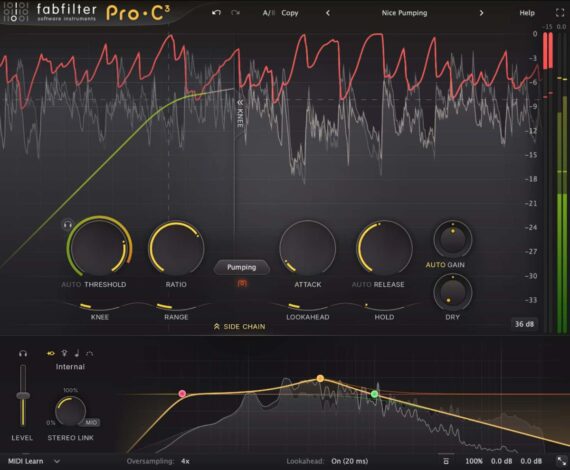
FabFilter has announced the immediate availability of Pro-C 3 and a free update to their Pro-Q 4 equalizer.
They say that “Pro-C 3 takes FabFilter’s professional compressor plug-in to the next level in terms of sound, features, and workflow, while Pro-Q 4.10 brings multi-plug-in support to the Instance List, turning the industry-standard EQ into a full multi-track channel strip.”
New in Pro-C 3:
- Six new compression algorithms – Adding to the eight styles of its predecessor, Pro-C 3 serves up six new compression algorithms. The Versatile Style is a general purpose algorithm for use on any material, and Smooth is the new go-to for super-smooth gluing at low ratios and longer envelope timings. At the more extreme end of the scale, the Upward algorithm applies pumping upward compression, and TTM combines downward and upward compression across multiple bands. The opto-like tube compression of Op-El, and the variable mu of Vari-Mu, Pro-C 3 are inspired by classic hardware compressors.
- Compress with character – the new Character panel offers three flavors of analog saturation. Choose the Tube, Diode, or Bright variations, raise the Drive amount, and switch between Pre and Post Compression routing for a variety of sound-enhancing harmonic distortion and coloration treatments.
- Improved Side Chain EQ – The ability to precisely filter and equalize the sidechain input is central to any great compressor, and Pro-C 3 ups the number of available EQ bands from three to six. Each band can be set to any of the filter shapes users know from Pro-Q 4; the menu of roll-off slopes now includes Brickwall Low Pass and High Pass options, and every band can be independently switched to mid or side processing.
- Immersive Dolby Atmos compatibility – Pro-C 3 supports all major surround formats up to Dolby Atmos 9.6.1.
- Host tempo triggering and Auto Threshold adjustment – Joining Internal, External, and MIDI triggering in the Side Chain section, Pro-C 3’s new Host Sync option outputs a steady internal pulse that triggers the compressor at any tempo-synced note value, with adjustable Offset and trigger Length for fine-tuning — ideal for dialing in rhythmic ducking effects without the need for an external trigger input. Further triggering flexibility is provided by the new Auto Threshold setting, which dynamically shifts the Threshold so that the same amount of compression is triggered at different input levels.
Features:
- Professional compressor plug-in for mixing and mastering, with 14 diverse compression algorithms, three flavors of highly-authentic analog coloration, and six-band Side Chain EQ, plus automatic Threshold control, Dolby Atmos surround support, up to 32x oversampling, and more.
- New: Versatile, Smooth, Upward, TTM, Op-El, and Vari-Mu compression Styles
- New: Character Mode adds three types of realistic analog saturation, coloration, and drift: Tube, Diode, and Bright
- New: Pro-C 3 instances can be controlled via the Instance List in Pro-Q 4.10, together with Pro-G and Pro-DS
- New: Full immersive/Dolby Atmos functionality (up to 9.1.6), with customizable channel/stereo linking
- New: Host tempo triggering for rhythmic compression
- New: Auto Threshold for level-independent compressor triggering
- New: Adjustable Maximum Lookahead enables balancing of latency against lookahead
- Improved: Fresh new design
- Improved: Side Chain EQ section increased to a maximum of six bands, with many more filter types, and LP/HP Brickwall slopes
- Improved: Oversampling up to 32x
- Improved: Redesigned preset browser, with easy search, tags, and metadata
- Improved: Showing and hiding the Side Chain section no longer turns the Side Chain itself on and off
- Improved: Easier access to Bypass button and MIDI triggering
- Improved: Better reverse linking of Dry and Wet level knobs
Pro-Q 4.10 Features:
- Professional mastering-grade EQ plug-in with up to 24 bands, a huge range of filter types and slopes, and centralized control of multiple instances of Pro-Q 4, Pro-C 3, Pro-G, and Pro-DS via the Instance List
- Improved: Multi-plug-in support in the Instance List enables multiple instances of Pro-Q 4, Pro-C 3, Pro-G, and Pro-DS to be controlled from a single, zoomable (up to full-screen) interface
- Improved: Having any band in Spectral mode now always introduces the associated latency, even if its Dynamic Range is set to zero
- Minor fixes and improvements
FabFilter Pro-C 3 is now available for €169, $199, or £149, supporting both Windows and macOS in VST and VST 3, Audio Units, AAX, AudioSuite, and CLAP plug-in formats. Existing FabFilter customers can purchase or upgrade to FabFilter Pro-C 3 at a discounted rate.