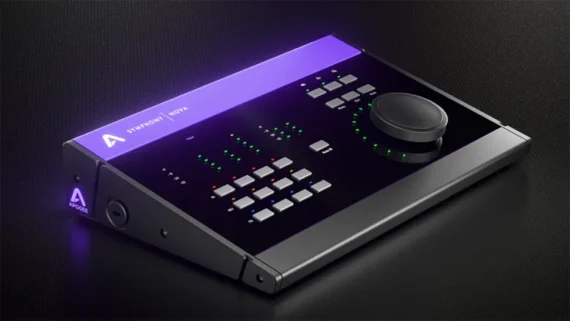
2026 Winter NAMM Show: Apogee has added to its line-up of Symphony desktop audio interfaces with the release of the Nova, which comes packed with DSP for onboard effects processing.
In fact, one of the Nova’s big USPs is that it offers simultaneous realtime DSP processing on all four of its mic inputs, meaning that multiple sources can be tracked with a consistent sound. This could be useful when you’re recording drums, small groups, multi-speaker podcasts or a selection of live instruments.
The majority of the effects are contained within Apogee’s enhanced ECS Channel Strip, which runs on the Nova’s onboard ARM processor. This contains a 4-band EQ, high-pass and low-pass filters, a compressor and saturation/drive. There are also realtime reverb and delay processors.
The advantage of having everything in the interface, is that you should have zero-latency monitoring even when the processing is activated, as there’s no need for your computer to get involved.
Similarly, there’s also realtime speaker correction on every analogue output so that you can correct any room imbalances. Again, this is handled by the hardware rather than using a plugin in your DAW.
Of course, the focus of any audio interface is its sound, and Apogee is promising pristine gain, low noise and consistent performance across all inputs. Guitarists can take advantage of the clean DI capture and a new re-amping section, and the combination of high-gain mic preamps and aforementioned processing is designed to make this a one-stop box for podcasters.
Other connectivity includes MIDI I/O and ADAT expansion should you need to add more preamps and converters.
The Symphony Nova is slated for release in the second quarter of 2026 and will cost $1,499. Find out more on the Apogee website.