Archive for November, 2025

Polyend Play+ Gets Major Firmware Update, Dirt Synth Engine
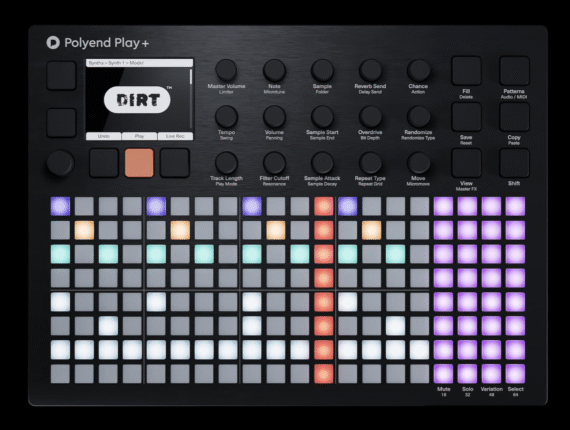

Polyend has released Play+ Firmware 1.3, a major update that adds Dirt, a new synth engine for warped, waveshaped timbres; a redesigned patch editor for faster sound design; and USB mass storage for direct SD card access alongside additional sound improvements.

New in Polyend Play+ Firmware 1.3:

The Dirt synth engine is built around waveshaping and warping, with 13 waveshaper modes that combine modulatable waveshapers with flexible filter routing and gain-staging for a massive palette of overdriven timbres. The main oscillator can be warped before being fed into the shaper.

Features:

  • Morphable Oscillator + New Sub Osc: Blend between five base waves (sine, triangle, saw, square, narrow pulse). Mix in a new slightly darker sub oscillator.
  • Bi-directional Warping: Skews the waveform in two distinct ways for positive vs. negative values, creating complex harmonics.
  • 13 shapers with pre/post-filter routing: From musical saturation to extreme destruction. Saturator, Overdrive, Diode Clipper, Asymmetric, Waveshaper, Waveshaper+, Fuzz, Exciter, Bitcrush, Rectifier, Redux, Redux+, Redux+Bitcrush—with pre/post-filter routing.
  • Modulation & Macros: Animate Warp and Drive via the mod envelope, assign any Dirt parameter to macros and sequence parameter locks for evolving synths.
  • Gain staging: Shape the sound with Pre-Gain into the shaper and balance levels on the Voice page.
  • New patch editor (faster sound design)
  • A 3×3 knob grid is used to control 9 screen parameters, turn a knob to adjust the on-screen value.
  • Page through synth parameters with the main encoder for continuous editing.
  • More immediate control over 50+ patch parameters—quicker to build, tweak, and perform.
  • USB mass storage (easier content management)
    • Manage sample packs, patches, and projects directly from your computer.
    • Enable via Main Menu – Settings – USB Mass Storage Mode to expose the SD card over USB.
  • Additional improvements
    • Perc engine kicks: Refined 808/909 kick engines for more accurate tone and feel.

Polyend Play + Firmware 1.3 Explained:

Play+ Firmware 1.3 is available now as a free update for all Play+ owners.

250 MiniFreak Patch Sound Library


Ultimate Patches has introduced 250 MiniFreak Ultimate Patches, a new sound library for the Arturia MiniFreak.


What they have to say about it:

“Taking the MiniFreak to the next level, Ultimate Patches has just released the all-new MiniFreak Ultimate Patches: 250 high-quality fresh patches with sounds from the 40s / 50s / 60s / 70s / 80s / 90s / 00s / 10s / 20s plus futuristic polys, pads, leads, keys, basses and fx, and classic non-synth instruments including acoustic and electric guitars and basses, acoustic pianos, rhodes and wurlitzer electric pianos, B3 / Vox / Farfisa classic organs, orchestral instruments and much more.

This musically useful collection of new patches touches on genres of classic and modern pop & rock, retrocade, orchestral, hiphop, vaporwave, cinematic, country, latin, R&B, reggae, jazz, chiptune, reggaeton, country, dubstep, tech/deep/retro house, trance, modular, experimental, synthwave, retropop and more.”

250 MiniFreak Ultimate Patches is available now, with Black Friday Sale pricing options starting at just $19.99. A free 15 Patch Taster Pack is also available.

DIY MiniTeensy Is An Open Source Polysynth, Based On Minimoog Synth Voice


Developer Nick Culbertson has introduced a new DIY synth project, MiniTeensy, that’s a 6-voice polyphonic VA synth, inspired by the iconic Moog Minimoog Model D.

“This project is a good representation of the surprisingly decent audio quality and limitation of microcontroller synths,” notes Culbertson. You can preview MiniTeensy via the above demo video.

MiniTeensy is an open-source project, based on the Teensy 4.1 microcontroller. The synth offers comprehensive synthesis options, with USB audio/MIDI and intuitive menu control.

Features:

  • 6-voice polyphony with 3 oscillators per voice (18 total)
  • 6 waveforms per oscillator
  • Noise shared white/pink noise
  • 24dB Moog-style ladder filter with ADSR envelopes
  • Independent LFO with pitch/filter/amp targets
  • Macro knob system – remap filter knobs to LFO controls
  • USB Audio + MIDI – single cable to computer
  • 20 hardware encoders + LCD for real-time control
  • 20 Presets – 80s Brass, Saw Keys, Bass sounds, Pads, and more
  • Multiple play modes – Mono, Poly, Legato with glide

The synth is available now as an open-source DIY project now on GitHub.